Reference of Measurements in Halacha and Hatmana: Difference between pages
From Halachipedia
(Difference between pages)
m (Text replacement - " Biblical" to " biblical") |
|||
| Line 1: | Line 1: | ||
[[Image: | [[Image:Crock_Pot.jpg|right]] | ||
When it comes to cooking and reheating foods on Shabbat, aside from the major biblical prohibition of [[Bishul|cooking]] there are three other rabbinic prohibitions. One is that before Shabbat one shouldn't leave raw food on an open fire to cook on Shabbat lest one come to cook. This is called [[Shehiya]]. The second is [[Hachzara]]; that is, on Shabbat one shouldn't return food to the fire that was removed from the fire on Shabbat since it appears like one is cooking and not just reheating. The third one is that it is forbidden to insulate food both before Shabbat so that it remains insulated on Shabbat and on Shabbat itself. This prohibition is called hatmana and is the subject of this article. | |||
==Insulating before Shabbat== | |||
# One is permitted to insulate food before [[Shabbat]], with material that preserves heat. This is permitted even during [[Ben HaShemashot|twilight period]]. However, before [[Shabbat]] one is not permitted to insulate food with material that increases the heat lest one insulate with hot ashes containing coals and lest the food be incompletely cooked and one come to rake the coals on the [[Shabbat]].<Ref>See Talmud [[Shabbat]] 34b, Rashi at loc, Shulchan Aruch O.C. 257:1</ref> | |||
# On the Sabbath itself insulating is forbidden even with material that only preserves the heat,<ref>See statement of Rava on Gemara Shabbat 34a</ref> as a prohibition lest one discover the pot to be too cold and heat it up on coals on the [[Shabbat]] and stoke the coals. This does not apply during twilight period as most pots are warm at that time.<ref>Shulchan Aruch 257:1</ref> | |||
# It is permitted to insulate before [[Shabbat]] with material that preserves heat like a cloth. <Ref> Shemirat Shabbat KeHilchata 1:75 (3rd edition) based on Shulchan Aruch 257:1 and 3.</ref> There is a dispute if a pot that is covered with clothes can be placed on a heating element, which would cause the pot to get hot. See further. | |||
## Everyone agrees that before Shabbat it is permissible to wrap a pot that is off the fire or on top of a hot pot which is off the fire.<ref>Shulchan Aruch 258:1, Mishna Brurah 258:2, Shemirat Shabbat KeHilchata 1:75 </ref> | |||
## According to most poskim, it is forbidden even before Shabbat to wrap a pot with clothes if the pot is on a covered fire or electric hotplate. <Ref>Shulchan Aruch 257:8 explains that even though covering with a cloth is considered something doesn't preserve the heat, since the pot is top of the fire insulating the pot with the cloth becomes like it is insulated with something that preserves the heat, which is forbidden even on Friday. Mishna Brurah 257:37, Kaf Hachaim 257:40, and Shemirat Shabbat KeHilchata 1:75 agree.</ref> However, if a Sephardic Jew has such a minhag he doesn't need to be stopped.<ref> Chazon Ovadia (Shabbat v. 1 p. 56) writes that some are lenient and there is a minhag to be lenient against Shulchan Aruch. | |||
* When Hatmana on it’s own doesn’t preserve heat but keeps in heat because of another source (that besides the cover of clothing, the food is on a Garuf or Katum stove) there is a dispute in the Rishonim if there’s an issue of Hatmana with something that preserves heat. Ran ([[Shabbat]] Bameh Tomnin) in name of Rabbenu Yonah and Rashba writes that if the insulation preserves heat because of an external source it is forbidden as Hatmana Dvar Hamosif Hevel because this insulation shows one is concerned about keeping the food warm. However, the Ramban permits if the Hatmana is done with permitted material and the Shehiyah (leaving food on a covered stove from before [[Shabbat]]) is done in a permitted way because these are two separate Gezerahs (the Gemara 47b which seemingly prohibits putting an insulated pot on a permitted stove is only forbidden because the food is put directly on the coals but if there’s a space of air in between the coals and the food it’d be permitted.) Ran (22a s.v. VeMinhagenu), Nemukei Yosef (Lo Yachpor), Rabbenu Yerucham (pg 68c), and Meiri ([[Shabbat]] Perek Kirah pg 142 s.v. Zu Hiy) write that the Minhag is like the Ramban's explanation. Ritva 47b mentions the Ramban and adds that some are strict to make a separation between the clothing and the pot (as that’s not the usual way to insulate) but concludes that he prefers a different stringency which is putting the pot on top of a cover that separates between the pot and stove. S”A 257:8 rules even though Shehiyah is permitted in certain cases (see S”A 253) if the pot is covered with clothes even though it is a material that doesn’t preserve heat it’s forbidden to be left on the fire. | |||
* Sh”t Chut MeShulash 8, Shaarei Yeshua 5:8, and Sh”t Divrei Moshe 64 say that the Minhag has what to rely on even though S”A was strict. Sh”t Zechur LeYitzchak 74 pg 113b brings the opinion of Maharar Moshe Ben Chaviv who says the Minhag has what to rely on based on the Ramban and the opinions that there’s no issue of Hatmana if the food is [[cooking]] for [[Shabbat]] day; nonetheless, Zechur LeYitzchak suggests that since the Minhag predates S”A it can continue, but concludes that one should be strict like S”A. Eretz Chaim 257, Memei Shlomo 257, Sh”t Yaskil Avdi 3:10(4:7), Gedolei Tzion 9:11 also quote the Maharar Ben Chaviv and Chazon Ovadyah ([[Shabbat]] 1 pg 56; as in Sh”t Yabia Omer O”C 6:33) conclude that one can be lenient. Halacha Brurah 257:29 writes that one doesn't need to stop someone who is lenient since there is what to rely upon.</ref> | |||
## If the cloth is placed on top of a wide tray on top of a pot which is on the covered fire such that the cloth doesn't actually touch the sides of the pot it is permitted.<ref> The Tur 257:8 adds that his father the Rosh held that if the clothes aren’t touching the pot it is permitted and not a normal way to do hatmana. Thus, Shulchan Aruch 257:8 rules that if the pot isn’t touching the coals it is a permissible Shehiyah and if one puts a tray on pot of the pot and clothing on top of the tray so that the cloth doesn’t touch the sides of the pot it is a permissible hatmana. Minchat Cohen (Mishmeret [[Shabbat]] 8) explains that S”A requires both requirements: 1) the pot doesn’t touch the coals and 2) the clothes don’t touch the sides of the pot. Shemirat Shabbat Kehilchata 1:76 accepts this.</ref> | |||
## According to most poskim it is forbidden to insulate a pot before Shabbat if it is on top of another pot which is on the fire.<ref>Kaf Hachaim 258:3 writes based on the Magen Avraham 258:1 that insulating a pot on top of another pot that is on the fire is forbidden even before Shabbat since it is considered like hatmana bdvar hamosif hevel. Mishna Brurah 258:2 agrees. Kaf Hachaim adds that according to the lenient opinion in the Rama 257:7 since there is no issue of shehiya on a pot on top of another pot there's also no issue of hatmana, but that is only if that is the minhag.</ref> | |||
===Food in Other Food=== | |||
# There is no issue of [[insulating food]] inside other food if there's no separation. <Ref> Shemirat Shabbat KeHilchata 1:72 </ref> | |||
# Before [[Shabbat]], some say that one can leave fully cooked food in a plastic, nylon, or aluminum bag in an pot of hot food (such as kuggel in chulent), however, some forbid because of Hatmana. <Ref> Chazon Ish 37:32 rules that a vessel inside a pot of hot water doesn’t have an issue of Hatmana. Even though, Aruch HaShulchan 258:3 and Sh”t Shevet HaLevi 3:47 argue on the Chazon Ish, Chazon Ovadyah ([[Shabbat]] 1 pg 62) says one can rely on the Chazon Ish to be lenient, especially if the food is fully cooked (for which Rama 257:7 permits Hatmana). Sh”t Shevet HaLevi 8:15(4) says that there is what to be lenient since the bag is only separating the food inside it but it would have been hot from the pot nonetheless. Sh”t Vayeshev Moshe (Zanger) O”C 19 adds that the bag or aluminum isn’t a real vessel that separates the food inside it. Rav Shlomo Zalman in Sh”t Minchat Shlomo (2:34(20) in Ostrot Shlomo version), Sh”t LeHorot Natan O”C 12, Kovetz Or Yisrael 5:23, Sh”t Shraga HaMeir 4:63, 6:3, Megilat Sefer on [[Shabbat]] 4:13, Sh”t Kinyan Torah 4:24, Sh”t Az Nidabru 6:78, Sh”t Or Letzion 2:17(13), and Sh”t Maaseh Nisim 163 agree that there’s no Hatmana in our case of a food within another food since it’s not meant to be totally separate. | |||
* In the 2nd edition of Shemirat Shabbat Kehilchasa 42:63 he was strict regarding materials that don’t allow liquid through such as plastic, nylon, or aluminum liners inside chulent or crock pots, however in the 3rd edition there’s an explicit retraction in 1:87 quoting Rav Shlomo Zalman to permit in all circumstances. | |||
* Meor [[Shabbat]] 3 pg 519, and Menuchat Ahavah 1:3(27) are somewhat strict on the issue, the Minhag is to be lenient on this issue. </ref>. | |||
# It is forbidden on Shabbat to insulate a bottle of liquid inside a container of hot water even if it won't reach yad soledet bo. However, according to Ashkenazim, it is permitted to insulate a bottle of liquid in a container of hot water if the bottle is partly out of the hot water (assuming that there is no issue of bishul).<ref>Mishna Brurah 258:2, Dirshu Footnote 258:7</ref> | |||
===Hot Plate Blanket=== | |||
[[File:Plata blanket.jpg|250px|thumb|right|According to Sephardim it is forbidden and according to Ashkenazim it is permitted if the sides of the pots are clearly and recognizable partially exposed (unlike this picture).]] | |||
# One may not completely wrap a pot with a blanket or towel if the pot is on top of a hot plate, covered fire, or any other heating element. Even though the blanket or towel is considered something that doesn't add heat, it is nonetheless considered as something that adds heat once it is on top of a pot which is on a heating element. This may not be done even before Shabbat.<ref>Shulchan Aruch O.C. 257:8, Mishna Brurah 257:37, Halacha Brurah 257:28. <br /> | |||
* Tur 257:8, quoting the Rosh, writes that those people who insulate a pot on Friday with a cloth and put the pot on a covered fire are doing wrong, since the cloth is considered an insulation that adds heat once the pot is on top of a heating element. The Bet Yosef (257:8 s.v. u'ma shekatav rabenu aval hatmana) writes that Tosfot Shabbat 48a s.v. dzeytim held that it is forbidden to use a cloth to cover a pot on top of covered coals since the cloth becomes something that adds heat since the pot is on top of a heating element. He also quotes the Smag Lav 65, Smak 282, Sefer Hatrumah 231, and Ran (shabbat 22a s.v. aval) citing the Rabbenu Yonah and Rashba as agreeing. He does cite the Ran quoting the Ramban as disagreeing that hatmana and shehiya are two separate issues, and if a cloth isn't something that adds heat itself it isn't considered something that adds heat for hatmana. | |||
* Shulchan Aruch 257:8 follows the opinion of the Tosfot, Smag, Smak, Sefer Hatrumah, Rashba, Rabbenu Yonah, Rosh, and Tur unlike the Ramban. This is accepted by the achronim including Shulchan Aruch Harav 257:10, Mishna Brurah 257:37, and Halacha Brurah 257:28. Aruch Hashulchan 257:11 agrees and adds that the Rambam and Rif agree with Tosfot. Halacha Brurah 257:28 adds that the Nemukei Yosef b"b 10a agrees with Tosfot.</ref> According to Ashkenazim this is forbidden. According to Sephardim this is forbidden, though someone who has a minhag to do so doesn't need to be stopped if he does so before Shabbat.<ref>Shulchan Aruch 257:8, Halacha Brurah 257:28-29, Chazon Ovadia Shabbat v. 1 p. 56. | |||
* According to Sephardim, Halacha Brurah 257:29 writes that someone who does insulate the pot before Shabbat with a blanket on top of the heating element, even though it is against most rishonim (Tosfot, Rosh, Tur, Smag, Smak, Sefer Hatrumah, Rashba, and Rabbenu Yonah) and Shulchan Aruch, someone who relies on the Ramban Shabbat 47b who holds that a cloth isn't considered something that adds heat even though the pot is on top of a heating element shouldn't be rebuked. (See there where he adds that although many rishonim are strict there are many who are lenient like the Ramban including Or Zaruah 2:8, Sefer Habatim ch. 5, Ohel Moed 3:10, Ritva Shabbat 47b quoting Rabbenu Tam, Sefer Hayashar no. 235, and Meiri 36b based on Rashi.) Furthermore, if the pot is heating food for the next day there is what to rely upon according to the Shibolei Haleket. Even though this is a minority opinion someone who follows it in conjugation with the Ramban shouldn't be rebuked. Halacha Brurah 258:3 p. 382 clarifies that this lenient is only before Shabbat.</ref> | |||
# If one only covers the top of the pot, according to many Ashkenazi poskim, it isn't considered insulation since it is only partially covered and it is permitted even on Shabbat. The exact definition of a partial covering is if the pot is only covered with a blanket on the top and the sides are recognizably exposed for a majority of the circumference of the pot.<ref> | |||
* Shemirat Shabbat Kehilchata 1:77-78 writes that it isn't considered insulating if the pot isn't completely covered. It would be permitted even if it is on the fire. In the footnote, he cites Rav Shlomo Zalman Auerbach who clarified that it is only not considered hatmana if a recognizable part of the side of the pot is exposed around a majority of its circumference and not just one little area. Orchot Shabbat v. 1 p. 110 agrees that covering a pot on a covered fire on Shabbat with clothes is permitted if they only partially cover the pot. The definition is that it needs to be uncovered in a significant way so that it negatively impacts on the heat of the pot. | |||
* However, Halacha Brurah 257:29 writes that even Ashkenazim should be strict. He explains that the implication of the Rama who doesn't comment on 257:8 is that it is forbidden to cover a pot on a heating element even though it is only partially covered. He quotes the Pri Megadim E"A 257:18, who explains that even though usually a partial covering isn't an issue for the Rama 253:1, here it is since it is clear that one is insulting the pot to keep it hot. However, he also quotes the Minchat Cohen 2:8 s.v. veheneh (cited by Halacha Brurah v. 14 p. 345) who says that according to the Rama it is permitted. Halacha Brurah writes that Ashkenazim should be strict.</ref> According to Sephardim, it is forbidden even before Shabbat, even if the blanket is only covering the top of the pots and not covering it on all sides.<ref>Halacha Brurah 257:28, based on Shulchan Aruch 253:1 that hatmana on one side is considered hatmana, writes that covering the pot on top of a covered fire is forbidden. He explains that this is the intent of Shulchan Aruch 257:8. </ref> | |||
# Obviously if one ever does use such a blanket one should be careful that it is fire safe. | |||
# | ==Insulating on Shabbat== | ||
# | # On [[Shabbat]] one is not allowed to insulate food whether it is cooked or raw from all sides even if one uses material that doesn’t preserve heat like clothing or cloth because of the Gezerah that one will find the food cold and come to heat it up.<Ref> Shulchan Aruch 257:1-2, Shemirat Shabbat KeHilchata 1:65 </ref> | ||
## It is forbidden to immerse an unopened can in hot water even if it’s fully cooked and even if the water is off the fire.<ref>Mishna Brurah 258:2, Shemirat Shabbat KeHilchata 1:75 </ref> | |||
# According to Ashkenazim, it’s permissible to insulate a pot that’s on the fire if the insulation doesn’t come into contact with all (6) sides of the pot only if the food is fully cooked and the food is liquid it must still not have completely cooled. <Ref>Shemirat Shabbat KeHilchata 1:66 </ref> | |||
## With respect to hatmana there is no issue of leaving food in an oven before or on Shabbat since the food isn't touching the heating element.<ref>Orchot Shabbat 2:86</ref> However, regarding Hachzara or Shehiya see [[Permissible_ways_to_heat_up_food_on_Shabbat#Ovens_with_Shabbos_Mode|the article on heating up foods on Shabbat]]. | |||
# It’s permissible to insulate a [[Kli Sheni]] with cloth. <Ref>Shemirat Shabbat KeHilchata 1:68 </ref> | |||
# It is forbidden on Shabbat to insulate a cold pot that is on top of a hot pot off the fire even if one only uses clothes.<ref>Mishna Brurah 258:2</ref> | |||
# It’s permitted to insulate on [[Shabbat]] cold food to remove its chill or to prevent it from getting colder with material that doesn’t preserve heat like clothing or clothes. <Ref>In [[Shabbat]] 51a, Rav Yehuda in the name of Shmuel says that it’s permitted to insulate cold food. Rashi ([[Shabbat]] 51a) explains that it’s permitted to keep it cold and there’s no Gezerah of Hatmana, implying that heating up cold food even with insulation of material that doesn’t preserve heat is forbidden. Mahari MeLunil 51a, Ravan 346, Ravyah 202 pg 287, and Rabbenu Yishaya MeTeranayah pg 294 concur with Rashi. However Rambam, ([[Shabbat]] 4:4) permits insulating the cold food even to remove its coldness. Rashba 51a in name of the Geonim, Ran 23b, Nemukei Yosef 51a, and Rabbenu Yerucham pg 68c in name of Tosfot agree with the Rambam. Shulchan Aruch 257:6 rules like the Rambam. </ref> | |||
</ref> | |||
# | |||
# | |||
=== | ==Pot Cover== | ||
# Covering a pot with its regular cover isn't considered insulating even if it is touching the food since one's intent is to protect the food from getting dirty.<ref>Shulchan Aruch 257:2, Orchot Shabbat 2:76</ref> | |||
==Wrapping with Tin Foil== | |||
# It is permitted to cover a food with tin foil since it is really just to prevent the food from getting dirty or dusty being uncovered. However, one should not use multiple layers of tin to cover food.<ref>Igrot Moshe 4:74 Hatmana no. 3, Orchot Shabbat 2:77. [https://itorah.com/global-search/wrapping%20foil Rabbi Mansour ("Hatmana: Foil –Placing Wrapped Foods on the Blech")] writes that Sephardim can be lenient like Rav Shlomo Zalman Auerbach who says that it is permitted to wrap a food in aluminum foil even if one isn't doing it to prevent it from getting dirty. It is just like encasing it in a pot.</ref> | |||
==Crock Pot== | |||
{{Crock Pots}} | |||
=== | ==Thermos== | ||
# Many permit pouring hot water from a Kli Rishon into a thermos on [[Shabbat]] as long as thermos is completely dry before pouring into it. <Ref> Shalmei Yehuda 6:4 quoting Rav Elyashiv, Chazon Ish 37:35, Az Nidbaru 1:48-9, 3:17, Shemirat Shabbat KeHilchata 1:70, and Sh”t Igrot Moshe 1:95 permit pouring hot water from a Kli Rishon into a thermos and there would be no issue of Hatmana. However, according to Sh”t Shevet HaLevi 1:93 that it’s forbidden to put hot water into a thermos, thermos should be considered a [[Kli Sh’Melachto LeIssur]]. </ref> | |||
==Hot Water Urn== | |||
# It is permitted to use a water boiler on Shabbat and it isn't considered hatmana to keep the water that was there from before Shabbat hot.<ref>Rav Ovadia Yosef in Mayan Omer 2:9 p. 119. The footnote explains even though the water is completely covered it isn't considered insulated since that is how the machine is made.</ref> | |||
==Rewrapping== | |||
# If a pot was wrapped in a permissible manner before [[Shabbat]], it’s permissible to uncover and rewrap it on [[Shabbat]], or add warmer clothes. <Ref>Shemirat Shabbat KeHilchata 1:67 </ref> | |||
#If | |||
==Sources== | ==Sources== | ||
<references /> | <references/> | ||
[[Category: | [[Category:Shabbat]] | ||
Revision as of 21:57, 2 December 2020

When it comes to cooking and reheating foods on Shabbat, aside from the major biblical prohibition of cooking there are three other rabbinic prohibitions. One is that before Shabbat one shouldn't leave raw food on an open fire to cook on Shabbat lest one come to cook. This is called Shehiya. The second is Hachzara; that is, on Shabbat one shouldn't return food to the fire that was removed from the fire on Shabbat since it appears like one is cooking and not just reheating. The third one is that it is forbidden to insulate food both before Shabbat so that it remains insulated on Shabbat and on Shabbat itself. This prohibition is called hatmana and is the subject of this article.
Insulating before Shabbat
- One is permitted to insulate food before Shabbat, with material that preserves heat. This is permitted even during twilight period. However, before Shabbat one is not permitted to insulate food with material that increases the heat lest one insulate with hot ashes containing coals and lest the food be incompletely cooked and one come to rake the coals on the Shabbat.[1]
- On the Sabbath itself insulating is forbidden even with material that only preserves the heat,[2] as a prohibition lest one discover the pot to be too cold and heat it up on coals on the Shabbat and stoke the coals. This does not apply during twilight period as most pots are warm at that time.[3]
- It is permitted to insulate before Shabbat with material that preserves heat like a cloth. [4] There is a dispute if a pot that is covered with clothes can be placed on a heating element, which would cause the pot to get hot. See further.
- Everyone agrees that before Shabbat it is permissible to wrap a pot that is off the fire or on top of a hot pot which is off the fire.[5]
- According to most poskim, it is forbidden even before Shabbat to wrap a pot with clothes if the pot is on a covered fire or electric hotplate. [6] However, if a Sephardic Jew has such a minhag he doesn't need to be stopped.[7]
- If the cloth is placed on top of a wide tray on top of a pot which is on the covered fire such that the cloth doesn't actually touch the sides of the pot it is permitted.[8]
- According to most poskim it is forbidden to insulate a pot before Shabbat if it is on top of another pot which is on the fire.[9]
Food in Other Food
- There is no issue of insulating food inside other food if there's no separation. [10]
- Before Shabbat, some say that one can leave fully cooked food in a plastic, nylon, or aluminum bag in an pot of hot food (such as kuggel in chulent), however, some forbid because of Hatmana. [11].
- It is forbidden on Shabbat to insulate a bottle of liquid inside a container of hot water even if it won't reach yad soledet bo. However, according to Ashkenazim, it is permitted to insulate a bottle of liquid in a container of hot water if the bottle is partly out of the hot water (assuming that there is no issue of bishul).[12]
Hot Plate Blanket

- One may not completely wrap a pot with a blanket or towel if the pot is on top of a hot plate, covered fire, or any other heating element. Even though the blanket or towel is considered something that doesn't add heat, it is nonetheless considered as something that adds heat once it is on top of a pot which is on a heating element. This may not be done even before Shabbat.[13] According to Ashkenazim this is forbidden. According to Sephardim this is forbidden, though someone who has a minhag to do so doesn't need to be stopped if he does so before Shabbat.[14]
- If one only covers the top of the pot, according to many Ashkenazi poskim, it isn't considered insulation since it is only partially covered and it is permitted even on Shabbat. The exact definition of a partial covering is if the pot is only covered with a blanket on the top and the sides are recognizably exposed for a majority of the circumference of the pot.[15] According to Sephardim, it is forbidden even before Shabbat, even if the blanket is only covering the top of the pots and not covering it on all sides.[16]
- Obviously if one ever does use such a blanket one should be careful that it is fire safe.
Insulating on Shabbat
- On Shabbat one is not allowed to insulate food whether it is cooked or raw from all sides even if one uses material that doesn’t preserve heat like clothing or cloth because of the Gezerah that one will find the food cold and come to heat it up.[17]
- It is forbidden to immerse an unopened can in hot water even if it’s fully cooked and even if the water is off the fire.[18]
- According to Ashkenazim, it’s permissible to insulate a pot that’s on the fire if the insulation doesn’t come into contact with all (6) sides of the pot only if the food is fully cooked and the food is liquid it must still not have completely cooled. [19]
- With respect to hatmana there is no issue of leaving food in an oven before or on Shabbat since the food isn't touching the heating element.[20] However, regarding Hachzara or Shehiya see the article on heating up foods on Shabbat.
- It’s permissible to insulate a Kli Sheni with cloth. [21]
- It is forbidden on Shabbat to insulate a cold pot that is on top of a hot pot off the fire even if one only uses clothes.[22]
- It’s permitted to insulate on Shabbat cold food to remove its chill or to prevent it from getting colder with material that doesn’t preserve heat like clothing or clothes. [23]
Pot Cover
- Covering a pot with its regular cover isn't considered insulating even if it is touching the food since one's intent is to protect the food from getting dirty.[24]
Wrapping with Tin Foil
- It is permitted to cover a food with tin foil since it is really just to prevent the food from getting dirty or dusty being uncovered. However, one should not use multiple layers of tin to cover food.[25]
Crock Pot
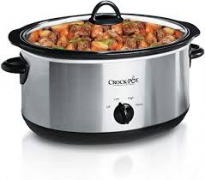
Crock Pot
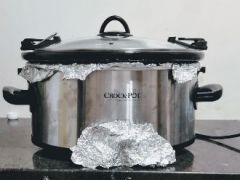
Crock Pot with Lining
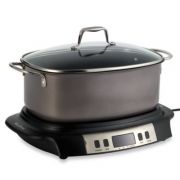
Slow Cooker on Base


- Leaving food in a crock pot, to alleviate both issues of shehiya and hatmana,
- according to some poskim all you need to do is cover the knob as long as it is cooking for Shabbat day.
- However, some forbid it unless there is an aluminum foil lining between the insert and the heating element and the knob is covered.[26]
- Furthermore, some take this a bit further and insist that there be a significant space between the heating element and the crock pot insert. This can be accomplished by placing a few balls of tin foil under the crock pot insert.[27]
- A crock pot or slow cooker that doesn’t fit into a heating element and just sit upon a heating element don’t have the question of hatmana and only need cover the heating element with aluminum foil and preferably the knob as well.[28]
Thermos
- Many permit pouring hot water from a Kli Rishon into a thermos on Shabbat as long as thermos is completely dry before pouring into it. [29]
Hot Water Urn
- It is permitted to use a water boiler on Shabbat and it isn't considered hatmana to keep the water that was there from before Shabbat hot.[30]
Rewrapping
- If a pot was wrapped in a permissible manner before Shabbat, it’s permissible to uncover and rewrap it on Shabbat, or add warmer clothes. [31]
Sources
- ↑ See Talmud Shabbat 34b, Rashi at loc, Shulchan Aruch O.C. 257:1
- ↑ See statement of Rava on Gemara Shabbat 34a
- ↑ Shulchan Aruch 257:1
- ↑ Shemirat Shabbat KeHilchata 1:75 (3rd edition) based on Shulchan Aruch 257:1 and 3.
- ↑ Shulchan Aruch 258:1, Mishna Brurah 258:2, Shemirat Shabbat KeHilchata 1:75
- ↑ Shulchan Aruch 257:8 explains that even though covering with a cloth is considered something doesn't preserve the heat, since the pot is top of the fire insulating the pot with the cloth becomes like it is insulated with something that preserves the heat, which is forbidden even on Friday. Mishna Brurah 257:37, Kaf Hachaim 257:40, and Shemirat Shabbat KeHilchata 1:75 agree.
- ↑ Chazon Ovadia (Shabbat v. 1 p. 56) writes that some are lenient and there is a minhag to be lenient against Shulchan Aruch.
- When Hatmana on it’s own doesn’t preserve heat but keeps in heat because of another source (that besides the cover of clothing, the food is on a Garuf or Katum stove) there is a dispute in the Rishonim if there’s an issue of Hatmana with something that preserves heat. Ran (Shabbat Bameh Tomnin) in name of Rabbenu Yonah and Rashba writes that if the insulation preserves heat because of an external source it is forbidden as Hatmana Dvar Hamosif Hevel because this insulation shows one is concerned about keeping the food warm. However, the Ramban permits if the Hatmana is done with permitted material and the Shehiyah (leaving food on a covered stove from before Shabbat) is done in a permitted way because these are two separate Gezerahs (the Gemara 47b which seemingly prohibits putting an insulated pot on a permitted stove is only forbidden because the food is put directly on the coals but if there’s a space of air in between the coals and the food it’d be permitted.) Ran (22a s.v. VeMinhagenu), Nemukei Yosef (Lo Yachpor), Rabbenu Yerucham (pg 68c), and Meiri (Shabbat Perek Kirah pg 142 s.v. Zu Hiy) write that the Minhag is like the Ramban's explanation. Ritva 47b mentions the Ramban and adds that some are strict to make a separation between the clothing and the pot (as that’s not the usual way to insulate) but concludes that he prefers a different stringency which is putting the pot on top of a cover that separates between the pot and stove. S”A 257:8 rules even though Shehiyah is permitted in certain cases (see S”A 253) if the pot is covered with clothes even though it is a material that doesn’t preserve heat it’s forbidden to be left on the fire.
- Sh”t Chut MeShulash 8, Shaarei Yeshua 5:8, and Sh”t Divrei Moshe 64 say that the Minhag has what to rely on even though S”A was strict. Sh”t Zechur LeYitzchak 74 pg 113b brings the opinion of Maharar Moshe Ben Chaviv who says the Minhag has what to rely on based on the Ramban and the opinions that there’s no issue of Hatmana if the food is cooking for Shabbat day; nonetheless, Zechur LeYitzchak suggests that since the Minhag predates S”A it can continue, but concludes that one should be strict like S”A. Eretz Chaim 257, Memei Shlomo 257, Sh”t Yaskil Avdi 3:10(4:7), Gedolei Tzion 9:11 also quote the Maharar Ben Chaviv and Chazon Ovadyah (Shabbat 1 pg 56; as in Sh”t Yabia Omer O”C 6:33) conclude that one can be lenient. Halacha Brurah 257:29 writes that one doesn't need to stop someone who is lenient since there is what to rely upon.
- ↑ The Tur 257:8 adds that his father the Rosh held that if the clothes aren’t touching the pot it is permitted and not a normal way to do hatmana. Thus, Shulchan Aruch 257:8 rules that if the pot isn’t touching the coals it is a permissible Shehiyah and if one puts a tray on pot of the pot and clothing on top of the tray so that the cloth doesn’t touch the sides of the pot it is a permissible hatmana. Minchat Cohen (Mishmeret Shabbat 8) explains that S”A requires both requirements: 1) the pot doesn’t touch the coals and 2) the clothes don’t touch the sides of the pot. Shemirat Shabbat Kehilchata 1:76 accepts this.
- ↑ Kaf Hachaim 258:3 writes based on the Magen Avraham 258:1 that insulating a pot on top of another pot that is on the fire is forbidden even before Shabbat since it is considered like hatmana bdvar hamosif hevel. Mishna Brurah 258:2 agrees. Kaf Hachaim adds that according to the lenient opinion in the Rama 257:7 since there is no issue of shehiya on a pot on top of another pot there's also no issue of hatmana, but that is only if that is the minhag.
- ↑ Shemirat Shabbat KeHilchata 1:72
- ↑ Chazon Ish 37:32 rules that a vessel inside a pot of hot water doesn’t have an issue of Hatmana. Even though, Aruch HaShulchan 258:3 and Sh”t Shevet HaLevi 3:47 argue on the Chazon Ish, Chazon Ovadyah (Shabbat 1 pg 62) says one can rely on the Chazon Ish to be lenient, especially if the food is fully cooked (for which Rama 257:7 permits Hatmana). Sh”t Shevet HaLevi 8:15(4) says that there is what to be lenient since the bag is only separating the food inside it but it would have been hot from the pot nonetheless. Sh”t Vayeshev Moshe (Zanger) O”C 19 adds that the bag or aluminum isn’t a real vessel that separates the food inside it. Rav Shlomo Zalman in Sh”t Minchat Shlomo (2:34(20) in Ostrot Shlomo version), Sh”t LeHorot Natan O”C 12, Kovetz Or Yisrael 5:23, Sh”t Shraga HaMeir 4:63, 6:3, Megilat Sefer on Shabbat 4:13, Sh”t Kinyan Torah 4:24, Sh”t Az Nidabru 6:78, Sh”t Or Letzion 2:17(13), and Sh”t Maaseh Nisim 163 agree that there’s no Hatmana in our case of a food within another food since it’s not meant to be totally separate.
- In the 2nd edition of Shemirat Shabbat Kehilchasa 42:63 he was strict regarding materials that don’t allow liquid through such as plastic, nylon, or aluminum liners inside chulent or crock pots, however in the 3rd edition there’s an explicit retraction in 1:87 quoting Rav Shlomo Zalman to permit in all circumstances.
- Meor Shabbat 3 pg 519, and Menuchat Ahavah 1:3(27) are somewhat strict on the issue, the Minhag is to be lenient on this issue.
- ↑ Mishna Brurah 258:2, Dirshu Footnote 258:7
- ↑ Shulchan Aruch O.C. 257:8, Mishna Brurah 257:37, Halacha Brurah 257:28.
- Tur 257:8, quoting the Rosh, writes that those people who insulate a pot on Friday with a cloth and put the pot on a covered fire are doing wrong, since the cloth is considered an insulation that adds heat once the pot is on top of a heating element. The Bet Yosef (257:8 s.v. u'ma shekatav rabenu aval hatmana) writes that Tosfot Shabbat 48a s.v. dzeytim held that it is forbidden to use a cloth to cover a pot on top of covered coals since the cloth becomes something that adds heat since the pot is on top of a heating element. He also quotes the Smag Lav 65, Smak 282, Sefer Hatrumah 231, and Ran (shabbat 22a s.v. aval) citing the Rabbenu Yonah and Rashba as agreeing. He does cite the Ran quoting the Ramban as disagreeing that hatmana and shehiya are two separate issues, and if a cloth isn't something that adds heat itself it isn't considered something that adds heat for hatmana.
- Shulchan Aruch 257:8 follows the opinion of the Tosfot, Smag, Smak, Sefer Hatrumah, Rashba, Rabbenu Yonah, Rosh, and Tur unlike the Ramban. This is accepted by the achronim including Shulchan Aruch Harav 257:10, Mishna Brurah 257:37, and Halacha Brurah 257:28. Aruch Hashulchan 257:11 agrees and adds that the Rambam and Rif agree with Tosfot. Halacha Brurah 257:28 adds that the Nemukei Yosef b"b 10a agrees with Tosfot.
- ↑ Shulchan Aruch 257:8, Halacha Brurah 257:28-29, Chazon Ovadia Shabbat v. 1 p. 56.
- According to Sephardim, Halacha Brurah 257:29 writes that someone who does insulate the pot before Shabbat with a blanket on top of the heating element, even though it is against most rishonim (Tosfot, Rosh, Tur, Smag, Smak, Sefer Hatrumah, Rashba, and Rabbenu Yonah) and Shulchan Aruch, someone who relies on the Ramban Shabbat 47b who holds that a cloth isn't considered something that adds heat even though the pot is on top of a heating element shouldn't be rebuked. (See there where he adds that although many rishonim are strict there are many who are lenient like the Ramban including Or Zaruah 2:8, Sefer Habatim ch. 5, Ohel Moed 3:10, Ritva Shabbat 47b quoting Rabbenu Tam, Sefer Hayashar no. 235, and Meiri 36b based on Rashi.) Furthermore, if the pot is heating food for the next day there is what to rely upon according to the Shibolei Haleket. Even though this is a minority opinion someone who follows it in conjugation with the Ramban shouldn't be rebuked. Halacha Brurah 258:3 p. 382 clarifies that this lenient is only before Shabbat.
- ↑
- Shemirat Shabbat Kehilchata 1:77-78 writes that it isn't considered insulating if the pot isn't completely covered. It would be permitted even if it is on the fire. In the footnote, he cites Rav Shlomo Zalman Auerbach who clarified that it is only not considered hatmana if a recognizable part of the side of the pot is exposed around a majority of its circumference and not just one little area. Orchot Shabbat v. 1 p. 110 agrees that covering a pot on a covered fire on Shabbat with clothes is permitted if they only partially cover the pot. The definition is that it needs to be uncovered in a significant way so that it negatively impacts on the heat of the pot.
- However, Halacha Brurah 257:29 writes that even Ashkenazim should be strict. He explains that the implication of the Rama who doesn't comment on 257:8 is that it is forbidden to cover a pot on a heating element even though it is only partially covered. He quotes the Pri Megadim E"A 257:18, who explains that even though usually a partial covering isn't an issue for the Rama 253:1, here it is since it is clear that one is insulting the pot to keep it hot. However, he also quotes the Minchat Cohen 2:8 s.v. veheneh (cited by Halacha Brurah v. 14 p. 345) who says that according to the Rama it is permitted. Halacha Brurah writes that Ashkenazim should be strict.
- ↑ Halacha Brurah 257:28, based on Shulchan Aruch 253:1 that hatmana on one side is considered hatmana, writes that covering the pot on top of a covered fire is forbidden. He explains that this is the intent of Shulchan Aruch 257:8.
- ↑ Shulchan Aruch 257:1-2, Shemirat Shabbat KeHilchata 1:65
- ↑ Mishna Brurah 258:2, Shemirat Shabbat KeHilchata 1:75
- ↑ Shemirat Shabbat KeHilchata 1:66
- ↑ Orchot Shabbat 2:86
- ↑ Shemirat Shabbat KeHilchata 1:68
- ↑ Mishna Brurah 258:2
- ↑ In Shabbat 51a, Rav Yehuda in the name of Shmuel says that it’s permitted to insulate cold food. Rashi (Shabbat 51a) explains that it’s permitted to keep it cold and there’s no Gezerah of Hatmana, implying that heating up cold food even with insulation of material that doesn’t preserve heat is forbidden. Mahari MeLunil 51a, Ravan 346, Ravyah 202 pg 287, and Rabbenu Yishaya MeTeranayah pg 294 concur with Rashi. However Rambam, (Shabbat 4:4) permits insulating the cold food even to remove its coldness. Rashba 51a in name of the Geonim, Ran 23b, Nemukei Yosef 51a, and Rabbenu Yerucham pg 68c in name of Tosfot agree with the Rambam. Shulchan Aruch 257:6 rules like the Rambam.
- ↑ Shulchan Aruch 257:2, Orchot Shabbat 2:76
- ↑ Igrot Moshe 4:74 Hatmana no. 3, Orchot Shabbat 2:77. Rabbi Mansour ("Hatmana: Foil –Placing Wrapped Foods on the Blech") writes that Sephardim can be lenient like Rav Shlomo Zalman Auerbach who says that it is permitted to wrap a food in aluminum foil even if one isn't doing it to prevent it from getting dirty. It is just like encasing it in a pot.
- ↑ 39 Melachos v. 2 p. 633 writes that Rav Moshe held the crock pot wasn't an issue and to avoid those who are strict it is sufficient to place aluminum foil between the insert and the heating element and also cover the knob.
- ↑ Reasons to permit:
- Hatmana: Hatmana for Tomorrow: There are some Rishonim that permit Hatmana if the food is meant to be eaten the next day. [Shibolei HaLeket 57 in name of Rabbenu Simcha says that Shehiya is permitted if a person has two pots and the one that’s cooking for Shabbat day is separate from the pot cooking for Friday night. Rabbenu Binyamin (quoted by Shibolei HaLeket), Mordechai (Shabbat 3:300), Rabbenu Yishaya HaRishon (Shabbat Bameh Tomnin), and Ravan (Shabbat 338) concerning Hatmana allow something that is set aside for the next day.] Rama 257:1 rules like these opinions. However Bet Yosef 253:1(4) concludes that this seemingly goes against many of the Mefarshim that are brought in the following Siman.
- Hatmana: Partial Insulation: There is a dispute in the Rishonim whether there is Hatmana when the food is touching the coals even though the food itself isn’t covered. S”A 253:1 end of saif rules (based on Rosh (Shabbat 3:1), Tur 253:1, Ran 15b s.v. Kirah, and Magid Mishna 3:4 in name of Rambam) that if the pot is touching the coals directly it’s forbidden to do hatmana in any case. However Rama 253:1 says that there are those who permit (namely, Mordechai (Shabbat 299, Hagahot Maimon 7:20, and Or Zaruh 2:8 pg 3c) and so is the Minhag. Chazon Ish 37:19 argues on this Rama and follows S”A. See The Great Crock Pot Controversy by Rabbi Yirmiyahu Kaganoff.
- Hatmana: The Tiny Space Between the Pot and Heating Element: Some distinguish between the pot directly on the coals and where there’s a small airspace in between including Mishna Brurah (Shaar Hatziyun 257:43) and Shulchan Aruch HaRav 257:10 (based on Ritva Shabbat 47b). Thus, Chazon Ovadyah (1 pg 64) argues that the small airspace is reason to permit even according to S”A, while Shulchan Shlomo 257:13 doesn’t consider the airspace as an interference between the coals and the pot because that’s the way it cooks.
- Shehiya: Covering the Knobs: Chazon Ovadia permits the shehiya because of covering the knobs. Orchot Shabbat 2:18 holds that covering the knob with tape permits shehiya.
- Shehiya: Other Solutions: Halacha Brurah 253:9 writes that if one covers the heating element with tin foil that solves the shehiya problem. Halacha Brurah 257:32 notes that if one puts in a raw piece of meat before Shabbat that also solves the issue of shehiya.
- Those who permit: Rav Vosner (Kovetz MeBet Levi 9, Shabbat LeYisrael pg 373), Sh”t Shevet HaLevi 9:52, and Rav Moshe Feinstein (Sefer Otzrot HaShabbat and Sefer Matmin UMevashel Beshabbat quote it in his name, see also Igros Moshe OC 4:74:Hatmana 4, Teshuvot Vihanhagot 3:106) permit (according to the Rama). Chazon Ovadyah (Shabbat 1 pg. 64) permits according to S”A based on a Safeka Safeka, and the small airspace, as long as one covers the knob to serve as a reminder. Rabbi Eli Mansour on DailyHalacha.com quotes this opinion of Rav Ovadia. Halacha Brurah 257:32 permits the crock pot for hatmana purposes if the food is intended for tomorrow.
- Those who forbid: Rav Shlomo Aurbach in Shulchan Shlomo 257:13 forbids. Rabbi Daniel Mann writes that although one is not required to do so, one who wishes to satisfy the opinion of Rav Shlomo Zalman may place little balls of tin foil underneath the removable part of the crock pot to create a separation between the pot of food and the heating element and raise the pot of food about the walls (see Rav Shlomo Zalman's letter in the back of Orchot Shabbat and Orchot Shabbat pg. 113). Rav Elyashiv (commonly quoted “in his name” (as in Sefer Otzrot HaShabbat and Sefer Matmin UMevashel Beshabbat) as forbidding the crock pot, however Shabbat Hayom recounts that he and his friend Rabbi Ofir Malka showed Rav Elyashiv the pot and Rav Elyashiv permitted it according to the Rama.
- Aluminum Balls Solution: Orchot Shabbat 2:88 writes that in terms of shehiya it is considered an uncovered fire which can be solved by creating a space between the pot and the insert. In terms of hatmana even though the top is uncovered it is still considered insulated since it is mostly surrounded by the heating element. Rav Shlomo Zalman Auerbach and Rav Elyashiv both held that it is only permitted to using a crock pot is the insert is raised in a noticeable way from the heating element otherwise it would be hatmana. Additionally, Rav Shlomo Zalman Auerbach added that the food had to be completely cooked before Shabbat to avoid hatmana. Lastly, Rav Wosner held that one should be strict but one doesn't have to protest Ashkenazim who are lenient since it is only partial insulation. Rav Hershel Schachter (The Laws of Cooking and Warming Food on Shabbat p. 184) writes that one should place something in between the pot and the heating element to avoid hatmana.
- ↑ 39 Melachos v. 2 p. 633
- ↑ Shalmei Yehuda 6:4 quoting Rav Elyashiv, Chazon Ish 37:35, Az Nidbaru 1:48-9, 3:17, Shemirat Shabbat KeHilchata 1:70, and Sh”t Igrot Moshe 1:95 permit pouring hot water from a Kli Rishon into a thermos and there would be no issue of Hatmana. However, according to Sh”t Shevet HaLevi 1:93 that it’s forbidden to put hot water into a thermos, thermos should be considered a Kli Sh’Melachto LeIssur.
- ↑ Rav Ovadia Yosef in Mayan Omer 2:9 p. 119. The footnote explains even though the water is completely covered it isn't considered insulated since that is how the machine is made.
- ↑ Shemirat Shabbat KeHilchata 1:67