|
|
| Line 1: |
Line 1: |
| One whose relative has passed away has an obligation<ref>There is a difference of opinion as to whether this obligation is derabanan or deoraisa, see below.</ref> to engage in several practices of mourning. The week of mourning, which begins (under normal circumstances) from the time of burial and continues for seven days, is colloquially referred to as "shiva" and is associated with several laws and customs.
| | Halacha places high importance on a community's responsibility to one another. A community is halachically obligated to fund communal needs. These needs include security needs; a community is required to build a wall and gates. These needs also include religous needs; a community is required to build a synagogue and ensure that is well stocked with a sefer Torah and seforim.<ref>All of this from Shulchan Aruch CM 163:1</ref> |
|
| |
|
| ==Who and For Whom Does One "Sit Shiva"== | | == Rationales behind Communal Responsibility == |
| # There are seven relatives for whom one is obligated to mourn: one's (1) father, (2) mother, (3) son, (4) daughter, (5) sister, (6) brother, and (7) spouse.<ref>Shulchan Aruch Y.D. 374:4. The Rambam in Hilchos Avel 2:1 considers the obligation of mourning for a spouse to be Midivreihem, which most (cf. Lechem Mishnah there) assume to mean that it is derabanan (although this is not the understanding of the Kesef Mishnah there). Ramban, however, in Toras HaAdam (Chavel ed.) page 213 believes that it must be deoraisa. Additionally, Ramban writes (to Vayikra 21:3) that mourning for one's married sister, or a married sister mourning for her brother, is only derabanan.</ref> One who is not biologically related to the deceased 'relative' is not obligated to mourn for them.<ref>Thus, an adopted child, strictly speaking, does not need to mourn for his/her parents. However, some have the practice to do so anyway out of respect and gratitude for their adopted parents. Pischei Teshuvah 374:3 writes that one should mourn for his/her step-parent.</ref>
| |
| # A ger (convert) is not obligated to mourn for his relatives.<ref>S.A 374:5 and Shach 374:4. </ref>
| |
| # The Rabbis decreed that one whose immediate relative (i.e. one of the seven described above) is in mourning should also act as if he himself is in mourning, as long as he is in the presence of his mourning relative.<ref>Gemara Moed Kattan 20b, Shulchan Aruch 376:6. See Tosfos there regarding one's spouse's relative</ref> Today, however, Rama believes that this rule is no longer in effect.<ref>Hagahos Maimoni Avel 2:2 writes that the mourners can forgo this right to have their relatives mourn with them, and so the Rama in 376:6 writes that it is assumed that today everyone relinquishes this right.</ref>
| |
| # Generally speaking, one does not mourn for a deceased person who has rebelled against Judaism,<ref>Sanhedrin 47a, Shulchan Aruch Y.D. 304:5 and Shach 304:8 (applying the Rosh and Mordechai Moed Kattan 886) that even one who sinned only for pleasure, but repeatedly, is also excluded from being mourned), </ref> or one who intentionally commits suicide (meabaid atzmo l'daat),<ref>Maseches Semachos 2:1, Shluchan Aruch Y.D. 345:1, against the opinion of Ramban in Toras HaAdam pg. 83</ref>. However, there are many possible exceptions to this rule, so every case must be determined by a qualified posek.<ref>cf. Chasam Sofer Sh"T Y.D. 326, Ritva Avodah Zarah 18a, Birkei Yosef Y.D. 341:2, Kol Bo Aveilus 1:4:3:39, Yabia Omer vol. 2, no. 24 miluim 15</ref>
| |
| # One does not mourn for a baby born prematurely who dies within thirty days of its birth, although there is considerable debate regarding how to determine "premature" in this context.<ref>Cf. Niddah 44b, Shulchan Aruch Y.D 374:8, Rama E.H. 156:4</ref>
| |
| # Children under bar mitzvah are not taught to observe aveilus. <ref>Derisha quoted in Taz 340:15 writes that in fact a child should be taught to observe aveilus, as the Gemara (Moed Kattan 26b) indicates that he should be taught to tear keriyah on the deceased. However, Dagul Merevavah there writes that there is no aveilus for children, and this is the common practice.</ref>
| |
| # There is a dispute regarding a boy who turns thirteen or a girl who turns twelve during the week or month after the burial of his/her relative, but the practice is for such a person to not observe aveilus at all.<ref>Rosh Moed Kattan 3:96, Tur and Shulchan Aruch 396, Taz 396:2</ref>
| |
| #We mourn over the loss of a Jew who wasn’t religious nowadays. <ref>Chazon Ovadia Aveilut v. 1 p. 538. His three reasons are the perhaps he did teshuva (Yad Yitzchak 3:149), perhaps avoiding mourning would lead to ayvah (Maharshag YD 1:25:6), and perhaps he was a tinok she’nishba (Emet LYakov 345:218).</ref> See [[Interactions with Non-Religious Jews]] for details.
| |
|
| |
|
| ==The Beginning and End of "Shiva"== | | == Extent of Communal Responsibility == |
| # Normally, aveilus begins from the end of the burial.<ref>Moed Kattan 27a (and elsewhere), according to R' Yehoshua regarding turning over the bed. Rashi (Kesuvos 4b) as understood by Ramban (Toras HaAdam pg. 156), holds that aveilus begins from the time that the casket is covered, even before it is placed in the ground, and the burial is only relevant if the body is buried without a casket. However, Shach (Y.D. 373:11) disputes this interpretation of Rashi, and Tosfos (Kesuvos 4b) write that aveilus begin when the stone covering is placed over the grave, or, if there is none, then it begins from the time that the relatives turn away from grave, having considered their burial complete. Bach (Tur Y.D. 375) believes that the Shulchan Aruch paskens like Rashi, but the based upon the Shach just cited, most assume that the aveilus does not begin until the end of the burial. According to Badei Hashulchan 375:2 quoting Daas Torah, the burial is not considered complete until the customary mound of earth is made marking the grave.</ref><ref>Although it is true that the aveilus does not begin until the completion of the burial, the period of aninus (at least for the purpose of davening) appears to end beforehand, from the beginning of the burial. Both Magen Avraham (O.C. 71:1) and Aruch Hashulchan (Y.D. 341:28) write that as soon as the body or casket begins to be covered by earth, the relatives may daven.</ref> Technically, the aveilim can keep their leather shoes on until they get home, but the custom is to remove them immediately after the burial.<ref>Ramban Toras HaAdam pg. 154, Shulchan Aruch 375:1. Badei Hashulchan Biurim "ve'achshav" writes that this may in fact be required according to the Magen Avraham O.C. 554:17, but the Aruch Hashulchan 375:5 writes that this is merely a custom which developed in order to symbolically display the onset of aveilus.</ref>
| | A big component of the halachic discussion around how far communal responsibility extends comes from a crucial Tshuva of the Maharik. This Tshuva of the Maharik is quoted by the Rama<ref>Rama CM 163:6</ref> and by many generations of Achronim, thereby making it a really focal point for the discussion of communal responsibility.The Maharik argued that in a case where there is a risk to the Jewish people of a region, all Jewish communities are required to pitch in. We will structure the article around the Tshuva and the response of other poskim in order to examine how poskim viewed the question. |
| # If the mourner already davened maariv before shkiah, and then heard of his relative’s death, he cannot count that first day as one of the seven days of aveilus, but begins counting as if it were already past shkiah.<ref>Shulchan Aruch Y.D 375:11 and 402:11 and Shach 375:15, although cf. Levush there who writes, based on Rama to Y.D. 196:1 that the Rama argues. </ref>
| |
| # Aveilus is not practiced for the full seven days, but ends on the morning of the seventh day, because we say that מקצת היום ככולו, part of the last day counts as if it were a whole day.<ref>Moed Kattan 19b</ref> However, we do not apply this concept to keeping aveilus at night, and instead the mourners have visitors come in the morning and end aveilus when they leave.<ref>This is the practice as described by the Gemara Moed Kattan 21b. Tosfos there (s.v. “Afilu”) believe that the nighttime cannot count as a partial day, but Ramban (Toras HaAdam p. 215) disagrees. Maharam of Rothenberg, quoted in the Rosh (Moed Kattan 3:30) and paskened by Shulchan Aruch (Y.D. 395:1) held that the concept of מקצת היום ככולו can be applied to the nighttime in principle, and is therefore relevant for the thirty days of aveilus, but nighttime does not suffice for ending the seven days because of a need to have a seven day count, similar to the count of a niddah. </ref>
| |
| ===If a Relative Doesn't Go to the Funeral===
| |
| # According to Sephardim if a relative isn't going to the funeral but knows when the funeral is going to take place, he may not start aveilut until after the burial. After the fact if the asked a rabbi and the rabbi allowed him to start aveilut they can count those days towards the aveilut.<ref>Chazon Ovadia (Aveilut v. 2 p. 100). The Rambam (Avel 1:5) and Shulchan Aruch YD 375:2 rule that if a relative escorts the dead to the end of the city and doesn't continue to travel to the funeral he starts his aveilut immediately as long as the funeral is so far that he doesn't know when the funeral is going to take place. Chazon Ovadia infers that if the relative knows when the funeral is going to take place he can't start observing aveilut before then. He quotes the Maharnach 2:51 and Radbaz 4:63 who also say this.</ref>
| |
| # If a relative hears about the death of a relative and he isn't going to be involved in the burial or funeral at all and doesn't know when the funeral is going to take place, some say that he can't start his aveilut until he knows that the burial was complete, while others hold that he starts his aveilut immediately. Most contemporary poskim follow the second opinion.<ref> The Gemara Moed Katan 22a states that if a relative sent the funeral procession on its way to a faraway place once he turns his face from the burial he begins his aveilut. This is codified in Shulchan Aruch 375:2. However, the Rosh (teshuva 27:5) writes that if a person observed aveilut before his relative was buried his aveilut doesn't count. There are two major approaches as to how to explain the difference between the Gemara and the Rosh.
| |
| * The Netsiv (Meishiv Dvar YD 27) holds that only if a person was involved with the burial and then sent the funeral procession off he begins his aveilut since he has completed his participation in the burial. However, if a person didn't do anything to contribute to the burial and was in another place he can't begin aveilut until after the burial.
| |
| * The Netsiv's son-in-law, Rav Rafael Shapira, quoted by Sdei Chemed (Avelut no. 14) argued that once a person despaired from making any further participation in the burial either because he did his part or because he is so distant that he can't do anything he begins aveilut. However, in the case of the Rosh the relatives didn't give up to do the burial, so they can't begin aveilut yet.
| |
| * Chazon Ovadia (Aveilut v. 2 p. 101) quotes the Chelkat Yakov 1:188, Maharsham 2:260, Shevet Halevi 3:168, and Igrot Moshe YD 1:253 who agreed with Rav Shapira.</ref>
| |
| # A relative who is not accompanying the meis to the place of burial begins the aveilus from the time that (s)he turns away from the meis,<ref>Moed Kattan 22a.</ref> as long as the burial is far enough that those relatives will certainly not make it to the burial.<ref>Shulchan Aruch Y.D. 375:2. Ramban (Toras HaAdam pg. 162, based on Rambam Avel 1:5) writes that this is only the case if the meis is being brought to a faraway city, and according to the Dagul Merevavah to Shach 375:1 is how the Shulchan Aruch paskens. However, the Behag (as quoted by Ramban, ibid.) appears to pasken that the relatives begin aveilus from the time that they turn away regardless of where the burial will be, and the Shulchan Aruch quotes this Behag in Y.D. 399:14. According to the Dagul Merevavah and Chachmas Adam (Matzeves Moshe 9), if the burial occurs in the same city, but a relative turns away from the procession and will certainly not return, such as on erev Yom Tov, this too would be enough to start aveilus.</ref> However, if the burial is being done in the city's cemetery, the aneinus ends without the aveilus beginning until those who were busy with the burial return<ref>Ramabn Toras HaAdam pg. 163, Shulchan Aruch Y.D. 375:2 as interpreted by Aruch Hashulchan 375:8 and paskened by Igros Moshe Y.D. 1:253 and Badei Hashulchan 375:11. However, Radbaz Sh"T 4:63 understands that even according to Ramban, once night falls, or once the relatives can be certain that the burial has occurred, they begin aveilus even if the burial occurred within their city despite not being present at the burial itself. See also Minchas Shelomo 1:91:25 regarding contemporary situations. In some situations, if the head of the family does not accompany the meis to the burial, then even the relatives who have stayed behind begin aveilus only after the burial. See Tosfos Moed Kattan 22a, Shulchan Aruch Y.D. 375:2</ref>
| |
| ===Completion of Shiva===
| |
| # On the seventh day of the mourning after the comforters leave the mourner can get up and that completes the shiva as part of the seventh day is considered like the whole day.<ref>Tur and Shulchan Aruch Y.D. 395:1. The Tur 395 cites a dispute if we apply the principle of a part of the day counts like the full day at night. The Bet Yosef quotes the Ramban (Torat Haadam Shaar Haavel, Inyan Haavelut s.v. amar rav amram n. 82) who holds that it does count but the Tosfot, Rosh, and Maharam hold it doesn't count. Shulchan Aruch follows the Maharam.</ref>
| |
| # If someone dies on Sunday and the shiva is completed on Shabbat, private aveilut is observed on Shabbat until after Shacharit Shabbat morning.<ref>Taz 402:5, Shach 402:4</ref>
| |
|
| |
|
| ==Prohibitions for the Avel== | | == Background of Maharik's Ruling == |
| # The avel is prohibited from working or leaving the house
| | [[File:Shul of regensburg.jpg|thumb|Sketch of Synagogue of Regensburg in 1519]] |
| # washing/bathing/anointing
| | In the late 1470s- a major blood libel broke out in Regensburg. The city of Regensburg imprisoned seventeen leading members of the Jewish community. After repeated negotiations the city of Regensburg agreed to release the imprisoned Jews in exchange for the payment of an immense sum; 23,000 florins. The Jewish community of Regensburg asked all the other communities of Germany to assist in paying the expense. The Rabbonim of Germany in turn asked the Maharik, [https://en.wikipedia.org/wiki/Joseph_Colon_Trabotto Rav Yosef Colon] (1420-1480), over whether they were obligated to pay. It is to these rabbonim that the Maharik directed his ruling. |
| # wearing shoes
| |
| # tashmish hamitah
| |
| # learning Torah<ref>Gemara Moed Katan 15a forbids learning Torah when one is a mourner based on the pasuk in Yechezkel 24:17. This is codified in Shulchan Aruch 384:1</ref>
| |
| # greeting others<ref>Gemara Moed Katan 15a forbids greeting others when one is a mourner based on the pasuk in Yechezkel 24:17. This is codified in Shulchan Aruch 385:1</ref>
| |
| # Today, the custom is not to turn over the beds or wrap one's head.<ref>Gemara Moed Katan 15a based on Yechezkel 24:17, Shulchan Aruch YD 386:1</ref> The custom is for a mourner to sleep in a bed and not the floor.<ref>Kitzur Shulchan Aruch 211:1, [http://www.hebrewbooks.org/pdfpager.aspx?sits=1&req=31174&st=%u05DC%u05D9%u05E9%u05DF Gesher Hachaim 1:20:10], Chazon Ovadia (Avelut v. 2 p. 255)</ref>
| |
| # laundering clothing and wearing freshly laundered clothing<ref>Gemara Moed Katan 15a based on Shmuel II 14:2, Shulchan Aruch YD 389:1</ref>
| |
| # haircutting and shaving<ref>Gemara Moed Katan 14b learned from the pasuk in Vayikra 10:6. This is codified in Shulchan Aruch YD 380:1</ref>
| |
| # other practices
| |
| ===Doing Business During Shiva===
| |
| # It is forbidden for an avel to do work so that he is available to mourn properly and repent.<ref>Torat HaAdam (p. 170), Bach 380:3, Badei Hashulchan 380:10</ref> This prohibition includes doing business.<ref>Rambam (Avel 5:7) writes that just like doing work is forbidden so too doing business during aveilut is forbidden. The Nemukei Yosef (Moed Katan 13b) quotes one opinion as holding that it is permitted but that isn't accepted. Tur and Shulchan Aruch 380:3 follow the Rambam.</ref>
| |
| # Even if someone is very poor and needs to take tzedaka may not work during the first three days of aveilut. Afterwards, he can work in private. However, cursed are the neighbors of such a person that they didn't take care of him and made him work during aveilut.<ref>Gemara Moed Katan 21b establishes that it is forbidden for a person to work during aveilut even if they are so poor that they need tzedaka but after 3 days they can work in private. The Hagahot Maimoniyot 5:8 writes that after 3 days it is forbidden for anyone who isn't so poor that they need tzedaka. He quotes the Yerushalmi, Maharam, and Raavad who agree with this explanation unlike Rabbenu Shemaya. Tur and Shulchan Aruch 380:2 follow the Hagahot Maimoniyot. The Yerushalmi 3:5 adds that cursed are the neighbors who cursed him to work during aveilut. This is codified by Shulchan Aruch.</ref>
| |
| # If not doing a certain activity will cause a loss it is permitted to have others do the work for the avel. For example, if a person has a barrel of wine unsealed and it will spoil if he doesn't seal it, he can have someone else seal it for him.<ref>The Gemara Moed Katan 11b cites a dispute between Rav Shisha and Rav Ashi whether it is permitted for an avel to work during aveilut to avoid a loss. The Rif (Moed Katan 5a), Rosh (Moed Katan 2:1), and Rambam (Avel 5:10) all accept the opinion of Rav Shisha that it is forbidden. This is codified in Tur and Shulchan Aruch 380:4.</ref> If there is no one else available to do the work that is necessary to avoid the loss, according to Ashkenazim it is permitted after 3 days of aveilut or even within 3 days to avoid a large loss. However, Sephardim would forbid doing work by oneself even to avoid a loss and even if no one else is available.<ref>Rabban Gamliel (Moed Katan 11b) holds that it is permitted to do the work to avoid a loss if no one is available. The Tur 380:4 quotes the Rif and Rambam who don't hold like Rabban Gamliel, while the Ramban (p. 165) and Rosh (Avel 2:4) accept his opinion. The Shulchan Aruch 380:4 doesn't mention this leniency of Rabban Gamliel, while the Rama does, though he only applies it after 3 days or within 3 days if there's a large loss based on the Rabbenu Yerucham.</ref>
| |
| # If a person is in aveilut then his workers can't work either.<ref>Shulchan Aruch 380:5</ref>
| |
| # If a person is in aveilut some permit his wife to work out of the house, while others permit her only if she specifies that she is giving up her rights to having her husband provide for her sustenance for that week.<ref>Chazon Ovadia (Aveilut v. 2 p. 130) writes that just like the Aval Rabati (5:1 codified by Shulchan Aruch 380:4) writes that it is forbidden for children of an avel to work if the money goes to the avel so too it is forbidden for the wife of an avel to work since her salary goes to her husband. Bet Dovid YD 181 agrees that it is forbidden for a wife of the avel to work. However, Chazon Ovadia continues that the Rashba (Bet Yosef EH 95), Rabbenu Yerucham, and Ritva (Ketubot 59b) as holding that if a woman works outside her house which she isn't obligated to do she keeps her salary. If so, Rav Ovadia concludes, a wife who works out of the house can work during shiva of her husband. Rav Ovadia adds that it is better for her to say that she gives up her rights to sustenance from her husband which in exchange means that she can keep her own salary. Peni Baruch (p. 460) quotes Rav Shlomo Zalman Auerbach as saying that a wife or family members of the avel who wants to work can specify that their profits not go to the avel that week. </ref>
| |
| # It is permitted to write in non-professional script during shiva if there is a need.<ref>Rama 380:2, Chazon Ovadia (Aveilut v. 2 p. 137)</ref> However, a sofer may not write or fix a sefer torah unless the congregation needs him since there is no other kosher sefer torah and no other sofer available.<ref>Chazon Ovadia (Aveilut v. 2 p. 138) quoting Shaarim Hametzuyim Bhalacha 208:6</ref>
| |
| # It is permitted for an avel to sweep, cook, make the beds, and clean dishes during aveilut.<ref>Aval Rabati 11:9, Ramban (p. 173), Maharik 35:4, Mordechai (Moed Katan no. 929), Shulchan Aruch 380:22, Chazon Ovadia (Aveilut v. 2 p. 135)</ref>
| |
| # A doctor during aveilut can leave his house to help his patients.<ref>Chazon Ovadia (Aveilut v. 2 p. 145), Minchat Shlomo 2:96:1</ref>
| |
| # If a company has to pay its workers (contracted per month or year) even if the company closes it would be considered a loss if the company closed when the owner was in aveilut. Therefore, the workers can continue to work even if the owner is in aveilut.<ref>Aruch Hashulchan 380:6, Gesher Hachaim 1:21:2:2, Chazon Ovadia (Aveilut v. 2 p. 146). See Chazon Ovadia for his discussion of the opinion of the Chida who was strict and the proofs from others including the Nodeh Beyehuda that it is considered a loss.</ref>
| |
| # If a shochet is an avel and there is no other shochet available in the town he can work during aveilut since his activity is ochel nefesh.<ref>The Mordechai (Moed Katan no. 929) writes that cooking is permitted for an avel since it is permitted on Yom Tov. The Darkei Moseh 380:5 learns from the Mordechai that anything which is permitted on Yom Tov is permitted for an avel (which follows from the source of working during aveilut being that we compare aveilut and yom tov in Moed Katan 15b). Therefore, Rav Ovadia in Chazon Ovadia (Aveilut v. 2 p. 141) holds that it is permitted for a shochet to do shechita during aveilut if there's no one else available in town. He quotes that Rabbi Akiva Eiger (Drush Vchidush p. 107b) also said this. Gesher Hachaim 1:21:2:2 is also lenient. See, however, the Gilyon Maharsha 380:15 who quotes the Shvut Yakov 3:86 as holding that it is forbidden because of work and the Mahara Klosner who held that it is forbidden because he might not do a proper shechita because of his sorrow. </ref>
| |
| # If a person contracted someone for a specific job for a fixed cost and not paid for time, and then became an avel, that hired person can continue to work even though his employer is in aveilut. But he can only do the job outside the house of the mourner.<ref>Shulchan Aruch YD 380:18, Gesher Hachaim 1:21:2:5</ref>
| |
| # If a person rented a car to someone and then became an avel the renter can continue to use it but the owner can't rent it out again during shiva.<ref>Shulchan Aruch 380:15 quotes a dispute about the rented boat or animal of the mourner if the renter can rent it a second time when the owner is in aveilut. Chazon Ovadia (Aveilut v. 2 p. 151) follows the second opinion who is strict. However,
| |
| from Shulchan Aruch YD 380:14 it is clear that it is permitted for the renter to finish up the rental period that started before the owner became an avel.</ref>
| |
| # The mourner may not work. He can get someone else to do his work for him.<ref>Rama YD 380:16. Even though the Shach 380:17 disagrees with the reasoning of the Levush for the Rama, Gesher Hachaim 1:21:2:4 follows the Levush. The Shach would only permit it if there is a loss to the employer. </ref>
| |
| ====Partners====
| |
| # If a partner in a company is an avel, the entire company has to close. The other partners who aren't in aveilut can work in their own houses in private unless it'll become known that the work is being done for the business at the time.<ref>Shulchan Aruch YD 380:21, Chazon Ovadia (Aveilut v. 2 p. 152). The Gesher Hachaim 1:21:2:7 writes that the minhag is to reopen the company after 3 days of aveilut. See Pitchei Teshuva 380:4 about a sale of the business to the other partners during shiva.</ref>
| |
| # If a partner in the company dies the partnership is undone and the other partner can work. This doesn't only apply if there are no inheritors of the deceased who will mourn him but even if the deceased has a child inheriting them and mourning them the other partner can work when the child is an avel since halachically the original partnership has been disbanded.<ref>Gesher Hachaim 1:21:2:10</ref>
| |
| # If before the relative dies a person sells the business to another person or to his partner then the business can stay open during aveilut. If the person already became an onen, in extenuating circumstances, he can sell the business to his partner or someone else during aninut.<ref>Chatom Sofer YD 2:324, Gesher Hachaim 1:21:2:14, Chazon Ovadia (Aveilut v. 1 p. 159)</ref>
| |
|
| |
|
| ===Bathing=== | | == Ruling of the Maharik == |
| # It is forbidden for a mourner to take a complete shower or bath whether it is hot or cold. It is permitted for the mourner to wash his hands, feet, and face with cold water<Ref>Shulchan Aruch YD 381:1</ref> but not hot or even lukewarm water.<ref>Chazon Ovadia (Aveilut v. 2 p. 158) quotes the Tiferet Moshe who writes that lukewarm is considered warm for this halacha.</ref>
| | The Maharik noted that were the blood libel not to be stopped, it would lead to the persecution of other Jewish communities in Germany. The Maharik said that any community that would potentially be a target of the blood libel was obligated to contribute to stop the libel from spreading in Regensburg. |
| # The Ashkenazic minhag is not to shower or bathe during shloshim unless one is doing so to remove dirt. Some permit taking a cold shower.<ref>Rama YD 381:1 writes that the Ashkenazic minhag is not to shower all of shloshim. The Taz 381:1 quotes the Maharshal who says that the reason for the minhag is because it was common to take a haircut together with bathing and since taking a haircut is forbidden during shloshim the minhag wasn't to bathe for all of shloshim. The Darkei Moshe 381:3 cites the Maharam who explains the minhag based on a similarity to bathing and laundering. The Shach 381:1 writes that bathing in cold isn't bathing. It isn't clear if the Shach is referring to a full body shower or just one's hands, feet, and face. The Dagul Mirvavah 381:1 writes that the Shach is only discussing hands, feet, and face. The Pitchei Teshuva 381:2 quotes the Teshuat Chen who says that for others it is okay to rule that a cold full body shower is permitted in shloshim. Badei Hashulchan 381:16 concludes that it is permitted to take a cold shower in shloshim because some are lenient and also it is very difficult not to shower for 30 days.</ref> Sephardim don't have this minhag.<ref>Chazon Ovadia (Aveilut v. 2 p. 164)</ref>
| |
| # If someone has two relatives pass away in succession and has to observe aveilut straight for longer than 7 days, after the first 7 days he may bathe immediately.<ref>Shulchan Aruch YD 381:4, Badei Hashulchan 381:34</ref>
| |
| # If someone will be in a lot of pain if he doesn't shower he may shower during shiva but not everyone is in this category.<ref>Shulchan Aruch YD 381:3</ref>
| |
| # It is forbidden for a woman who is in shiva to go to the [[Mikvaot|mikveh]]<ref>Shulchan Aruch 381:5</ref> and also a man who regularly goes to mikveh for davening may not go during shiva.<ref>Chazon Ovadia (Aveilut v. 2 p. 159), Badei Hashulchan 381:18</ref> However, during shloshim, it is permitted for a niddah, for a man who regularly goes every day for davening or every week for Shabbat to go to the mikveh.<ref>Rama 381:5, Badei Hashulchan 381:18</ref>
| |
| # A woman may prepare herself for [[Hefsek Tahara and Shiva Nekiyim|hefsek tahara]] before shiva nekiyim during shiva by washing that area and between her legs even with hot water.<ref>Even though the Rama 381:5 doesn't allow this washing to prepare for the hefsek tahara during shiva except during shloshim, the Shach 381:3 and Taz 381:2 quote the Masat Binyamin who allows washing that area and between her legs even with hot water during shiva. Badei Hashulchan 381:38 and Chazon Ovadia (Aveilut v. 2 p. 162) agree with the Masat Binyamin.</ref>
| |
|
| |
|
| === Anointing and Deodorant ===
| | In the Maharik's exact worlds <blockquote>It is according to my humble opinion that all those communities (the Jewish communities of Germany) which are fit to be considered and almost certainly, that God forbidden, also upon them should pass the poisoned chalice, if this matter is not repaired as much as possible. The law is that they (the other Jewish communities at risk of blood libel) too should bear the burden, for because the safety of the holy community of Regensburg is their safety, and the opposite, the opposite, God forbid.<ref>Shut Maharik Shoresh 4</ref> </blockquote> |
| # It is forbidden for an avel to use soap or anoint oneself with oil except to remove dirt.<ref>Gesher Hachaim 1:21:3:2</ref>
| |
| # Some poskim hold that it is permitted for an avel to use deodorant during shiva.<ref>Rav Mordechai Willig ([https://www.yutorah.org/sidebar/lecturedata/1106391/Halachos-of-The-9-Days-and-Tisha-B%E2%80%99Av Hilchos Three Weeks Part 1, min 32])</ref>
| |
| ===Learning Torah and Getting Aliyot===
| |
| # It is forbidden for a mourner in shiva to learn Torah including Tanach, Mishna, Gemara, Halacha, and Midrash.<ref>Shulchan Aruch YD 384:1</ref> However, it is permitted to learn by himself Iyov, Kinot, the sad parts of Yirmiyahu, and the laws of mourning.<ref>Shulchan Aruch YD 384:4</ref>
| |
| # If many people need the mourner to give a shiur it is permissible for him to teach Torah during shiva. The Ashkenazic minhag is not to give a shiur to one's students.<ref>Shulchan Aruch YD 384:1 and Rama</ref>
| |
| # It is forbidden for an to get an aliyah even if he's the only kohen in the shul.<ref>Shulchan Aruch YD 384:2</ref>
| |
| # The Sephardic minhag is that the mourner during shiva specifically isn't the shaliach tzibur.<ref>Shulchan Aruch YD 384:3</ref>
| |
| # A child who is in mourning shouldn't be held up from his learning during shiva because there is no chinuch on Aveilut.<ref>Shulchan Aruch YD 384:5, Shach 384:5</ref>
| |
| # If a person's seventh day of Shiva is Shabbat, it is better to wait until the comforters leave and the shiva is complete to do shenayim mikra.<ref>Chazon Ovadia (Avelut v. 2 p. 206)</ref>
| |
|
| |
|
| ===Leaving the House=== | | === Proof of Maharik === |
| # During shiva it is forbidden for the mourner to leave the house even to go to shul during the week<ref>Although the Mahari Geyitz (cited by Tur 393:3) held that a mourner can leave his house to go to shul each day, the Raavad and Ramban (p. 217, cited by Bet Yosef 393:3) dispute his opinion. The Shulchan Aruch 393:4 follows the Ramban. Yet, he adds that the Sephardic minhag was to leave the house for kriyat hatorah on Monday and Thursday. Pitchei Teshuva 393:2 cites a dispute between the Chaye Adam (Mesevet Moshe 8) and Magen Avraham 696:8 whether the mourner can leave his house if there won't be a minyan at the shiva house in order to participate in kaddish and kedusha.</ref>, to visit another mourner, or visit the cemetery.<ref>Moed Katan 21b, Tur and Shulchan Aruch 393:1</ref> The reason for this prohibition is that chazal wanted a mourner not to be distracted from the mourning especially with the company of others.<ref>Trumat Hadeshen (responsa 290)</ref>
| | The Maharik brought proof from the Gemara in Bava Metzia 108a- the gemara there how to assess the expenses for an urban gutter. A gutter must be regularly cleaned in order to allow outflow. The Gemara says that if the downriver community cleans the gutter- the city's residents must contribute to the downriver community's expenses. If the gutter is clogged, the downriver community is first at risk of potential flooding. If the gutter is overfilled, next at risk are the residents of the city. Rashi explains that since the city is saved from potential danger of flooding by the gutter cleaning, it is liable to contribute to the expenses of gutter cleaning. |
| # If a mourner needs to leave his house he can do so at night when people aren't around.<ref>Trumat Hadeshen (responsa 290), Rama 393:2</ref>
| |
| # Even to perform a mitzvah such as attending a milah or wedding an avel may not leave his house during shiva.<ref>The Rosh (responsa 27:2, cited by Bet Yosef 393:2) writes that even though a mourner is obligated in all of the mitzvot, that only includes mitizvot he can do on his own like tzitzit and tefillin. However, attending a wedding or milah as a chesed that isn't a cause for him to leave the house. The Tur and Shulchan Aruch 393:2 follow the Rosh in opposition to the Nemukei Yosef (Moed Katan 13b s.v. bmakom) who allows leaving the house for a mitzvah purpose.</ref>
| |
| # It is permissible after 3 days to visit another mourner's house and sit on the side of the mourners.<ref>Moed Katan 21b, Shulchan Aruch YD 393:1</ref> The Ashkenazic minhag is not to leave the house to visit another mourner.<Ref>Rama YD 393:1 writes that the minhag isn't to visit another mourner's house during shiva since we can't comfort mourners as they used to it is better to be passive and not leave the house.</ref> Similarly, it is permissible for the mourner after 3 days to go to the cemetery for another person's funeral and he stands together with the mourners.<ref>Tur and Shulchan Aruch 393:1, Mordechai (Moed Katan no. 895)</ref>
| |
| # A mourner within 3 days of the death who is the only mohel available can he leave his house to do a milah. He should first daven at home and at the time of the milah he should go to the shul. However, if it is possible to get another mohel it is forbidden.<ref>Hagahot Ashuri (Moed Katan 3:37). Rama 393:3 quotes the Hagahot Ashuri and the Bet Yosef. However, the Shach 393:6 wonders why the Rama even quoted the Bet Yosef.</ref> who only According to Sephardim it is permitted to be the mohel even if another mohel is available.<ref>Bet Yosef 393:3 writes that since the minhag was to go to shul for kriyat hatorah on Monday and Thursday then certainly to be the mohel it is permitted to leave the house.</ref>
| |
| # If the mourner needs to leave the house for a major need such as to prevent a major loss or the government needs him it permissible for him to leave the house.<ref>Tosfot (Moed Katan 29a s.v. im), Mordechai (Avel no. 896), Rama 393:2</ref>
| |
| ===Laundry===
| |
| # There is a minhag to wear black clothing during the year of aveilut for a parent.<ref>The Maharitz Gayitz (cited by Bet Yosef 345:6) writes that the minhag is that mourners wear black. Rosh (Moed Katan no. 94) and Rambam (Torat Haadam p. 85) agree.</ref> In Israel it isn't the minhag.<ref>Chazon Ovadia (Aveilut v. 3, p. 60). He cites the Radvaz 4:62 who writes the minhag of Egypt was not to wear black.</ref> On Shabbat one should change his clothing to nice non-black clothing.<ref>Ben Ish Chai (Shana Sheniya, Lech Lecha no. 18)</ref>
| |
|
| |
|
| === Sitting on a Chair === | | === Maharik's Response to Potential challenges === |
| | The Maharik extends this analogy to his case. If the dangerous situation in Regensburg is not resolved, the catastrophic wave of anti-Semitism will engulf all of Germany. |
|
| |
|
| # The minhag is for a mourner to sit on a low bench during shiva.<ref>[https://www.yutorah.org/lectures/1106392 Rav Mordechai Willig (Halachos of Three Weeks Part 2, min 61-63)] explains the minhag that everyone, even those who are not weak or old, sit on a low chair and not on the floor directly. </ref>
| | The Maharik notes a potential challenge to his comparison- he is comparing the physical phenomenon of flooding with the social phenomenon of anti-antisemitism. It is among the laws of physics that if too much rain occurs the gutter will flood. There is a certain and predictable danger of flooding. In contrast, the wave of persecution is not inanimate- but the product of human decisions and thereby more uncertain.<blockquote>But here the danger is not so certain, that one can doubt and say maybe this false libel and slander won't spread in other places.<ref>Continued quotation of the Maharik quoted prior</ref></blockquote>In response, the Maharik responds with two arguments. The first is a chillingly prophetic analysis on the spread of antisemitism.<blockquote>We see that, because of our many sins, all of their plots on us are to overpower and ambush us, and Hashem in his great mercy will save us from their hands- every situation like this (of antisemitism) is a certain danger.<ref>continued quotation from Maharik</ref></blockquote>The Maharik argues that the current expression of antisemitism in Regensburg is not merely a one-of, but rather an expression of deeper antisemitism that lurks behind the seemingly calm exterior of German society. |
|
| |
|
| ==Tefillin for a Mourner==
| | The Maharik goes on to say, that even were antisemitism to be a rare threat- Chazal viewed any threat as deserving attention. As chief example, the Maharik notes that communities can nonetheless obligate all of their citizens to pay tax against any threat no matter its likelihood. |
| {{Tefillin_for_a_Mourner}}
| |
|
| |
|
| ==Aveilus on Shabbat and Yom Tov==
| | Orphans are exempt from paying all Jewish communal taxes, except for urban expenses which benefit the orphans, including the the security expenses of the city. The Gemara lists among the security expenses an enigmatic ''Turzina.'' The Aruch explains that Turizna means that the community "purchases horses for the knights so that they can ride outside of the city to see if invaders are coming." |
| # For details see the [[Aveilut_on_Shabbat]] and [[Aveilut_on_Yom_Tov]] pages.
| |
|
| |
|
| ==Behavior towards Visitors==
| | The Maharik argues that if even orphans are required to contribute to a warning system for a potential threat, then that means that even avoiding a potential threat counts as a security expense. |
| # A mourner does not have to stand up for his/her guests, even if the guest is a Talmid Chacham or person of high stature.<ref>Moed Kattan 27b, Rama Yoreh Deah 376:1.</ref> However, if the mourner did stand, one need not tell him to sit, and doing so is considered a bad omen.<ref>Shulchan Aruch YD 376:2, Kitzur Shulchan Aruch 207:2</ref>
| |
| # The avel should stand for a Sefer Torah.<ref>Sh"t Rivevos Efraim 7:230 quotes Rabbi Shlomo Zalman Auerbach is quoted as saying that even a mourner must stand for a sefer Torah if it passes by, although the Rivevos Efraim himself appears to be uncertain. Chazon Ovadia (Aveilut v. 3 p. 74) agreed with Rav Shlomo Zalman.</ref>
| |
|
| |
|
| ==At the Beis Ha'Avel (or "Shiva House")==
| | The Maharik brings further proof from the obligation of a city's residents to build a wall. The wall is only built to defend against a potential danger- yet we force all the residents of the community to pay because of the possibility of a threat to the community. On these grounds, ultimately, the Maharik rests his case with the insistence that all of the potential communities in Germany at risk because of the Regensburg Blood Libel must contribute. |
| See the [[Practices_in_the_Mourner%27s_House]] page.
| |
|
| |
|
| ==If a Relative Missed Mourning during Shiva==
| | The Maharik concludes by placing a decree of cherem and a curse on anyone from the vulnerable communities of Germany who does not contribute to the Jews of Regensburg. |
| # If someone didn't mourn during shiva intentionally or unintentionally he has to make it up and mourn within thirty days of the death.<ref>The Ramban (p. 216, cited by Bet Yosef 396:1) quotes a Raavad who says that if a person didn't mourn when he was supposed to he has to make it up within thirty days since it is a mitzvah and he didn't fulfill it yet. Shulchan Aruch 396:1 codifies the Raavad.</ref>
| |
| # If someone didn't tear keriya he can make it up during shiva but not afterwards. For a parent if someone didn't tear keriya within shiva he can even tear afterwards.<ref>Shulchan Aruch YD 340:18, 396:1</ref>
| |
| # If a person didn't mourn on the first few days but did mourn afterwards, even the beginning days count towards the shiva.<ref>Shulchan Aruch YD 396:2</ref>
| |
|
| |
|
| ==Chinuch for Mourning== | | === Premises of the Maharik's Argument === |
| # If a child's relative died the child doesn't need to observe aveilut as there is no chinuch for aveilut.<ref>Shulchan Aruch 396:3, Dagul Mirvavah 340. See Taz 340:15 who quotes Derisha as arguing that there's chinuch on aveilut.</ref>
| | Given the wide scope of the Maharik's arguments- I have restated a bullet point order of his assumptions so as to provide an easy summary. |
| # If a child's relative died and the child becomes bar mitzvah'ed within shiva or within shloshim, the child is exempt from mourning altogether.<ref>
| |
| * The Maharam (cited by Rosh Moed Katan 3:96) held that once the child becomes bar mitzvah'ed he begins to observe aveilut from that time. His proof is Chullin 87a that if dirt covered blood that was supposed to be covered and then was uncovered he is obligated to cover the blood since a pushed off mitzvah isn't considered completely lost. So too, a child who didn't have to observe aveilut is exempt while he is a minor but once he becomes an adult he is obligated to mourn and a delayed mitzvah isn't completely lost.
| |
| * However, the Rosh (Moed Katan 3:96) argued with his teacher; he said that in the case of the blood, the mitzvah wasn't delayed, there was just an obstacle in the way and once the obstacle was removed the mitzvah is in place. However, a child is exempt from aveilut and fulfilling aveilut at a later time is considered a makeup of the original aveilut. Since he was exempt from the original aveilut he is also exempt from the makeup. His proof is from the gemara Chagiga 9a that a child who became bar mitzvah'ed between Pesach and Pesach Sheni he isn't obligated in Pesach Sheni since he was exempt from the original Pesach according to the opinion that Pesach Sheni is a makeup of Pesach.
| |
| * The Taz 396:2 has a third approach. He says that once aveilut was pushed off it is completely pushed off altogether. His proof is from Sanhedrin 47b that the relatives of a person who was killed by Bet Din don't have aveilut. The gemara asks but doesn't have kapara after he is buried and the body is affected by the burial. The second answer of the gemara is that once the aveilut wasn't fit to begin when he was buried, it can't didn't set in afterwards either.
| |
| * The Shulchan Aruch 396:3 follows the opinion of the Rosh, while the Bach 396:2 follows the opinion of the Maharam. The Taz accepts Shulchan Aruch for his own reason, and the Nekudat Hakesef argues with the Taz's proof. The Nekudat Hakesef's distinction is that when the person wasn't fit to be mourned over then the entire aveilut is totally pushed off, however, if there was aveilut but just the relative was exempt at the time then the aveilut can set it afterwards. </ref>
| |
| ==Mourning for Two Relatives Simultaneously== | |
| # If someone had two relatives who passed away he can observe aveilut for both of them at the same time. If they passed away with some separation he starts the second aveilut continues until it would have regularly finished just like if there would not been the first aveilut.<ref>Shulchan Aruch YD 402:9</ref>
| |
| ==Informing Someone of Bad News==
| |
| # It is improper to be the bearer of bad news and as such there is no obligation to tell someone about his relative's death. However, if he is asked if someone died he can say someone ambiguous but he can't lie.<ref>Shulchan Aruch YD 402:12, Taz 402:8</ref> The Ashkenazic minhag is to inform the sons of the deceased so that they can say kaddish for their father.<ref>Rama YD 402:12</ref>
| |
|
| |
|
| ==Sources== | | Here is a summary of the Maharik's assumption on Realia. |
| <references/> | | |
| [[Category:Mourning]]
| | # The Blood libel in the community of Regensberg can be resolved by the Jews of Regensburg arranging a payout with the local government there |
| | # Were the Jewish community of Regensburg not to arrange a financial settlement, Jewish communities all over Germany would be at risk |
| | |
| | The Maharik's argument is as follows |
| | |
| | # If there is a danger that presently is harming A, and if not resolved will harm A, and from there harm B |
| | # Both A and B must jointly pay to prevent the danger- since both are at risk |
| | ## The Maharik proves this from Bava Metzia 108a and the gutter case |
| | # This is so even if the risk is not certain because all risks of danger are considered certain risks |
| | ## The Maharik proves this argument Bava Batra 8b- since orphans are given a wide series of tax exemptions, but are nevertheless required to pay for scouts lest an invader, come- that indicates potential danger is a source of obligation.<ref>The Masah Melech (2:4.4) is not impressed by the Maharik's proof. Orphans are obligated in taxes that relate to protection. Even if that protection is for an unlikely scenario, this does not mean that orphans only pay taxes for certain dangers. The Maharik spins this assumption out of nowhere</ref> |
| | ## The Maharik also proves this from Bava Batra 7b- we force all inhabitants of a city to contribute to build a wall out of concern for potential danger. We force even those who are not inhabitants of the city but own property in the city, because their property is subject to danger. This implies that merely being subject to shared danger is the source of the obligation to pay, not a preexisting relationship.<ref>The Masah Melech (2:4.4) rejects this argument. He argues that inhabitants in a city are obligated in the expenses for a wall out of their joint state partnership. This state of partnership does not exist in the Maharik's case, where the case, where the communities are not joined into a wider community. The Masah Melech rejects the attempt of the Maharik to pass off the property owner point as a proof that anyone affected by a danger must contribute- the property owner is himself a resident in some respects. Even though the property owner does not live in the city, his property gains value as the city prospers, and hence he is a partner in the city. </ref> |
| | ### This fact is crucial, since the other cities of Germany do not have a formal relationship besides their shared country |
| | |
| | == Explanations of the Maharik's Ruling == |
| | After the Rama included the opinion of the Maharik in the Shulchan Aruch- many commentators discovered a seemingly contradiction within the Rama. The Rama describes a case of person who, while trying to save his himself or his property, also ends up saving other people. Do the other people owe the rescuer anything? The rescuer was saving his own items, not solely doing a magnanimous deed. The Rema writes that in such a case, the rescued person pays the rescuer if one of the following two conditions are fulfilled |
| | |
| | # The rescuer had to spend additional money to save the other person, more than he would have spent had he saved only himself |
| | # The rescuer performed the rescue with intent to save the other people |
| | |
| | This ruling of the Rama flatly contradicts the Rama's citation of the Maharik. In the Maharik case neither condition was applicable |
| | |
| | # The Communinity of Regignsburg spent no more on behalf of the other communities |
| | # The Community of Reginsburg paid with intent to save itself |
| | |
| | === Explanation of the Shvut Yaakov === |
| | The Shvut Yaakov answer the question by challenging its premises.<ref>Shut Shvut Yaakov 1:158</ref> The Maharik case is dealing with a community, while the rescuer case is dealing with private individuals. The Shvut Yaakov says that community have far wider powers to demand compensation than individuals. |
| | |
| | The Shvut Yaakov premises this distinction on the principle of ''Kdeira Debei Shutfei''. The Gemara explains that in a certain case, a community can cut down a privately owned tree and pay the tree owner later. How can the community appropriate the tree without even paying for it. The Gemara cites the rationale of ''Kdeira Debei Shutfei''- a phrase that literally means a dish owned by many partners. The Rashbam explains that in a case where a dish has multiple cooks, each cook assumes that the other cook will take responsibility for the dish. Ultimately the dish will not be cooked, because each person will pass off responsibility. In order that community's behave proactively, the community is permitted to chop down and raise the money later. The Shvuut Yaakov states that in a case of communal danger- halacha incentives a speedy response lest no community take action. Therefore- the first community to respond is awarded compensation |
| | |
| | === Explanation of the Netivot Hamishpat === |
| | The Netivot Hamishpat links the ruling of the Maharik to a wider rule about partners.<ref>Netivot Hamisphat Biurim 196:3</ref> The Netivot explains that anytime two people need the same thing; each party can force the other to contribute. If one party does the essential task- then the other person must compensate the doer. If the task is not essential, then the conditions of the Rama apply. The Netivot says the Rama's case is one where the rescued could have been saved without the rescuer. The Netivot explains that the Maharik's case is where the other communities could not be saved without the intervention of Regensburg. It is interest |
| | |
| | == Opponents of the Maharik's Ruling == |
| | The Maharik's wide conceptual leap was deeply controversial in the generations to come. Most of the attackers viewed the Maharik as not having strongly grounded his ruling in the Talmudic text. They attributed this perceived carelessness of the Maharik to the exigencies of the crisis in Regensburg. The Masah Melech wrote "love causes the straight line to be crooked, that is the order of the law."<ref>Masah Melech Chelek 2, Shaar 4 |
| | |
| | The Maseh Melech is making a play on words in his attack |
| | |
| | He uses the expression "ואהבה קלקלה את שורה" an expression which originates in Bereishit Medrish Rabbah Vayira Parsha 55:8, which Rabbi Shimon bar Yochai uses to explain why Avraham saddled the donkey himself during the akeida and why Yosef rode the chariot himself to greet his father. In both cases, great men performed things ordinarily done by servants out of a sense of love. The Maaseh Melech makes a pun on the word "shura" which means order, and follows it with "shuras hadin," which means the strict letter of the law.</ref> The Masah Melech viewed the Maharik's ruling as resulting from the Maharik's empathy with the brutal suffering of the Jews of Rothenburg, at the expense of a proper reading of the law. |
| | |
| | === The Maharik Himself- Contradiction === |
| | |
| | === Dispute with the Rashba === |
| | |
| | === Challenge of the Masah Melech === |
| | |
| | === Shagat Aryeh's Attack === |
| | |
| | == Similar Opinions to the Maharik == |
Halacha places high importance on a community's responsibility to one another. A community is halachically obligated to fund communal needs. These needs include security needs; a community is required to build a wall and gates. These needs also include religous needs; a community is required to build a synagogue and ensure that is well stocked with a sefer Torah and seforim.[1]
Rationales behind Communal Responsibility
Extent of Communal Responsibility
A big component of the halachic discussion around how far communal responsibility extends comes from a crucial Tshuva of the Maharik. This Tshuva of the Maharik is quoted by the Rama[2] and by many generations of Achronim, thereby making it a really focal point for the discussion of communal responsibility.The Maharik argued that in a case where there is a risk to the Jewish people of a region, all Jewish communities are required to pitch in. We will structure the article around the Tshuva and the response of other poskim in order to examine how poskim viewed the question.
Background of Maharik's Ruling
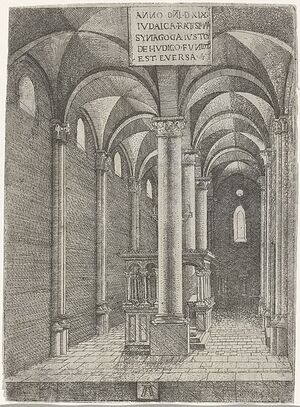
Sketch of Synagogue of Regensburg in 1519
In the late 1470s- a major blood libel broke out in Regensburg. The city of Regensburg imprisoned seventeen leading members of the Jewish community. After repeated negotiations the city of Regensburg agreed to release the imprisoned Jews in exchange for the payment of an immense sum; 23,000 florins. The Jewish community of Regensburg asked all the other communities of Germany to assist in paying the expense. The Rabbonim of Germany in turn asked the Maharik, Rav Yosef Colon (1420-1480), over whether they were obligated to pay. It is to these rabbonim that the Maharik directed his ruling.
Ruling of the Maharik
The Maharik noted that were the blood libel not to be stopped, it would lead to the persecution of other Jewish communities in Germany. The Maharik said that any community that would potentially be a target of the blood libel was obligated to contribute to stop the libel from spreading in Regensburg.
In the Maharik's exact worlds
It is according to my humble opinion that all those communities (the Jewish communities of Germany) which are fit to be considered and almost certainly, that God forbidden, also upon them should pass the poisoned chalice, if this matter is not repaired as much as possible. The law is that they (the other Jewish communities at risk of blood libel) too should bear the burden, for because the safety of the holy community of Regensburg is their safety, and the opposite, the opposite, God forbid.[3]
Proof of Maharik
The Maharik brought proof from the Gemara in Bava Metzia 108a- the gemara there how to assess the expenses for an urban gutter. A gutter must be regularly cleaned in order to allow outflow. The Gemara says that if the downriver community cleans the gutter- the city's residents must contribute to the downriver community's expenses. If the gutter is clogged, the downriver community is first at risk of potential flooding. If the gutter is overfilled, next at risk are the residents of the city. Rashi explains that since the city is saved from potential danger of flooding by the gutter cleaning, it is liable to contribute to the expenses of gutter cleaning.
Maharik's Response to Potential challenges
The Maharik extends this analogy to his case. If the dangerous situation in Regensburg is not resolved, the catastrophic wave of anti-Semitism will engulf all of Germany.
The Maharik notes a potential challenge to his comparison- he is comparing the physical phenomenon of flooding with the social phenomenon of anti-antisemitism. It is among the laws of physics that if too much rain occurs the gutter will flood. There is a certain and predictable danger of flooding. In contrast, the wave of persecution is not inanimate- but the product of human decisions and thereby more uncertain.
But here the danger is not so certain, that one can doubt and say maybe this false libel and slander won't spread in other places.[4]
In response, the Maharik responds with two arguments. The first is a chillingly prophetic analysis on the spread of antisemitism.
We see that, because of our many sins, all of their plots on us are to overpower and ambush us, and Hashem in his great mercy will save us from their hands- every situation like this (of antisemitism) is a certain danger.[5]
The Maharik argues that the current expression of antisemitism in Regensburg is not merely a one-of, but rather an expression of deeper antisemitism that lurks behind the seemingly calm exterior of German society.
The Maharik goes on to say, that even were antisemitism to be a rare threat- Chazal viewed any threat as deserving attention. As chief example, the Maharik notes that communities can nonetheless obligate all of their citizens to pay tax against any threat no matter its likelihood.
Orphans are exempt from paying all Jewish communal taxes, except for urban expenses which benefit the orphans, including the the security expenses of the city. The Gemara lists among the security expenses an enigmatic Turzina. The Aruch explains that Turizna means that the community "purchases horses for the knights so that they can ride outside of the city to see if invaders are coming."
The Maharik argues that if even orphans are required to contribute to a warning system for a potential threat, then that means that even avoiding a potential threat counts as a security expense.
The Maharik brings further proof from the obligation of a city's residents to build a wall. The wall is only built to defend against a potential danger- yet we force all the residents of the community to pay because of the possibility of a threat to the community. On these grounds, ultimately, the Maharik rests his case with the insistence that all of the potential communities in Germany at risk because of the Regensburg Blood Libel must contribute.
The Maharik concludes by placing a decree of cherem and a curse on anyone from the vulnerable communities of Germany who does not contribute to the Jews of Regensburg.
Premises of the Maharik's Argument
Given the wide scope of the Maharik's arguments- I have restated a bullet point order of his assumptions so as to provide an easy summary.
Here is a summary of the Maharik's assumption on Realia.
- The Blood libel in the community of Regensberg can be resolved by the Jews of Regensburg arranging a payout with the local government there
- Were the Jewish community of Regensburg not to arrange a financial settlement, Jewish communities all over Germany would be at risk
The Maharik's argument is as follows
- If there is a danger that presently is harming A, and if not resolved will harm A, and from there harm B
- Both A and B must jointly pay to prevent the danger- since both are at risk
- The Maharik proves this from Bava Metzia 108a and the gutter case
- This is so even if the risk is not certain because all risks of danger are considered certain risks
- The Maharik proves this argument Bava Batra 8b- since orphans are given a wide series of tax exemptions, but are nevertheless required to pay for scouts lest an invader, come- that indicates potential danger is a source of obligation.[6]
- The Maharik also proves this from Bava Batra 7b- we force all inhabitants of a city to contribute to build a wall out of concern for potential danger. We force even those who are not inhabitants of the city but own property in the city, because their property is subject to danger. This implies that merely being subject to shared danger is the source of the obligation to pay, not a preexisting relationship.[7]
- This fact is crucial, since the other cities of Germany do not have a formal relationship besides their shared country
Explanations of the Maharik's Ruling
After the Rama included the opinion of the Maharik in the Shulchan Aruch- many commentators discovered a seemingly contradiction within the Rama. The Rama describes a case of person who, while trying to save his himself or his property, also ends up saving other people. Do the other people owe the rescuer anything? The rescuer was saving his own items, not solely doing a magnanimous deed. The Rema writes that in such a case, the rescued person pays the rescuer if one of the following two conditions are fulfilled
- The rescuer had to spend additional money to save the other person, more than he would have spent had he saved only himself
- The rescuer performed the rescue with intent to save the other people
This ruling of the Rama flatly contradicts the Rama's citation of the Maharik. In the Maharik case neither condition was applicable
- The Communinity of Regignsburg spent no more on behalf of the other communities
- The Community of Reginsburg paid with intent to save itself
Explanation of the Shvut Yaakov
The Shvut Yaakov answer the question by challenging its premises.[8] The Maharik case is dealing with a community, while the rescuer case is dealing with private individuals. The Shvut Yaakov says that community have far wider powers to demand compensation than individuals.
The Shvut Yaakov premises this distinction on the principle of Kdeira Debei Shutfei. The Gemara explains that in a certain case, a community can cut down a privately owned tree and pay the tree owner later. How can the community appropriate the tree without even paying for it. The Gemara cites the rationale of Kdeira Debei Shutfei- a phrase that literally means a dish owned by many partners. The Rashbam explains that in a case where a dish has multiple cooks, each cook assumes that the other cook will take responsibility for the dish. Ultimately the dish will not be cooked, because each person will pass off responsibility. In order that community's behave proactively, the community is permitted to chop down and raise the money later. The Shvuut Yaakov states that in a case of communal danger- halacha incentives a speedy response lest no community take action. Therefore- the first community to respond is awarded compensation
Explanation of the Netivot Hamishpat
The Netivot Hamishpat links the ruling of the Maharik to a wider rule about partners.[9] The Netivot explains that anytime two people need the same thing; each party can force the other to contribute. If one party does the essential task- then the other person must compensate the doer. If the task is not essential, then the conditions of the Rama apply. The Netivot says the Rama's case is one where the rescued could have been saved without the rescuer. The Netivot explains that the Maharik's case is where the other communities could not be saved without the intervention of Regensburg. It is interest
Opponents of the Maharik's Ruling
The Maharik's wide conceptual leap was deeply controversial in the generations to come. Most of the attackers viewed the Maharik as not having strongly grounded his ruling in the Talmudic text. They attributed this perceived carelessness of the Maharik to the exigencies of the crisis in Regensburg. The Masah Melech wrote "love causes the straight line to be crooked, that is the order of the law."[10] The Masah Melech viewed the Maharik's ruling as resulting from the Maharik's empathy with the brutal suffering of the Jews of Rothenburg, at the expense of a proper reading of the law.
The Maharik Himself- Contradiction
Dispute with the Rashba
Challenge of the Masah Melech
Shagat Aryeh's Attack
Similar Opinions to the Maharik
- ↑ All of this from Shulchan Aruch CM 163:1
- ↑ Rama CM 163:6
- ↑ Shut Maharik Shoresh 4
- ↑ Continued quotation of the Maharik quoted prior
- ↑ continued quotation from Maharik
- ↑ The Masah Melech (2:4.4) is not impressed by the Maharik's proof. Orphans are obligated in taxes that relate to protection. Even if that protection is for an unlikely scenario, this does not mean that orphans only pay taxes for certain dangers. The Maharik spins this assumption out of nowhere
- ↑ The Masah Melech (2:4.4) rejects this argument. He argues that inhabitants in a city are obligated in the expenses for a wall out of their joint state partnership. This state of partnership does not exist in the Maharik's case, where the case, where the communities are not joined into a wider community. The Masah Melech rejects the attempt of the Maharik to pass off the property owner point as a proof that anyone affected by a danger must contribute- the property owner is himself a resident in some respects. Even though the property owner does not live in the city, his property gains value as the city prospers, and hence he is a partner in the city.
- ↑ Shut Shvut Yaakov 1:158
- ↑ Netivot Hamisphat Biurim 196:3
- ↑ Masah Melech Chelek 2, Shaar 4
The Maseh Melech is making a play on words in his attack
He uses the expression "ואהבה קלקלה את שורה" an expression which originates in Bereishit Medrish Rabbah Vayira Parsha 55:8, which Rabbi Shimon bar Yochai uses to explain why Avraham saddled the donkey himself during the akeida and why Yosef rode the chariot himself to greet his father. In both cases, great men performed things ordinarily done by servants out of a sense of love. The Maaseh Melech makes a pun on the word "shura" which means order, and follows it with "shuras hadin," which means the strict letter of the law.