Shiva and Kashering the Kitchen for Pesach: Difference between pages
No edit summary |
|||
| Line 1: | Line 1: | ||
[[Image:Hagalah.jpg|right]] | |||
When preparing the kitchen for Pesach Klal Yisrael are very careful to meticulously clean for Pesach and kosher the kitchen. In the process, the pots, pans, plates, silverware,<ref>Hagalah Kelim 13:330 writes silverware usually needs hagalah in a kli rishon.</ref> ovens, and other utensils that were used for chametz need to be koshered if they are to be used for Pesach. For someone who can afford it, it is an ideal option to buy separate Pesach pots that aren't used for chametz and this minimizes the need to kasher.<ref>Pitchei Teshuva 451:1-2 writes from some poskim that it is ideal to get new pots and not kasher for pesach since it is difficult to kasher pots correctly.</ref> When kashering, the rishonim debate whether according to the strict law, the laws of kosher for pesach mimic those of koshering a kitchen from non-kosher or are more lenient.<ref>The Rishonim argue whether the absorption of chametz is considered a permitted absorption and as such it is sufficient to kosher with hagalah, or it is like a forbidden absorption and needs libun if the utensil was used on the fire. Ramban Avoda Zara 76a, Rashba Avoda Zara 76a, Meiri Pesachim 30b all hold that chametz is considered a forbidden absorption. The Ran Pesachim 8b explains that this is the case since the title of chametz is relevant all year even though it is only forbidden on Pesach. Bet Yosef 451:4 explains that this is the opinion of the Rif and Rosh. However, the Rambam (according to Maggid Mishna 5:23), Hagahot Maimoniyot Chametz 5:23:1, Rashi and Raavad cited by Ran Pesachim 30b all hold that chametz is considered a permitted absorption. Shulchan Aruch 451 assumes that it is a forbidden absorption but in 452:1 he seems to contradict himself. See Biur Halacha there.</ref> | |||
== | ==Dishes One Isn't Kashering== | ||
#Dishes or pots that one isn't kashering for Pesach can be owned and do not need to be sold over Pesach. They should, however, be stored away so that someone doesn't make a mistake and use them. Ideally, one should lock them in a cabinet or room and hide the key.<ref>Shulchan Aruch O.C. 451:1</ref> | |||
# | #There is what to rely upon to store the chametz utensils on high shelves in the kitchen and we're not concerned that one would accidentally use them. The more proper practice is to store them in a locked area.<ref>Taz 451:1 quotes the Bach who is adamant that those who store chametz pots high up are incorrect because height isn't considered stored away. Taz only disagrees with the Bach with respect to storing Pesach utensils during the year high up is fine. However, the Magen Avraham 451:2 defends the practice that the Bach rejected. Mishna Brurah 451:7 rules that one doesn't need to protest those who are lenient but those who are strict will be blessed.</ref> | ||
# | |||
== | ==Which Materials Can be Kashered?== | ||
#It is possible kasher wooden, metal, or stone utensils. It is impossible to kasher earthenware utensils.<ref>Kitzur Shulchan Aruch 116:1-2</ref> | |||
# It is | #If a vessel was used even once for Chametz it needs to be cleansed to be used for [[Pesach]]. A bread knife which was once for cutting a Chametz food that was hot such as warm cake, warm breaded-chicken, or used to stir chulent, must be cleansed. A teapot needs be cleansed because it probably touched Chametz when it was warm. <ref>Yalkut Yosef (Isser VeHeter vol 3 pg 470) </ref> | ||
# | #There is a question if it is possible to kasher plastic utensils. <ref>Rav Shimon Eider in Halachos of [[Pesach]] (p. 137) rules that one may not kasher plastic utensils for [[Pesach]] based on Igrot Moshe 2:92 who doesn’t allow kashering synthetic rubber since it is a new material that wasn’t discussed by the Rishonim. Rav Moshe Feinstein (cited by A Guide to Practical Halacha v. 5 p. 90 n. 4) disallowed using corningware, correlle, or pyrex used for chametz to be used for Pesach. See however, Chazon Ovadia (p. 151), Minchat Yitzchak 3:67, Chelkat Yaakov YD 45, Tzitz Eliezer 4:6 who allow kashering plastic. [https://www.yutorah.org/lectures/lecture.cfm/950230/rabbi-eliyahu-ben-chaim/passover-with-covid-19/ Rav Ben Chaim] allows kashering plastic.</ref> | ||
# | #The Ashkenazic minhag is not to kasher glass.<ref>Kitzur Shulchan Aruch 116:13</ref> According to Sephardim, one never needs to kasher glass, as it does not absorb. Rather, one must wash it thoroughly. The same is true for Pyrex and Duralex.<ref>Yechave Daat 1:6</ref> | ||
# | |||
== | ==Hagalah== | ||
#If a vessel is used a majority of the time for [[cooking]] in liquid it is cleansed through boiling water. <ref>Chazon Ovadyah (pg 124) </ref> | |||
# | #Hagalah includes cleaning the pot well from all Chametz, then immersing it in (boiling) hot water in a pot that’s on the fire (or an electric heating source) or a pot that was just removed from the fire.<ref>Chazon Ovadyah (pg 136) </ref> | ||
#The minhag is to wash the utensils in cold water after performing Hagalah.<ref>Kitzur S”A 116:17</ref> | |||
#If one is koshering utensils before the beginning of the fifth hour on Erev Pesach one can do hagalah with the following leniencies: | |||
##even with pots that were used within 24 hours.<ref>Shulchan Aruch 452:1</ref> | |||
##to ensure that there's sixty times the utensil in the water.<ref>Shulchan Aruch 452:1</ref> | |||
##one can do hagalah on multiple utensils at the same time.<ref>Shulchan Aruch 452:1, Mishna Brurah 432:3</ref> | |||
##the pot used for hagalah doesn't need to be koshered itself.<ref>Shulchan Aruch 452:1</ref> | |||
#The minhag is to be strict even when koshering before the fifth hour to only kosher utensils that weren't used within 24 hours.<ref>Magen Avraham 452:6, Mishna Brurah 452:13</ref> | |||
#If one is do hagalah after the fourth hour needs to be careful only to kosher a utensil that wasn't used within 24 hours or to have sixty times the utensil in the water. Some add that if is doing hagalah after the sixth hour they need to be careful about both conditions.<ref>Mishna Brurah 452:13</ref> | |||
#Some say that it is critical to make sure to have the utensils to be not used within 24 hours before doing hagalah or to have sixty times the utensil in the water even when doing hagalah prior to the fifth hour.<ref>Mishna Brurah 452:13 quotes some achronim who are concerned for the opinions of isura baala.</ref> | |||
== | ==Libun== | ||
#If a utensil is used over the fire a majority of its uses such as the oven racks it is cleansed through making it red hot. <ref>Chazon Ovadyah (pg 124) </ref> | |||
#Grills and skewers need Libun since it probably touched meat that was mixed with Chametz and should be heated until it sparks. <ref>Chazon Ovadyah (pg 126) </ref> | |||
== | ==Stovetop== | ||
#For a gas stove put a pot on top of the grate so that the fire spreads out and leave it on for a half hour to an hour.<ref>[https://www.torahanytime.com/#/lectures?v=106099 Rav Shmuel Fuerst (min 14)]. Note that you don't need to wait 24 hours since the grates need [[#libun]] to be koshered. The Mishna Brurah 451:34 writes that really the reason that grates need to be koshered is a chumra of chametz since a pot doesn't absorb from another pot without liquids in between. After the fact if someone used grates without kashering them it isn't an issue.</ref> Some say that you should buy new grates for pesach or put them in the oven at 550 for an hour.<ref>[https://oukosher.org/passover/how-to-kasher-your-kitchen-for-passover/ OU] allows using 550 as libun kal for the grates</ref> Some require that the grates be put in an oven's self-clean cycle.<ref>[https://www.star-k.org/articles/articles/seasonal/338/preparing-kashering-the-pesach-kitchen/ Star-K] writes that the grates should be put in a self-clean cycle to have libun. The Star-K notes that a person should check with the manufacturer if the grates will break in the self-clean cycle.</ref> | |||
# | #The stovetop surface should be covered with tin foil for all of pesach.<ref>[https://oukosher.org/passover/how-to-kasher-your-kitchen-for-passover/ OU], [https://www.star-k.org/articles/articles/seasonal/338/preparing-kashering-the-pesach-kitchen/ Star-K]</ref> For safety, the oven vent should not be covered.<ref>[https://www.star-k.org/articles/articles/seasonal/338/preparing-kashering-the-pesach-kitchen/ Star-K]</ref> | ||
# | #For an electric stove you need to turn it so that it gets red hot (which might only take several minutes).<ref>[https://www.torahanytime.com/#/lectures?v=106099 Rav Shmuel Fuerst (min 14)], [https://oukosher.org/passover/how-to-kasher-your-kitchen-for-passover/ OU], [https://www.star-k.org/articles/articles/seasonal/338/preparing-kashering-the-pesach-kitchen/ Star-K]</ref> The stovetop surface should be cleaned and covered.<ref>[https://oukosher.org/passover/how-to-kasher-your-kitchen-for-passover/ OU]</ref> | ||
#Drip pans for the gas stove should be replaced for pesach, or placed in a self-clean oven, or covered with thick aluminum foil.<ref>https://www.torahanytime.com/#/lectures?v=106099 Rav Shmuel Fuerst (min 14-5)]</ref> | |||
==Oven== | |||
#An electric or gas oven should be cleaned from all specks of Chametz and left 24 hours unused. If it has a self-cleaning mode, it should be put on self-clean and that is sufficient.<ref>Rabbi Jachter (Gray Matter vol. 2, p. 221) quoting Rabbi Elazar Teitz, [http://www.crcweb.org/Passover/2016/Pesach_Guide_2016.pdf CRC Pesach Guide 2016 (p. 19)], Yesodei Yeshurun v. 6 p. 156-160, OU Pesach Guide 2016 p. 24, Halachos of Pesach by Rabbi Ribiat p. 354.</ref> However, if it doesn't have self-clean, many hold that the oven can be heated to the highest temperature it reaches for one hour or two and that is sufficient. <ref>Rav Ovadia Yosef (Chazon Ovadyah pg 73, Sh”t Yechave Daat 2:63), Rav Aharon Kotler (quoted by Rabbi Eider in Halachos of Pesach 1:180), and Rav Soloveitchik (quoted by Gray Matter vol. 2, p. 219) hold that conventional ovens which don't have a self-cleaning setting can be koshered by raising them to the highest temperature that they can reach for an hour or two. Chut Shani Pesach 10:2 writes that the minhag isn't to kosher such an oven but after the fact the koshering is effective. | |||
*Rav Ovadia Yosef explains that according to many rishonim chametz is considered something which is permitted that was absorbed in a utensil that only becomes forbidden over time and as such even items which normally would require libun can suffice with hagalah. Even though Shulchan Aruch O.C. 451:4 holds like the rishonim who hold that chametz is considered like a forbdiden taste all year since on Pesach it will be forbidden and as such libun is necessary on utensils used over the fire, nonetheless, for utensils which can't be koshered any other way and it is difficult not to use the oven all of Pesach, one can rely on the lenient opinion. See Rav Ovadia's responsa for his lengthy explanation. | |||
*Rabbi Soloveitchik offered another reason to be lenient. Since chametz only got absorbed through a certain temperature, those absorptions can be removed in the same way that they went in, which is certainly less than the maximum temperature that the oven can reach. This seems to be at odds with the Pri Megadim E"A 451:30 who holds that libun needs to be a certain temperature to burn out the forbidden tastes, but it is supported by the Arugot Bosem 119. Igrot Moshe YD 1:60 s.v. aval and Or Letzion 3:10:2 agree with Pri Megadim. | |||
*[http://www.crcweb.org/Passover/2016/Pesach_Guide_2016.pdf CRC Pesach Guide 2016 (p. 19)] writes that for non-self cleaning ovens one should heat it to the highest temperature it could reach for one hour after waiting 24 hours. Additionally, the racks and grates should be covered with aluminum foil perforated for air circulation and no food should touch the side bottom or top of the oven on Pesach.</ref> Some hold that ovens which don't have a self-clean setting can't be koshered for Pesach.<ref>Rav Jachter (Gray Matter vol. 2, p. 218) and OU Pesach Guide 2016 p. 26 quoting Rav Mohe Feinstein. | |||
*Rav Aharon Felder (Yesodei Yeshurun v. 6 p. 158) writes that even though the oven walls only absorb taste through steam since we're concerned that they absorb taste from something solid spilling on it, it needs libun. Ashkenazim can't follow the majority of uses (Rama 451:6). | |||
*However, the Or Letzion is concerned even though the absorption is through steam. One proof of the Or Letzion is Shulchan Aruch 451:15 which is a cover of chametz foods on the fire requires libun. One of the reasons of the Tur and Magen Avraham 451:30 because of the steam and the same is relevant to ovens. Minchat Shlomo 2:51 writes that even steam can be koshered with hagalah and the reason that the Shulchan Aruch 451:15 required libun for the cover of chametz is because it is a close cover.</ref> In practice, one should consult one's rabbi.<ref>Rabbi Ribiat in Halachos of Pesach p. 354 cites both opinions and advises being strict not to use an oven that doesn't have a self-clean option or to get an oven insert.</ref> | |||
#Racks of electric ovens should be cleansed with Libun and if one does it with Hagalah according to Sephardim one has to what to rely on. <ref>Chazon Ovadyah (pg 132-4) </ref> | |||
For a detailed discussion of the halachic issues of koshering an oven for Pesach see the [[Koshering an Oven for Pesach]] page. | |||
==Toaster Ovens== | |||
#Generally toaster ovens can't be kashered since they don't reach 850 degrees and usually not even 500 degrees.<ref>[https://www.yutorah.org/lectures/lecture.cfm/950230/rabbi-eliyahu-ben-chaim/passover-with-covid-19/ Rav Ben Chaim]</ref> | |||
==Countertops== | |||
#If one isn’t going to put any hot food on the counters on [[Pesach]], it is sufficient to clean the counters very well. If one is going to put hot food on the counters on [[Pesach]], one should clean and cover the counters. Regarding kashering the counters, see the footnote. <ref>The Tur and S”A 451:20 write that the minhag is to pour hot water on the tables and cabinets used for food during the year because sometimes hot liquid chametz spills onto them. The Magen Avraham 451:38 quotes the Maharil who records the minhag to cover the tables and cabinets after this kashering procedure because perhaps some actual chametz was stuck onto the table or cabinet. | |||
*Kaf HaChaim 451:233 notes that wooden tables which one always eats on with a tablecloth don’t need to be kashered and one should simply remove the actual chametz and wipe down the surface. Rav Mordechai Willig (“Shiur 64 – Pesachim” min 80-82) says that strictly speaking this is also true for countertops on which people don’t put chametz directly. [https://www.dropbox.com/s/tgm9gww30vkgw7s/_Rabbi_Willig_Shailos_03_25_2020_.mp3?dl=0 Rav Willig (min 36)] said that it is best to cover the counter tops. Rav Hershel Schachter [https://www.ou.org/holidays/ou_kosher_pre-pesach_webcast_5769/ (OU Pre-Pesach Webcast 5769, min 11-13)] adds that one could either kasher the counters or cover them, but if one isn’t going to put any hot food on the counters on [[Pesach]] one could simply clean the counters well. | |||
*Thus, Rav Moshe Feinstein (quoted by Halachos of [[Pesach]] p. 140) maintains that one should not kasher Formica countertops, which are made out of hardened plastic, rather these should be washed and covered.</ref> | |||
==Sink== | |||
#A should pour hot water (that is [[Yad Soledet Bo]]) on top of all of the surfaces of the sink including the faucet itself. Even so it is best not to place the dishes on the bottom of the sink but rather on top of a rack.<ref>[https://yeshiva-university.zoom.us/rec/play/usAsduuh-283HoLAtASDAPZ9W9S0eq2s0igX-_pez0jkW3EFZFr1M7QRa7Qf9B_vOGt5lyO0vcW9I1-0?startTime=1585760529000&_x_zm_rtaid=CQsocm3ZRaq6pGgFL5OMGQ.1585880286593.75ff95374a21dbfc2f0c45524d508e2a&_x_zm_rhtaid=674 Rav Willig (April 1 2020, min 4-5)] explained that since it is possible for noodles when being strained into the sink to fall onto the sink directly they could cause a greater transfer of taste then simply doing hagalah with water, therefore, a person shouldn't use the bottom of the sink even after doing hagalah with iruy.</ref> | |||
==Food Processor== | |||
#The blade of the food processor should be kashered with hagalah like any other knife. Also, the receptacle should be replaced with a new one.<ref>[https://www.star-k.org/articles/articles/seasonal/pesach/app/4625/pesach-kitchen-checklist/ Star-K]. [http://www.crcweb.org/kosher_articles/Kashering_in_the_Kitchen.php#electricmixers CRC] writes that a person should buy a new blade.</ref> | |||
#It is recommended not to kasher a food processor if the motor is exposed to food and is hard to clean, however, if it is sealed then this doesn't apply.<ref>[http://www.crcweb.org/kosher_articles/Kashering_in_the_Kitchen.php#electricmixers]</ref> | |||
==Tables== | |||
#One should kosher one's table by pouring on it boiling water or cover it.<ref>Shulchan Aruch OC 451:20 writes that one should kosher one's tables since often one spills soup on it. Isn't the majority of use of a table for cold? | |||
*Rav Yitzchak Yosef Marechet Hashulchan v. 2 p. 310 answers that really this is a chumra and that's why the language of Shulchan Aruch is that it is something people usually did but not that it is necessary. | |||
*Megilat Sefer Tarovet p. 271-2 writes that the majority use is defined by whatever the utensil is designated for and potentially it could be designated for multiple uses. Regarding tables since the spills happen because you are using the table to hold food that is also part of the use of the table. Binat Tzvi p. 78 and Rav Azriel Auerbach in Bnetivot Hahalacha 342:292 agree that spills are including in the majority use since they come because of the regular use. | |||
*Chut Shani Pesach p. 125-6 based on Gra answers that it is a utensil that is designated to be used for iruy. The fact that is used for cold doesn't relate to the use of spills since when it is used for cold or to hold a plate it doesn't absorb anything. Therefore, its use in terms of absorptions is only for spills and as such its majority of use requires it to have hagalah with iruy. However, he is troubled by Shulchan Aruch 451:25 who says that cups can just be cleaned since they are used for a majority of cold. He simply posits that if they were ever used for hot they couldn't be used without koshering. | |||
*Darkei Chachma 74:3 has another theory. Since spills aren't part of the use of the table they can't be judged as part of the majority or minority use. | |||
</ref> | |||
#One can use a tablecloth that is used all year for Chametz for Pesach as long as it is clean. If it has stains on it from food it is better not to use.<ref>[https://www.torahanytime.com/#/lectures?v=106099 Rabbi Shmuel Fuerst (min 7)]</ref> | |||
==Microwaves== | |||
#Microwave which heat up food like an oven are cleansed like an oven by having it cleaned from all Chametz, left unused for 24 hours, and then heated to it’s highest temperature for an hour.<ref>Yalkut Yosef (Kitzur S”A 451:10) </ref> | |||
#Microwaves which are used to heat up food by radiation then if the microwave walls are made out of metal, many hold that one can kasher the microwave by cleaning it thoroughly and boiling a cup of water in the microwave until it steams. If the walls are made out of plastic, many say that one can follow the above procedure and then cover the food put in the microwave on [[Pesach]]. <ref>The Mishna (Avoda Zara 75b) writes that utensils, which absorbed the taste of forbidden food through fire, can be purified through Libun. Tosfot (Chullin 8a s.v. SheLivna) explains that since when chametz is absorbed into the utensils before [[Pesach]] the chametz taste was permitted, utensils that usually required Libun, can be kashered with Hagalah. The Ran (Pesachim 8b s.v. Devarim) explains that the Rif considers chametz taste to be a forbidden taste since it has a status of chametz even before [[Pesach]]. Although S”A and Rama 451:4 rule stringently, the Mishna Brurah 451:32 notes that in some cases we rely on the lenient opinions. | |||
*Yalkut Yosef (Moadim p. 600-8, [[Pesach]] p. 38) writes that if a microwave is used mostly to reheat and the walls of the microwave don’t reach a temperature of Yad Soledet Bo, one could kasher it by heating up a cup of water with some soap in the microwave for a few minutes. | |||
*He explains that since most of the time the microwave doesn’t reach Yad Soledet Bo it may not require kashering. Even if it does reach Yad Soledet Bo, heating up water in the microwave until it steams up the microwave is considered Hagalah. He reasons that steam suffices since the taste was only absorbed through steam. He adds several other reasons to be lenient with absorptions through steam such as perhaps the walls don’t absorb through steam, perhaps steam applies only to liquid foods, and perhaps steam absorptions are only d’rabanan altogether. He adds that it is still preferable to cover foods on [[Pesach]] in the microwave. Lastly, if the microwave is mostly used to cook or is a commercial microwave that is used very frequently and the walls usually reach Yad Soledet Bo, it shouldn’t be used on [[Pesach]]. | |||
*Rav Moshe Feinstein (quoted by Halachos of [[Pesach]] p. 182) agreed that a microwave can be kashered with steam just as it absorbed through steam. Rav Mordechai Willig (“Shiur 64 – Pesachim” min 66-8) agrees if the walls are metal the microwave can be kashered with steam, but if the walls are plastic it shouldn’t be kashered. Rav Hershel Schachter (“Kashering the Kitchen for [[Pesach]]” min 10-13) said that if the walls are plastic one could kasher it with steam as long as one covers one’s food on [[Pesach]] because it is improbable that forbidden taste is transferred in the air. Similarly, Rav Shimon Eider (Halachos of [[Pesach]] p. 182) writes if the walls are plastic one may cover the interior completely and cook in it when the food is covered.</ref> | |||
==Dishwasher== | |||
#If the walls of the dishwasher are made out of plastic or porcelain, many hold that one cannot kasher the dishwasher. <ref>Rav Hershel Schachter (“Kashering the Kitchen for [[Pesach]]” min 13-15) said that dishwashers which have a plastic or porcelain walls can not be kashered for [[Pesach]], however, the stainless steel ones can kashered but one must be sure to remove all the particles of chametz stuck in the drain. Halachos of [[Pesach]] (p. 175) agrees. See, however, Yalkut Yosef (451:11) who writes that dishwashers can be kashered by cleaning it well and running an empty cycle with soap. </ref> | |||
#According to Sephardim, a dishwasher, which is used with soap, can be used on [[Pesach]] after cleaning it well. It is preferable to run a cycle without dishes with soap. <ref>Yalkut Yosef (Kitzur S”A 451:11), Yalkut Yosef (Pesach v. 38) </ref> | |||
==Pots and Pans== | |||
<gallery mode="packed-hover"> | |||
Sous vide.jpg| Sous Vide Cooker | |||
Pot with Rolled Lip.jpg| Pot with Rolled Lip | |||
Rolled Lip.jpg| Rolled Lip up Close | |||
</gallery> | |||
#Frying pans which one uses with a little oil should be koshered with Libun<ref>Shulchan Aruch Y.D. 121:4 writes that a frying pan can be koshered with hagalah for Pesach. He repeats this in 451:11. Also, Shach YD 121:8 is lenient to allow hagalah for a frying pan for Pesach and cites the Rama Mpano 96 to support this. Although in YD the Rama doesn't comment, in O.C. 451:11 he quote some rishonim who require libun. He concludes that there's a minhag to do libun but the strict halacha is that hagalah is enough. Biur Halacha 451:11 s.v. muteret defends the position of the majority of rishonim that hagalah is sufficient and concludes that after the fact certainly hagalah works. | |||
*The Rosh Pesachim 3:7 quotes a dispute between the Raavan and his grandson the Ravyah whether a frying pan needs hagalah or libun. The Ravyah held hagalah since it is used with oil and quotes the Tosefta Avoda Zara 9:2 to this effect. The Rosh, Mordechai Pesachim 577, Hagahot Maimoniyot 5:23:1, and Tur 451:11 accept the Ravyah. [http://www.hebrewbooks.org/pdfpager.aspx?req=8922&st=&pgnum=261 Rashba Torat Habayit 35a] held like the Raavan that libun is necessary.</ref> but according to Sephardim one has what to rely on to kosher it with Hagalah. <ref>Yechave Daat 1:7, Chazon Ovadyah (pg 134). [https://www.torahanytime.com/#/lectures?a=106484 Rav Yitzchak Yosef (Vayikra 5780 min 6)] said that Sephardim hold that a frying pan only needs hagalah since majority of its use is with liquids. (Another factor that is relevant is that chametz according to some rishonim is hetera baala.)</ref> | |||
#However, frying pans used without any oil need libun.<ref>Bet Yosef 451:11</ref> | |||
#Pans used to bake cakes with a little oil should not be used on [[Pesach]] because doing Libun on it will break it but still according to Sephardim one has what to rely on to do Hagalah. <ref>Yechave Daat 1:7, Yalkut Yosef (Kitzur S”A 451:13) </ref> | |||
#A Sous-vide cooker can be koshered with waiting 24 hours and Hagalah.<ref>[https://www.dropbox.com/s/tgm9gww30vkgw7s/_Rabbi_Willig_Shailos_03_25_2020_.mp3?dl=0 Rav Willig (min 35)]</ref> | |||
#A pot with a rolled lip or rim should either not be kashered because there is grease or food stuck within that rim that is hard or nearly impossible to completely remove<ref>[https://oukosher.org/content/uploads/sites/2/2020/03/Whole-guide-2020-low2.pdf OU (Pesach Guide 2020 p. 18)]</ref> or one can kasher it with hagalah after having made that grease or food inedible by pouring bleach on that area.<ref>Piskei Teshuvot 451:15 citing Sefer Hagalat Kelim 6:4</ref> | |||
#Pot covers should be kashered with hagalah and this opinion is primary.<ref>Shulchan Aruch O.C. 451:14</ref> Some poskim require libun for a pot cover where the pot is sometimes used to cook dry foods like rice.<ref>Chut Shani Pesach second edition p. 130</ref> Also, some allow kashering it with steam such as by simply placing it on top of a pot of boiling water.<ref>Hechsher Kelim p. 178 by Rav Avram Edrey cites Pri Chadash 121:15, Bet Lechem Yehuda 121, Levushei Mordechai OC 72 who allow using zeyia to kasher the pot covers. However, he also cites the Sdei Chemed Hey n. 24 and Shoel Umeishiv 3:3:125, 5:4 as arguing that zeyia doesn't work. He concludes that the main opinion is that one shouldn't use zeyia to kasher.</ref> | |||
==Other== | |||
#A knife should be kashered with hagalah.<ref>Pesachim 30b quotes Rav Ashi's practice to do libun on the blade of the knife and hagalah on the handle and concludes that it needs hagalah for the whole thing. Tosfot wonders why for chametz it seems that hagalah is sufficient, while for non-kosher the Tosefta, Yerushalmi, and Chullin 8a imply libun is necessary. First he answers that a knife which is used to cut something on the fire should be kashered with libun, but if it is used with liquid heat hagalah is sufficient. Secondly he answers that for chametz hagalah is sufficient since chametz is considered a permitted absorption (trans. ''hetera baala''; Hebrew התירא בלעא). | |||
*Ramban Avoda Zara 76a disagrees with Tosfot and holds that knives only ever need halagah. The Tosefta and Yerushalmi could have another opinion but the bavli only requires hagalah for all prohibitions. The Gemara Chullin 8a just means that it is possible to do libun but not that it is necessary. The Ramban fundamentally disagrees with the Tosfot and considered chametz a prohibited absorption. Furthermore, Ramban is not concerned with the possibility that the knife is sometimes used for dry heat since we should judge it according to its majority usage. Tosfot Rash Pesachim 30b quotes an opinion who indeed requires libun in addition to halagah for knives for pesach and rejects that view. | |||
*Shulchan Aruch O.C. 451:3 rules that knives need hagalah for Pesach and makes no distinction whether it was used for liquid heat or dry heat. Taz 451:7 agrees. However, Magen Avraham 451:6 is concerned for the minority use with dry heat and would require libun in accordance with Rama 451:6. Mishna Brurah 451:19 is lenient to use haglaah for knives. He is willing to be lenient based on two factors; some rishonim hold that chametz is hetera baala (Tosfot) and some rishonim hold that we follow majority of the uses (Ramban) and even though we're strict regarding each factor alone, together we're lenient.</ref> | |||
#One should purchase new baby bottles for [[pesach]].<ref>http://www.star-k.org/kashrus/kk-passover-kashering.htm </ref> | |||
#A person should kasher a kiddush cup for Pesach.<ref>[https://oukosher.org/halacha-yomis/how-do-i-kasher-a-silver-kiddush-cup-for-pesach/ OU]</ref> | |||
#According to Ashkenazim, some say that dentures should just be cleaned well, while others require hagalah. A compromise view is to avoid eating hot chametz with them within 24 hours before pesach and clean them well without hagalah.<ref>*Dvar Charif ch. 7 fnt. 101 notes that some of these reasons don't help for if a person eats a dvar charif on pesach and the taste of the chametz comes out of his teeth. | |||
*Reasons that dentures don't need to be kashered for pesach: our dvar charif's today aren't the ones of the gemara (Moadim Uzmanim cited by Dvar Charif p. 120), the dentures are smooth like glass and don't have beliyot (Minchat Shlomo 2:50), the taste of the food is so pagum because of one's breath and saliva that it can't even be reinvigorated by a sharp food to taste good again (Minchat Shlomo 2:50), the teeth aren't as sharp as knives (Orchot Rabbenu v. 2 p. 27-9). The Steipler said that because of the issue he advised not eating hot chametz within 24 hours of the time when chametz will become forbidden. Some of these reasons apply to filings and braces. [https://www.dafhalacha.com/wp-content/uploads/2019/12/DHYB-Monthly-Bulletin-Kislev-5780-English-11-29-19-EMAIL.pdf Dirshu (Kislev 5780)] summarizes some of the poskim on this topic. Rav Shmuel Kamenetsky (Kovetz Halachot Piskei Rav Shmuel Kamenetsky Pesach p. 127) is lenient on dentures, fillings, and braces no to require hagalah as long as one didn't eat hot chametz or dvar charif of chametz within 24 hours of the time of chametz becoming prohibited.</ref> According to Sephardim, dentures need only be cleaned well.<ref>Yechave Daat 1:8</ref> | |||
==Categories of Utensils== | |||
#A utensil only used as a kli sheni, according to some has chametz absorptions and needs to be kashered with a kli sheni at least, while according to others doesn't have absorptions. Sephardim are strict. Ashkenazim hold that after the fact in a case of large financial loss and whether enjoying Yom Tov is at stake one can be lenient.<ref>Mishna Brurah 451:11</ref> | |||
==Nullification== | |||
==='''Mashahu'''=== | |||
#Chametz is not nullified in any proportion (trans. ''mashahu''; Heb. משהו), even one crumb in a gigantic mixture is forbidden.<ref>Shulchan Aruch O.C. 447:1. Gemara: In Pesachim 29b, Rav and Shmuel hold that on Pesach chametz is forbidden in any amount because of the opinion of Rabbi Yehuda that items of like kind (''min bmino'') are not nullified and everything is a gezerah because of that case. Rabbi Yochanan disputes that because the Chachamim hold that all prohibitions of like or unlike kind are nullified once the taste is nullified. Rava has some conclusion but there are variant texts of what he said and meant. Rif, Rosh, and Rambam understand Rava that it is not nullified. | |||
*Is chametz on pesach nullified? Rabbenu Tam understands the gemara to mean that it is nullified in 60 like other prohibitions. This is also the opinion of the Baal Hameor, Shiltot, and Riaz (Pesakim Pesachim 2:2:6). However, Rabbenu Tam was afraid to rule that way because the minhag was strict. Additionally, most rishonim hold that it is not nullified in any amount. These rishonim include the Rambam, Ramban, Rabbenu Dovid.</ref> Some say that it is not nullified because chametz is a very serious prohibition and people are used to chametz.<ref>Tosfot Pesachim 30a s.v. amar, Ramban (Milchamot Hashem Pesachim 7b s.v. vod), and Rabbenu Dovid Pesachim 30a s.v. amar explain one reason to forbid chametz if we don't hold like Rabbi Yehuda, is that chazal forbade chametz since people are used to eating chametz and it is very grave prohibition.</ref> Others say that the reason chametz is not nullified is because it is going to be permitted after Pesach, making it [[dvar sheyesh lo matirin]].<ref>The Rambam Machalot Asurot 15:9 and Ramban Pesachim 7b offer another reason; chametz is a dvar sheyesh lo matirin and that's why it is not nullified. Rabbenu Dovid Pesachim 30a s.v. viy lav explains the approach of the Ramban but humbly notes that if he wasn't fearful of the Ramban he would disagree and claim that chametz isn't dvar sheyesh lo matirin since the Torah wants a person to dispose of chametz and not hold onto it until after Pesach.</ref> One practical difference between these opinions is whether chametz is nullified on erev pesach, according to the first opinion it is, and according to the second opinion it isn't.<ref>Maggid Mishna (Chametz 1:5) says that according to the Rambam's reason it shouldn't be nullified on erev pesach. Ran Pesachim 7b s.v. amar and Ritva Pesachim 30a s.v. amar agree. On the other hand, Bet Yosef 447:2 quotes the Tosfot a"z 66b s.v. rava, Rosh Pesachim 2:5, Mordechai 554, Hagahot Maimon 1:8, Smak 226, Rabbenu Yerucham, and Tur 447:2 as holding that it is nullified in sixty on erev pesach.</ref> | |||
We follow like the first opinion and chametz is not a dvar sheyesh lo matirin.<ref>Shulchan Aruch 447:2 permit chametz on erev pesach like majority of the rishonim and not the Rambam who says that chametz on erev pesach is not nullified because dvar sheyesh lo matirin. This is also the opinion of the Rama Y.D. 102:4, Gra YD 102:20, Magen Avraham 447:40, Pri Chadash 447:1, and Mishna Brurah (Biur Halacha 447:2 s.v. chametz). Note, however, the Shach (Nekudat Hakesef on Taz 92:16 and Shach 102:13) who thinks that we are initially concerned for the Rambam and argues that this is also the intention of Shulchan Aruch. | |||
*Why is chametz not considered a dvar sheyesh lo matirin? | |||
Mordechai explains that dvar sheyesh lo matirin only applies to something which is forbidden once and will become permitted, but chametz becomes forbidden every year. Rama Y.D. 102:4 rules like this opinion. | |||
Rabbenu Dovid Pesachim 30a s.v. viy lav suggests that chametz isn't dvar sheyesh lo matirin since there is a mitzvah to destroy and rid oneself of one's chametz on Pesach. The Ramban responds to that since chametz in a mixture can be maintained over pesach. Rabbenu Dovid answers that when judging if something is dvar sheyesh lo matirin we view the category of that prohibition as a whole. Minchat Yakov 74:19 agrees with the Rabbenu Dovid's approach. | |||
The Ran (Pesachim 7b s.v. vani) and Meiri explains that chametz is not dvar sheyesh lo matirin since it becomes forbidden after pesach and so the chametz never has a moment to become practically permitted. The Ramban responds that although the chametz isn't practically permitted the prohibition of chametz that was owned on Pesach is an external penalty and not considered the same prohibition that the chametz was beforehand. Also, the penalty does not apply when the chametz was in a mixture.</ref> | |||
===''Chozer Vnair''=== | |||
#Something nullified before Pesach according to Sephardim remains permitted on Pesach. According to Ashkenazim if it was liquid ingredients it remains nullified but if it was a mixture of dry ingredients the nullification is undone when Pesach begins.<ref>Sh"t Ran 59 and Raavad in Tamim Deyim 36 write that chametz is nullified before Pesach and remained nullified. Their proof that something permitted can be nullified and stay nullified is the Mishna Kelayim 9:1. Rabbi Akiva Eiger 1:38 and Pri Chadash 447 asks that it isn't a proof is kilayim is always a prohibition as opposed to chametz. Chida 447 quotes someone who answers that on erev pesach it becomes nullified. However, Yalkut Yosef Moadim sh"t siman 2 and Yabia Omer O.C. 2:23 write that perhaps the opinion of the Rambam is that there's chozer vneer with chametz on Pesach since he holds chametz on erev pesach isn't nullified.</ref> | |||
#If one piece of solid Chametz was mixed into two mixed of solid non-Chametz, such as if one Chametz cookie was mixed with two kosher lpesach cookies, one may not eat or benefit from any of the pieces.<ref>The Shulchan Aruch O.C. 447:9 quotes a dispute whether we say that for solid items there is nullification for chametz. The primary opinion is strict.</ref> | |||
==='''Mashahu of a Mashahu'''=== | |||
#If a piece of food absorbed a taste of chametz even if that piece has sixty times that amount of chametz it absorbed it is forbidden to eat. If that piece was mixed with two other pieces of non-Chametz food some poskim hold that all of the pieces are permitted since the piece that absorbed chametz is nullified. However, other poskim are strict that there's never nullification even though there is a minuscule absorption of chametz in one of the pieces.<ref>The Levush YD 92 writes that if a piece of food absorbed a taste of chametz and was mixed with non-chametz foods it is nullified one in two. However, the Taz YD 92:16 argues that since there's no nullification of solid items with chametz (Shulchan Aruch O.C. 447:9) the same is true with pieces that absorb the taste of chametz. Nekudat Hakesef answers that Shulchan Aruch was only strict not to have nullification if the piece of chametz was real chametz but not if it just absorbed a taste of chametz that would have been nullified if not for the fact that it is chametz. Mishna Brurah 447:93 cites this dispute and seems to conclude that we're strict.</ref> If that piece absorbed a taste of chametz more than one in sixty then it is forbidden and forbids a mixture of two kosher pieces.<ref>Mishna Brurah 451:111</ref> | |||
#If a liquid mixture absorbed chametz and it was nullified one in sixty it is still forbidden since chametz makes something forbidden in any amount. Even if a bit of that mixture then mixes into another liquid mixture that second mixture is completely forbidden.<ref>Taz YD 92:16 explains that even though we generally don't have two mixtures made forbidden in any amount (תרי משהוין לא אמרינן) for liquid mixtures even the second one is forbidden since part of the first mixture is mixed into the second one. Nekudat Hakesef agrees. Mishna Brurah 467:38 codifies this.</ref> | |||
#If a food absorbed a taste of chametz on Pesach and there was sixty times the volume of the chametz in the permitted food, the whole piece is forbidden. If that piece was cooked with other pieces, according to some poskim, if there's sixty times that original piece it wouldn't render them forbidden. According to most other poskim all of them are forbidden.<ref>Taz 92:16 is lenient since the first piece was only forbidden in a minuscule amount it wouldn't render the cooked mixture forbidden (תרי משהוין לא אמרינן). Dirshu quotes two reasons for the Taz. Either the minuscule amount in the first piece physically can't come out (Rabbi Akiva Eiger 92:3, Pri Megadim YD 92:16) or there's halachically not enough strength in a minuscule amount to forbid the second mixture (Yad Yehuda 92:17, Chazon Ish 34:1). Shach in Nekukdat Hakesef YD 92 argues. Birkei Yosef 447:1 and Mekor Chaim 447:17 are strict.</ref> | |||
===Public Water with Crumb of Chametz=== | |||
#Some people buy water before Pesach so that any tiny crumb that is in the water sources are nullified before Pesach. However, the halacha is that it isn't necessary.<ref>[https://www.torahanytime.com/#/lectures?v=105777 Rav Yitzchak Yosef (Motzei Shabbat Vayahekel Pekudei 5780 min 33-37)] explained that the crumbs are nullified and in a state that it is impossible to come to give any taste. Therefore they are nullified even on Pesach.</ref> | |||
===Using Chametz Pots for Pesach Foods before Pesach=== | |||
#According to Sephardim, if one cooked in a Chametz pot that was clean from any actual chametz, the food one may in there can be consumed on Pesach.<ref>Yabia Omer 10:35:18 and 10:35:21 writes that we rely on nat bar nat for chametz ben yomo utensils into pesach foods only after the fact. Yalkut Yosef (Pesach 5771 447:29) agrees. Yachava Daat 1:11 also permits and it isn't clear if he would allow even initially. [https://www.torahanytime.com/#/lectures?a=106484 Rav Yitzchak Yosef (Vayikra 5778, min 26-7)] explained that it is only nat bar nat of Chametz to use the utensils for Pesach foods and from Shulchan Aruch O.C. 452:1 holds that nat bar nat is permitted for chametz before Pesach. Also, he explained that nat bar nat is permitted even initially. According to Chazon Ish 119:14 it isn't a contradiction to the question of hetera baala with respect to how to kasher kelim (451:1).</ref> | |||
==Noten Taam Lifgam== | |||
===Chametz on Pesach=== | |||
#If someone cooks kosher for Pesach food in a Chametz pot that wasn't used within 24 hours, according to Sephardim is permitted, while according to Ashkenazim is forbidden.<ref>Shulchan Aruch OC 447:10 holds noten taam lifgam on pesach is permitted, while the Rama argues. Ravyah 2:464 s.v. upeliya holds that noten taam lifgam is forbidden for chametz. [https://itorah.com/daily-halacha/lecture/pesah-if-one-mistakenly-cooked-food-on-pesah-in-a-hametz-pot/3799 Rabbi Mansour] is lenient for Sephardim.</ref> | |||
===Chametz on Erev Pesach=== | |||
#Chametz on the Erev Pesach if it is a solid mixture it is nullified one in two and if it is a liquid mixture it is nullified one in sixty.<ref>Shulchan Aruch 447:2, Mishna Brurah 447:93. However, Shach YD 92 in Nekudat Hakesef argues that chametz on Erev Pesach isn't nullified at all since it is a dvar sheyesh lo matirin like the Rambam.</ref> | |||
===Chametz after Pesach=== | |||
#Chametz that a Jew owned on Pesach is forbidden. If it was mixed with kosher food if it is a solid mixture it is nullified one in two and if it is a liquid mixture it is nullified one in sixty.<ref>Shulchan Aruch OC 447:11</ref> In a case of great financial loss even a liquid mixture is nullified in a majority.<ref>Mishna Brurah 447:105 based on the Magen Avraham. Interestingly see the Shach in Nekudat Hakesef YD 92 who assumes that chametz after Pesach isn't nullified at all.</ref> | |||
==Links== | |||
*[http://www.yutorah.org/lectures/lecture.cfm/733537/rabbi-hershel-schachter/kashering-the-kitchen-for-pesach/ Kashering the kitchen for pesach] by Rabbi Hershel Schachter | |||
*[http://www.yutorah.org/lectures/lecture.cfm/718083/rabbi-zvi-sobolofsky/kashering-keilim-for-pesach/ Kashering keilim for pesach] by Rabbi Zvi Sobolofsky | |||
*Article on [http://www.yutorah.org/lectures/lecture.cfm/723213/rabbi-josh-flug/kashering-utensils-for-pesach/ Kashering utensils for pesach] by Rabbi Josh Flug | |||
==Sources== | ==Sources== | ||
<references/> | <references /> | ||
[[Category: | [[Category:Pesach]] | ||
Revision as of 17:33, 14 February 2023

When preparing the kitchen for Pesach Klal Yisrael are very careful to meticulously clean for Pesach and kosher the kitchen. In the process, the pots, pans, plates, silverware,[1] ovens, and other utensils that were used for chametz need to be koshered if they are to be used for Pesach. For someone who can afford it, it is an ideal option to buy separate Pesach pots that aren't used for chametz and this minimizes the need to kasher.[2] When kashering, the rishonim debate whether according to the strict law, the laws of kosher for pesach mimic those of koshering a kitchen from non-kosher or are more lenient.[3]
Dishes One Isn't Kashering
- Dishes or pots that one isn't kashering for Pesach can be owned and do not need to be sold over Pesach. They should, however, be stored away so that someone doesn't make a mistake and use them. Ideally, one should lock them in a cabinet or room and hide the key.[4]
- There is what to rely upon to store the chametz utensils on high shelves in the kitchen and we're not concerned that one would accidentally use them. The more proper practice is to store them in a locked area.[5]
Which Materials Can be Kashered?
- It is possible kasher wooden, metal, or stone utensils. It is impossible to kasher earthenware utensils.[6]
- If a vessel was used even once for Chametz it needs to be cleansed to be used for Pesach. A bread knife which was once for cutting a Chametz food that was hot such as warm cake, warm breaded-chicken, or used to stir chulent, must be cleansed. A teapot needs be cleansed because it probably touched Chametz when it was warm. [7]
- There is a question if it is possible to kasher plastic utensils. [8]
- The Ashkenazic minhag is not to kasher glass.[9] According to Sephardim, one never needs to kasher glass, as it does not absorb. Rather, one must wash it thoroughly. The same is true for Pyrex and Duralex.[10]
Hagalah
- If a vessel is used a majority of the time for cooking in liquid it is cleansed through boiling water. [11]
- Hagalah includes cleaning the pot well from all Chametz, then immersing it in (boiling) hot water in a pot that’s on the fire (or an electric heating source) or a pot that was just removed from the fire.[12]
- The minhag is to wash the utensils in cold water after performing Hagalah.[13]
- If one is koshering utensils before the beginning of the fifth hour on Erev Pesach one can do hagalah with the following leniencies:
- The minhag is to be strict even when koshering before the fifth hour to only kosher utensils that weren't used within 24 hours.[18]
- If one is do hagalah after the fourth hour needs to be careful only to kosher a utensil that wasn't used within 24 hours or to have sixty times the utensil in the water. Some add that if is doing hagalah after the sixth hour they need to be careful about both conditions.[19]
- Some say that it is critical to make sure to have the utensils to be not used within 24 hours before doing hagalah or to have sixty times the utensil in the water even when doing hagalah prior to the fifth hour.[20]
Libun
- If a utensil is used over the fire a majority of its uses such as the oven racks it is cleansed through making it red hot. [21]
- Grills and skewers need Libun since it probably touched meat that was mixed with Chametz and should be heated until it sparks. [22]
Stovetop
- For a gas stove put a pot on top of the grate so that the fire spreads out and leave it on for a half hour to an hour.[23] Some say that you should buy new grates for pesach or put them in the oven at 550 for an hour.[24] Some require that the grates be put in an oven's self-clean cycle.[25]
- The stovetop surface should be covered with tin foil for all of pesach.[26] For safety, the oven vent should not be covered.[27]
- For an electric stove you need to turn it so that it gets red hot (which might only take several minutes).[28] The stovetop surface should be cleaned and covered.[29]
- Drip pans for the gas stove should be replaced for pesach, or placed in a self-clean oven, or covered with thick aluminum foil.[30]
Oven
- An electric or gas oven should be cleaned from all specks of Chametz and left 24 hours unused. If it has a self-cleaning mode, it should be put on self-clean and that is sufficient.[31] However, if it doesn't have self-clean, many hold that the oven can be heated to the highest temperature it reaches for one hour or two and that is sufficient. [32] Some hold that ovens which don't have a self-clean setting can't be koshered for Pesach.[33] In practice, one should consult one's rabbi.[34]
- Racks of electric ovens should be cleansed with Libun and if one does it with Hagalah according to Sephardim one has to what to rely on. [35]
For a detailed discussion of the halachic issues of koshering an oven for Pesach see the Koshering an Oven for Pesach page.
Toaster Ovens
- Generally toaster ovens can't be kashered since they don't reach 850 degrees and usually not even 500 degrees.[36]
Countertops
- If one isn’t going to put any hot food on the counters on Pesach, it is sufficient to clean the counters very well. If one is going to put hot food on the counters on Pesach, one should clean and cover the counters. Regarding kashering the counters, see the footnote. [37]
Sink
- A should pour hot water (that is Yad Soledet Bo) on top of all of the surfaces of the sink including the faucet itself. Even so it is best not to place the dishes on the bottom of the sink but rather on top of a rack.[38]
Food Processor
- The blade of the food processor should be kashered with hagalah like any other knife. Also, the receptacle should be replaced with a new one.[39]
- It is recommended not to kasher a food processor if the motor is exposed to food and is hard to clean, however, if it is sealed then this doesn't apply.[40]
Tables
- One should kosher one's table by pouring on it boiling water or cover it.[41]
- One can use a tablecloth that is used all year for Chametz for Pesach as long as it is clean. If it has stains on it from food it is better not to use.[42]
Microwaves
- Microwave which heat up food like an oven are cleansed like an oven by having it cleaned from all Chametz, left unused for 24 hours, and then heated to it’s highest temperature for an hour.[43]
- Microwaves which are used to heat up food by radiation then if the microwave walls are made out of metal, many hold that one can kasher the microwave by cleaning it thoroughly and boiling a cup of water in the microwave until it steams. If the walls are made out of plastic, many say that one can follow the above procedure and then cover the food put in the microwave on Pesach. [44]
Dishwasher
- If the walls of the dishwasher are made out of plastic or porcelain, many hold that one cannot kasher the dishwasher. [45]
- According to Sephardim, a dishwasher, which is used with soap, can be used on Pesach after cleaning it well. It is preferable to run a cycle without dishes with soap. [46]
Pots and Pans
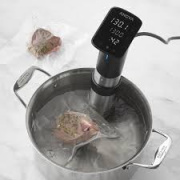
Sous Vide Cooker
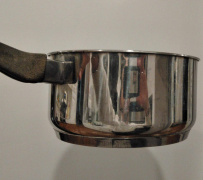
Pot with Rolled Lip
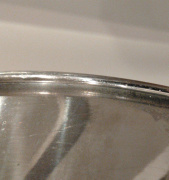
Rolled Lip up Close


- Frying pans which one uses with a little oil should be koshered with Libun[47] but according to Sephardim one has what to rely on to kosher it with Hagalah. [48]
- However, frying pans used without any oil need libun.[49]
- Pans used to bake cakes with a little oil should not be used on Pesach because doing Libun on it will break it but still according to Sephardim one has what to rely on to do Hagalah. [50]
- A Sous-vide cooker can be koshered with waiting 24 hours and Hagalah.[51]
- A pot with a rolled lip or rim should either not be kashered because there is grease or food stuck within that rim that is hard or nearly impossible to completely remove[52] or one can kasher it with hagalah after having made that grease or food inedible by pouring bleach on that area.[53]
- Pot covers should be kashered with hagalah and this opinion is primary.[54] Some poskim require libun for a pot cover where the pot is sometimes used to cook dry foods like rice.[55] Also, some allow kashering it with steam such as by simply placing it on top of a pot of boiling water.[56]
Other
- A knife should be kashered with hagalah.[57]
- One should purchase new baby bottles for pesach.[58]
- A person should kasher a kiddush cup for Pesach.[59]
- According to Ashkenazim, some say that dentures should just be cleaned well, while others require hagalah. A compromise view is to avoid eating hot chametz with them within 24 hours before pesach and clean them well without hagalah.[60] According to Sephardim, dentures need only be cleaned well.[61]
Categories of Utensils
- A utensil only used as a kli sheni, according to some has chametz absorptions and needs to be kashered with a kli sheni at least, while according to others doesn't have absorptions. Sephardim are strict. Ashkenazim hold that after the fact in a case of large financial loss and whether enjoying Yom Tov is at stake one can be lenient.[62]
Nullification
Mashahu
- Chametz is not nullified in any proportion (trans. mashahu; Heb. משהו), even one crumb in a gigantic mixture is forbidden.[63] Some say that it is not nullified because chametz is a very serious prohibition and people are used to chametz.[64] Others say that the reason chametz is not nullified is because it is going to be permitted after Pesach, making it dvar sheyesh lo matirin.[65] One practical difference between these opinions is whether chametz is nullified on erev pesach, according to the first opinion it is, and according to the second opinion it isn't.[66]
We follow like the first opinion and chametz is not a dvar sheyesh lo matirin.[67]
Chozer Vnair
- Something nullified before Pesach according to Sephardim remains permitted on Pesach. According to Ashkenazim if it was liquid ingredients it remains nullified but if it was a mixture of dry ingredients the nullification is undone when Pesach begins.[68]
- If one piece of solid Chametz was mixed into two mixed of solid non-Chametz, such as if one Chametz cookie was mixed with two kosher lpesach cookies, one may not eat or benefit from any of the pieces.[69]
Mashahu of a Mashahu
- If a piece of food absorbed a taste of chametz even if that piece has sixty times that amount of chametz it absorbed it is forbidden to eat. If that piece was mixed with two other pieces of non-Chametz food some poskim hold that all of the pieces are permitted since the piece that absorbed chametz is nullified. However, other poskim are strict that there's never nullification even though there is a minuscule absorption of chametz in one of the pieces.[70] If that piece absorbed a taste of chametz more than one in sixty then it is forbidden and forbids a mixture of two kosher pieces.[71]
- If a liquid mixture absorbed chametz and it was nullified one in sixty it is still forbidden since chametz makes something forbidden in any amount. Even if a bit of that mixture then mixes into another liquid mixture that second mixture is completely forbidden.[72]
- If a food absorbed a taste of chametz on Pesach and there was sixty times the volume of the chametz in the permitted food, the whole piece is forbidden. If that piece was cooked with other pieces, according to some poskim, if there's sixty times that original piece it wouldn't render them forbidden. According to most other poskim all of them are forbidden.[73]
Public Water with Crumb of Chametz
- Some people buy water before Pesach so that any tiny crumb that is in the water sources are nullified before Pesach. However, the halacha is that it isn't necessary.[74]
Using Chametz Pots for Pesach Foods before Pesach
- According to Sephardim, if one cooked in a Chametz pot that was clean from any actual chametz, the food one may in there can be consumed on Pesach.[75]
Noten Taam Lifgam
Chametz on Pesach
- If someone cooks kosher for Pesach food in a Chametz pot that wasn't used within 24 hours, according to Sephardim is permitted, while according to Ashkenazim is forbidden.[76]
Chametz on Erev Pesach
- Chametz on the Erev Pesach if it is a solid mixture it is nullified one in two and if it is a liquid mixture it is nullified one in sixty.[77]
Chametz after Pesach
- Chametz that a Jew owned on Pesach is forbidden. If it was mixed with kosher food if it is a solid mixture it is nullified one in two and if it is a liquid mixture it is nullified one in sixty.[78] In a case of great financial loss even a liquid mixture is nullified in a majority.[79]
Links
- Kashering the kitchen for pesach by Rabbi Hershel Schachter
- Kashering keilim for pesach by Rabbi Zvi Sobolofsky
- Article on Kashering utensils for pesach by Rabbi Josh Flug
Sources
- ↑ Hagalah Kelim 13:330 writes silverware usually needs hagalah in a kli rishon.
- ↑ Pitchei Teshuva 451:1-2 writes from some poskim that it is ideal to get new pots and not kasher for pesach since it is difficult to kasher pots correctly.
- ↑ The Rishonim argue whether the absorption of chametz is considered a permitted absorption and as such it is sufficient to kosher with hagalah, or it is like a forbidden absorption and needs libun if the utensil was used on the fire. Ramban Avoda Zara 76a, Rashba Avoda Zara 76a, Meiri Pesachim 30b all hold that chametz is considered a forbidden absorption. The Ran Pesachim 8b explains that this is the case since the title of chametz is relevant all year even though it is only forbidden on Pesach. Bet Yosef 451:4 explains that this is the opinion of the Rif and Rosh. However, the Rambam (according to Maggid Mishna 5:23), Hagahot Maimoniyot Chametz 5:23:1, Rashi and Raavad cited by Ran Pesachim 30b all hold that chametz is considered a permitted absorption. Shulchan Aruch 451 assumes that it is a forbidden absorption but in 452:1 he seems to contradict himself. See Biur Halacha there.
- ↑ Shulchan Aruch O.C. 451:1
- ↑ Taz 451:1 quotes the Bach who is adamant that those who store chametz pots high up are incorrect because height isn't considered stored away. Taz only disagrees with the Bach with respect to storing Pesach utensils during the year high up is fine. However, the Magen Avraham 451:2 defends the practice that the Bach rejected. Mishna Brurah 451:7 rules that one doesn't need to protest those who are lenient but those who are strict will be blessed.
- ↑ Kitzur Shulchan Aruch 116:1-2
- ↑ Yalkut Yosef (Isser VeHeter vol 3 pg 470)
- ↑ Rav Shimon Eider in Halachos of Pesach (p. 137) rules that one may not kasher plastic utensils for Pesach based on Igrot Moshe 2:92 who doesn’t allow kashering synthetic rubber since it is a new material that wasn’t discussed by the Rishonim. Rav Moshe Feinstein (cited by A Guide to Practical Halacha v. 5 p. 90 n. 4) disallowed using corningware, correlle, or pyrex used for chametz to be used for Pesach. See however, Chazon Ovadia (p. 151), Minchat Yitzchak 3:67, Chelkat Yaakov YD 45, Tzitz Eliezer 4:6 who allow kashering plastic. Rav Ben Chaim allows kashering plastic.
- ↑ Kitzur Shulchan Aruch 116:13
- ↑ Yechave Daat 1:6
- ↑ Chazon Ovadyah (pg 124)
- ↑ Chazon Ovadyah (pg 136)
- ↑ Kitzur S”A 116:17
- ↑ Shulchan Aruch 452:1
- ↑ Shulchan Aruch 452:1
- ↑ Shulchan Aruch 452:1, Mishna Brurah 432:3
- ↑ Shulchan Aruch 452:1
- ↑ Magen Avraham 452:6, Mishna Brurah 452:13
- ↑ Mishna Brurah 452:13
- ↑ Mishna Brurah 452:13 quotes some achronim who are concerned for the opinions of isura baala.
- ↑ Chazon Ovadyah (pg 124)
- ↑ Chazon Ovadyah (pg 126)
- ↑ Rav Shmuel Fuerst (min 14). Note that you don't need to wait 24 hours since the grates need #libun to be koshered. The Mishna Brurah 451:34 writes that really the reason that grates need to be koshered is a chumra of chametz since a pot doesn't absorb from another pot without liquids in between. After the fact if someone used grates without kashering them it isn't an issue.
- ↑ OU allows using 550 as libun kal for the grates
- ↑ Star-K writes that the grates should be put in a self-clean cycle to have libun. The Star-K notes that a person should check with the manufacturer if the grates will break in the self-clean cycle.
- ↑ OU, Star-K
- ↑ Star-K
- ↑ Rav Shmuel Fuerst (min 14), OU, Star-K
- ↑ OU
- ↑ https://www.torahanytime.com/#/lectures?v=106099 Rav Shmuel Fuerst (min 14-5)]
- ↑ Rabbi Jachter (Gray Matter vol. 2, p. 221) quoting Rabbi Elazar Teitz, CRC Pesach Guide 2016 (p. 19), Yesodei Yeshurun v. 6 p. 156-160, OU Pesach Guide 2016 p. 24, Halachos of Pesach by Rabbi Ribiat p. 354.
- ↑ Rav Ovadia Yosef (Chazon Ovadyah pg 73, Sh”t Yechave Daat 2:63), Rav Aharon Kotler (quoted by Rabbi Eider in Halachos of Pesach 1:180), and Rav Soloveitchik (quoted by Gray Matter vol. 2, p. 219) hold that conventional ovens which don't have a self-cleaning setting can be koshered by raising them to the highest temperature that they can reach for an hour or two. Chut Shani Pesach 10:2 writes that the minhag isn't to kosher such an oven but after the fact the koshering is effective.
- Rav Ovadia Yosef explains that according to many rishonim chametz is considered something which is permitted that was absorbed in a utensil that only becomes forbidden over time and as such even items which normally would require libun can suffice with hagalah. Even though Shulchan Aruch O.C. 451:4 holds like the rishonim who hold that chametz is considered like a forbdiden taste all year since on Pesach it will be forbidden and as such libun is necessary on utensils used over the fire, nonetheless, for utensils which can't be koshered any other way and it is difficult not to use the oven all of Pesach, one can rely on the lenient opinion. See Rav Ovadia's responsa for his lengthy explanation.
- Rabbi Soloveitchik offered another reason to be lenient. Since chametz only got absorbed through a certain temperature, those absorptions can be removed in the same way that they went in, which is certainly less than the maximum temperature that the oven can reach. This seems to be at odds with the Pri Megadim E"A 451:30 who holds that libun needs to be a certain temperature to burn out the forbidden tastes, but it is supported by the Arugot Bosem 119. Igrot Moshe YD 1:60 s.v. aval and Or Letzion 3:10:2 agree with Pri Megadim.
- CRC Pesach Guide 2016 (p. 19) writes that for non-self cleaning ovens one should heat it to the highest temperature it could reach for one hour after waiting 24 hours. Additionally, the racks and grates should be covered with aluminum foil perforated for air circulation and no food should touch the side bottom or top of the oven on Pesach.
- ↑ Rav Jachter (Gray Matter vol. 2, p. 218) and OU Pesach Guide 2016 p. 26 quoting Rav Mohe Feinstein.
- Rav Aharon Felder (Yesodei Yeshurun v. 6 p. 158) writes that even though the oven walls only absorb taste through steam since we're concerned that they absorb taste from something solid spilling on it, it needs libun. Ashkenazim can't follow the majority of uses (Rama 451:6).
- However, the Or Letzion is concerned even though the absorption is through steam. One proof of the Or Letzion is Shulchan Aruch 451:15 which is a cover of chametz foods on the fire requires libun. One of the reasons of the Tur and Magen Avraham 451:30 because of the steam and the same is relevant to ovens. Minchat Shlomo 2:51 writes that even steam can be koshered with hagalah and the reason that the Shulchan Aruch 451:15 required libun for the cover of chametz is because it is a close cover.
- ↑ Rabbi Ribiat in Halachos of Pesach p. 354 cites both opinions and advises being strict not to use an oven that doesn't have a self-clean option or to get an oven insert.
- ↑ Chazon Ovadyah (pg 132-4)
- ↑ Rav Ben Chaim
- ↑ The Tur and S”A 451:20 write that the minhag is to pour hot water on the tables and cabinets used for food during the year because sometimes hot liquid chametz spills onto them. The Magen Avraham 451:38 quotes the Maharil who records the minhag to cover the tables and cabinets after this kashering procedure because perhaps some actual chametz was stuck onto the table or cabinet.
- Kaf HaChaim 451:233 notes that wooden tables which one always eats on with a tablecloth don’t need to be kashered and one should simply remove the actual chametz and wipe down the surface. Rav Mordechai Willig (“Shiur 64 – Pesachim” min 80-82) says that strictly speaking this is also true for countertops on which people don’t put chametz directly. Rav Willig (min 36) said that it is best to cover the counter tops. Rav Hershel Schachter (OU Pre-Pesach Webcast 5769, min 11-13) adds that one could either kasher the counters or cover them, but if one isn’t going to put any hot food on the counters on Pesach one could simply clean the counters well.
- Thus, Rav Moshe Feinstein (quoted by Halachos of Pesach p. 140) maintains that one should not kasher Formica countertops, which are made out of hardened plastic, rather these should be washed and covered.
- ↑ Rav Willig (April 1 2020, min 4-5) explained that since it is possible for noodles when being strained into the sink to fall onto the sink directly they could cause a greater transfer of taste then simply doing hagalah with water, therefore, a person shouldn't use the bottom of the sink even after doing hagalah with iruy.
- ↑ Star-K. CRC writes that a person should buy a new blade.
- ↑ [1]
- ↑ Shulchan Aruch OC 451:20 writes that one should kosher one's tables since often one spills soup on it. Isn't the majority of use of a table for cold?
- Rav Yitzchak Yosef Marechet Hashulchan v. 2 p. 310 answers that really this is a chumra and that's why the language of Shulchan Aruch is that it is something people usually did but not that it is necessary.
- Megilat Sefer Tarovet p. 271-2 writes that the majority use is defined by whatever the utensil is designated for and potentially it could be designated for multiple uses. Regarding tables since the spills happen because you are using the table to hold food that is also part of the use of the table. Binat Tzvi p. 78 and Rav Azriel Auerbach in Bnetivot Hahalacha 342:292 agree that spills are including in the majority use since they come because of the regular use.
- Chut Shani Pesach p. 125-6 based on Gra answers that it is a utensil that is designated to be used for iruy. The fact that is used for cold doesn't relate to the use of spills since when it is used for cold or to hold a plate it doesn't absorb anything. Therefore, its use in terms of absorptions is only for spills and as such its majority of use requires it to have hagalah with iruy. However, he is troubled by Shulchan Aruch 451:25 who says that cups can just be cleaned since they are used for a majority of cold. He simply posits that if they were ever used for hot they couldn't be used without koshering.
- Darkei Chachma 74:3 has another theory. Since spills aren't part of the use of the table they can't be judged as part of the majority or minority use.
- ↑ Rabbi Shmuel Fuerst (min 7)
- ↑ Yalkut Yosef (Kitzur S”A 451:10)
- ↑ The Mishna (Avoda Zara 75b) writes that utensils, which absorbed the taste of forbidden food through fire, can be purified through Libun. Tosfot (Chullin 8a s.v. SheLivna) explains that since when chametz is absorbed into the utensils before Pesach the chametz taste was permitted, utensils that usually required Libun, can be kashered with Hagalah. The Ran (Pesachim 8b s.v. Devarim) explains that the Rif considers chametz taste to be a forbidden taste since it has a status of chametz even before Pesach. Although S”A and Rama 451:4 rule stringently, the Mishna Brurah 451:32 notes that in some cases we rely on the lenient opinions.
- Yalkut Yosef (Moadim p. 600-8, Pesach p. 38) writes that if a microwave is used mostly to reheat and the walls of the microwave don’t reach a temperature of Yad Soledet Bo, one could kasher it by heating up a cup of water with some soap in the microwave for a few minutes.
- He explains that since most of the time the microwave doesn’t reach Yad Soledet Bo it may not require kashering. Even if it does reach Yad Soledet Bo, heating up water in the microwave until it steams up the microwave is considered Hagalah. He reasons that steam suffices since the taste was only absorbed through steam. He adds several other reasons to be lenient with absorptions through steam such as perhaps the walls don’t absorb through steam, perhaps steam applies only to liquid foods, and perhaps steam absorptions are only d’rabanan altogether. He adds that it is still preferable to cover foods on Pesach in the microwave. Lastly, if the microwave is mostly used to cook or is a commercial microwave that is used very frequently and the walls usually reach Yad Soledet Bo, it shouldn’t be used on Pesach.
- Rav Moshe Feinstein (quoted by Halachos of Pesach p. 182) agreed that a microwave can be kashered with steam just as it absorbed through steam. Rav Mordechai Willig (“Shiur 64 – Pesachim” min 66-8) agrees if the walls are metal the microwave can be kashered with steam, but if the walls are plastic it shouldn’t be kashered. Rav Hershel Schachter (“Kashering the Kitchen for Pesach” min 10-13) said that if the walls are plastic one could kasher it with steam as long as one covers one’s food on Pesach because it is improbable that forbidden taste is transferred in the air. Similarly, Rav Shimon Eider (Halachos of Pesach p. 182) writes if the walls are plastic one may cover the interior completely and cook in it when the food is covered.
- ↑ Rav Hershel Schachter (“Kashering the Kitchen for Pesach” min 13-15) said that dishwashers which have a plastic or porcelain walls can not be kashered for Pesach, however, the stainless steel ones can kashered but one must be sure to remove all the particles of chametz stuck in the drain. Halachos of Pesach (p. 175) agrees. See, however, Yalkut Yosef (451:11) who writes that dishwashers can be kashered by cleaning it well and running an empty cycle with soap.
- ↑ Yalkut Yosef (Kitzur S”A 451:11), Yalkut Yosef (Pesach v. 38)
- ↑ Shulchan Aruch Y.D. 121:4 writes that a frying pan can be koshered with hagalah for Pesach. He repeats this in 451:11. Also, Shach YD 121:8 is lenient to allow hagalah for a frying pan for Pesach and cites the Rama Mpano 96 to support this. Although in YD the Rama doesn't comment, in O.C. 451:11 he quote some rishonim who require libun. He concludes that there's a minhag to do libun but the strict halacha is that hagalah is enough. Biur Halacha 451:11 s.v. muteret defends the position of the majority of rishonim that hagalah is sufficient and concludes that after the fact certainly hagalah works.
- The Rosh Pesachim 3:7 quotes a dispute between the Raavan and his grandson the Ravyah whether a frying pan needs hagalah or libun. The Ravyah held hagalah since it is used with oil and quotes the Tosefta Avoda Zara 9:2 to this effect. The Rosh, Mordechai Pesachim 577, Hagahot Maimoniyot 5:23:1, and Tur 451:11 accept the Ravyah. Rashba Torat Habayit 35a held like the Raavan that libun is necessary.
- ↑ Yechave Daat 1:7, Chazon Ovadyah (pg 134). Rav Yitzchak Yosef (Vayikra 5780 min 6) said that Sephardim hold that a frying pan only needs hagalah since majority of its use is with liquids. (Another factor that is relevant is that chametz according to some rishonim is hetera baala.)
- ↑ Bet Yosef 451:11
- ↑ Yechave Daat 1:7, Yalkut Yosef (Kitzur S”A 451:13)
- ↑ Rav Willig (min 35)
- ↑ OU (Pesach Guide 2020 p. 18)
- ↑ Piskei Teshuvot 451:15 citing Sefer Hagalat Kelim 6:4
- ↑ Shulchan Aruch O.C. 451:14
- ↑ Chut Shani Pesach second edition p. 130
- ↑ Hechsher Kelim p. 178 by Rav Avram Edrey cites Pri Chadash 121:15, Bet Lechem Yehuda 121, Levushei Mordechai OC 72 who allow using zeyia to kasher the pot covers. However, he also cites the Sdei Chemed Hey n. 24 and Shoel Umeishiv 3:3:125, 5:4 as arguing that zeyia doesn't work. He concludes that the main opinion is that one shouldn't use zeyia to kasher.
- ↑ Pesachim 30b quotes Rav Ashi's practice to do libun on the blade of the knife and hagalah on the handle and concludes that it needs hagalah for the whole thing. Tosfot wonders why for chametz it seems that hagalah is sufficient, while for non-kosher the Tosefta, Yerushalmi, and Chullin 8a imply libun is necessary. First he answers that a knife which is used to cut something on the fire should be kashered with libun, but if it is used with liquid heat hagalah is sufficient. Secondly he answers that for chametz hagalah is sufficient since chametz is considered a permitted absorption (trans. hetera baala; Hebrew התירא בלעא).
- Ramban Avoda Zara 76a disagrees with Tosfot and holds that knives only ever need halagah. The Tosefta and Yerushalmi could have another opinion but the bavli only requires hagalah for all prohibitions. The Gemara Chullin 8a just means that it is possible to do libun but not that it is necessary. The Ramban fundamentally disagrees with the Tosfot and considered chametz a prohibited absorption. Furthermore, Ramban is not concerned with the possibility that the knife is sometimes used for dry heat since we should judge it according to its majority usage. Tosfot Rash Pesachim 30b quotes an opinion who indeed requires libun in addition to halagah for knives for pesach and rejects that view.
- Shulchan Aruch O.C. 451:3 rules that knives need hagalah for Pesach and makes no distinction whether it was used for liquid heat or dry heat. Taz 451:7 agrees. However, Magen Avraham 451:6 is concerned for the minority use with dry heat and would require libun in accordance with Rama 451:6. Mishna Brurah 451:19 is lenient to use haglaah for knives. He is willing to be lenient based on two factors; some rishonim hold that chametz is hetera baala (Tosfot) and some rishonim hold that we follow majority of the uses (Ramban) and even though we're strict regarding each factor alone, together we're lenient.
- ↑ http://www.star-k.org/kashrus/kk-passover-kashering.htm
- ↑ OU
- ↑ *Dvar Charif ch. 7 fnt. 101 notes that some of these reasons don't help for if a person eats a dvar charif on pesach and the taste of the chametz comes out of his teeth.
- Reasons that dentures don't need to be kashered for pesach: our dvar charif's today aren't the ones of the gemara (Moadim Uzmanim cited by Dvar Charif p. 120), the dentures are smooth like glass and don't have beliyot (Minchat Shlomo 2:50), the taste of the food is so pagum because of one's breath and saliva that it can't even be reinvigorated by a sharp food to taste good again (Minchat Shlomo 2:50), the teeth aren't as sharp as knives (Orchot Rabbenu v. 2 p. 27-9). The Steipler said that because of the issue he advised not eating hot chametz within 24 hours of the time when chametz will become forbidden. Some of these reasons apply to filings and braces. Dirshu (Kislev 5780) summarizes some of the poskim on this topic. Rav Shmuel Kamenetsky (Kovetz Halachot Piskei Rav Shmuel Kamenetsky Pesach p. 127) is lenient on dentures, fillings, and braces no to require hagalah as long as one didn't eat hot chametz or dvar charif of chametz within 24 hours of the time of chametz becoming prohibited.
- ↑ Yechave Daat 1:8
- ↑ Mishna Brurah 451:11
- ↑ Shulchan Aruch O.C. 447:1. Gemara: In Pesachim 29b, Rav and Shmuel hold that on Pesach chametz is forbidden in any amount because of the opinion of Rabbi Yehuda that items of like kind (min bmino) are not nullified and everything is a gezerah because of that case. Rabbi Yochanan disputes that because the Chachamim hold that all prohibitions of like or unlike kind are nullified once the taste is nullified. Rava has some conclusion but there are variant texts of what he said and meant. Rif, Rosh, and Rambam understand Rava that it is not nullified.
- Is chametz on pesach nullified? Rabbenu Tam understands the gemara to mean that it is nullified in 60 like other prohibitions. This is also the opinion of the Baal Hameor, Shiltot, and Riaz (Pesakim Pesachim 2:2:6). However, Rabbenu Tam was afraid to rule that way because the minhag was strict. Additionally, most rishonim hold that it is not nullified in any amount. These rishonim include the Rambam, Ramban, Rabbenu Dovid.
- ↑ Tosfot Pesachim 30a s.v. amar, Ramban (Milchamot Hashem Pesachim 7b s.v. vod), and Rabbenu Dovid Pesachim 30a s.v. amar explain one reason to forbid chametz if we don't hold like Rabbi Yehuda, is that chazal forbade chametz since people are used to eating chametz and it is very grave prohibition.
- ↑ The Rambam Machalot Asurot 15:9 and Ramban Pesachim 7b offer another reason; chametz is a dvar sheyesh lo matirin and that's why it is not nullified. Rabbenu Dovid Pesachim 30a s.v. viy lav explains the approach of the Ramban but humbly notes that if he wasn't fearful of the Ramban he would disagree and claim that chametz isn't dvar sheyesh lo matirin since the Torah wants a person to dispose of chametz and not hold onto it until after Pesach.
- ↑ Maggid Mishna (Chametz 1:5) says that according to the Rambam's reason it shouldn't be nullified on erev pesach. Ran Pesachim 7b s.v. amar and Ritva Pesachim 30a s.v. amar agree. On the other hand, Bet Yosef 447:2 quotes the Tosfot a"z 66b s.v. rava, Rosh Pesachim 2:5, Mordechai 554, Hagahot Maimon 1:8, Smak 226, Rabbenu Yerucham, and Tur 447:2 as holding that it is nullified in sixty on erev pesach.
- ↑ Shulchan Aruch 447:2 permit chametz on erev pesach like majority of the rishonim and not the Rambam who says that chametz on erev pesach is not nullified because dvar sheyesh lo matirin. This is also the opinion of the Rama Y.D. 102:4, Gra YD 102:20, Magen Avraham 447:40, Pri Chadash 447:1, and Mishna Brurah (Biur Halacha 447:2 s.v. chametz). Note, however, the Shach (Nekudat Hakesef on Taz 92:16 and Shach 102:13) who thinks that we are initially concerned for the Rambam and argues that this is also the intention of Shulchan Aruch.
- Why is chametz not considered a dvar sheyesh lo matirin?
- ↑ Sh"t Ran 59 and Raavad in Tamim Deyim 36 write that chametz is nullified before Pesach and remained nullified. Their proof that something permitted can be nullified and stay nullified is the Mishna Kelayim 9:1. Rabbi Akiva Eiger 1:38 and Pri Chadash 447 asks that it isn't a proof is kilayim is always a prohibition as opposed to chametz. Chida 447 quotes someone who answers that on erev pesach it becomes nullified. However, Yalkut Yosef Moadim sh"t siman 2 and Yabia Omer O.C. 2:23 write that perhaps the opinion of the Rambam is that there's chozer vneer with chametz on Pesach since he holds chametz on erev pesach isn't nullified.
- ↑ The Shulchan Aruch O.C. 447:9 quotes a dispute whether we say that for solid items there is nullification for chametz. The primary opinion is strict.
- ↑ The Levush YD 92 writes that if a piece of food absorbed a taste of chametz and was mixed with non-chametz foods it is nullified one in two. However, the Taz YD 92:16 argues that since there's no nullification of solid items with chametz (Shulchan Aruch O.C. 447:9) the same is true with pieces that absorb the taste of chametz. Nekudat Hakesef answers that Shulchan Aruch was only strict not to have nullification if the piece of chametz was real chametz but not if it just absorbed a taste of chametz that would have been nullified if not for the fact that it is chametz. Mishna Brurah 447:93 cites this dispute and seems to conclude that we're strict.
- ↑ Mishna Brurah 451:111
- ↑ Taz YD 92:16 explains that even though we generally don't have two mixtures made forbidden in any amount (תרי משהוין לא אמרינן) for liquid mixtures even the second one is forbidden since part of the first mixture is mixed into the second one. Nekudat Hakesef agrees. Mishna Brurah 467:38 codifies this.
- ↑ Taz 92:16 is lenient since the first piece was only forbidden in a minuscule amount it wouldn't render the cooked mixture forbidden (תרי משהוין לא אמרינן). Dirshu quotes two reasons for the Taz. Either the minuscule amount in the first piece physically can't come out (Rabbi Akiva Eiger 92:3, Pri Megadim YD 92:16) or there's halachically not enough strength in a minuscule amount to forbid the second mixture (Yad Yehuda 92:17, Chazon Ish 34:1). Shach in Nekukdat Hakesef YD 92 argues. Birkei Yosef 447:1 and Mekor Chaim 447:17 are strict.
- ↑ Rav Yitzchak Yosef (Motzei Shabbat Vayahekel Pekudei 5780 min 33-37) explained that the crumbs are nullified and in a state that it is impossible to come to give any taste. Therefore they are nullified even on Pesach.
- ↑ Yabia Omer 10:35:18 and 10:35:21 writes that we rely on nat bar nat for chametz ben yomo utensils into pesach foods only after the fact. Yalkut Yosef (Pesach 5771 447:29) agrees. Yachava Daat 1:11 also permits and it isn't clear if he would allow even initially. Rav Yitzchak Yosef (Vayikra 5778, min 26-7) explained that it is only nat bar nat of Chametz to use the utensils for Pesach foods and from Shulchan Aruch O.C. 452:1 holds that nat bar nat is permitted for chametz before Pesach. Also, he explained that nat bar nat is permitted even initially. According to Chazon Ish 119:14 it isn't a contradiction to the question of hetera baala with respect to how to kasher kelim (451:1).
- ↑ Shulchan Aruch OC 447:10 holds noten taam lifgam on pesach is permitted, while the Rama argues. Ravyah 2:464 s.v. upeliya holds that noten taam lifgam is forbidden for chametz. Rabbi Mansour is lenient for Sephardim.
- ↑ Shulchan Aruch 447:2, Mishna Brurah 447:93. However, Shach YD 92 in Nekudat Hakesef argues that chametz on Erev Pesach isn't nullified at all since it is a dvar sheyesh lo matirin like the Rambam.
- ↑ Shulchan Aruch OC 447:11
- ↑ Mishna Brurah 447:105 based on the Magen Avraham. Interestingly see the Shach in Nekudat Hakesef YD 92 who assumes that chametz after Pesach isn't nullified at all.