Opening Bottles, Cans, and Packages and Shehiya: Difference between pages
From Halachipedia
(Difference between pages)
| Line 1: | Line 1: | ||
{{Good}} | {{Good}} | ||
==Basics== | |||
# There is a Rabbinic prohibition of shehiya to leave a pot of uncooked food on a stove or oven on Friday afternoon before [[Shabbat]] because one might come to stoke the coals on [[Shabbat]].<Ref> The Mishna [[Shabbat]] 36b records the prohibition of chazal not to leave uncooked food on the fire before Shabbat. Shulchan Aruch O.C. 253:1 codifies this. Rashi explains that the prohibition is based on a concern that one will come to stoke the coals. Rashi also mentions that there is an additional issue of 'Mosif Hevel' (keeping food in a state of raised temperature). Tosfot questions this addition of Rashi because Mosif Hevel is normally associated with the rabbinic prohibition of [[Hatmanah]] and not Shehiyah. Even though technically the gemara is discussing a two pot coal-heated stove (Kirah) see the next halachot for its applicability to modern day stoves.</ref> | |||
== | # To avoid this gezerah there are few possible options: 1) Cover the fire, 2) Make sure that the food is already cooked to the point that it is edible even if it isn’t fully cooked, OR 3) Put in the food when it is raw. | ||
# | === Different Types of Cooking Appliances=== | ||
# A Kirah was a stove in the times of the Gemara which that had room to hold two pots on top (with the heating element below).<ref> See copy of paper by Rabbi Brand for a detailed description of the different types of "stoves" used in the ancient world: http://www.the-daf.com/wp-content/uploads/2011/05/Earthenware-Vessels-Kupach-Kira-and-Tanur-Brand.pdf</ref> The Kirah is considered the most lenient of the stoves and it’s permissible to leave food on it on [[Shabbat]] by fulfilling one of five conditions: 1) The fire is covered 2) The food is considered totally cooked 3) The food is totally raw 4) The coals are removed 5) The fuel is straw, stubble or the like (which will be discussed below at length). <ref> S”A 253:1 writes that a Kirah has the resemblance of a large pot and has room for two pots. The five leniencies listed are all sourced in S”A 253:1 but will be discussed below at length. See Laws of [[Shabbat]] (Rabbi Shimon Eider; vol 4 pg 326) for a description and pictures. </ref> | |||
# A modern day gas stove is considered a Kirah (and so requires one of the five requirements to be fulfilled, see further.) <ref> Orchot [[Shabbat]] (vol 1 pg 62), [[Shabbos]] Kitchen (pg 52), and Laws of [[Shabbat]] (Rabbi Shimon Eider; vol 4 pg 327) quoting Rav Moshe and Rav Henkin hold that a modern stove is considered a Kirah. | |||
* Rav Ovadia Yosef (Chazon Ovadia Shabbat v. 1 pp. 48-9) writes that seemingly there shouldn't be any prohibition of shehiya with a gas stove or burner because they didn't exist in the days of Chazal. Since it didn't exist in the days of chazal, perhaps we can't invent a gezerah today to forbid Shehiyah on modern stoves. However, he cites numerous poskim who write that there is a prohibition of Shehiyah with a gas stove. These poskim include: Panim Meirot 1:84, Maharsham 3:165, Maharam Brisk 2:76, and Shoel VeNishal 1:36. In conclusion, Chazon Ovadia pp.49-50 agrees with those who are strict on the matter as he says in order to satisfy the opinion of Maran one should cover the fire. Additionally on p. 44 he writes that nowadays one can be lenient if it is for the day time meal, implying that otherwise not.</ref> | |||
# A modern day oven is considered a Kirah (and so requires one of the five requirements to be fulfilled.) <ref> Sh”t Igrot Moshe (1:93 and 4:74:26) considers a modern day oven to be considered like a Kirah. This is also the opinion of Orchot [[Shabbat]] (2:15, vol 1 pg 67), Laws of [[Shabbat]] (Rabbi Shimon Eider; vol 4 pg 327), and [[Shabbos]] Kitchen (Rabbi Simcha Bunim Cohen, pg 53). However, Sh”t Az Nidbaru 4:18 considers it be a Tanur based on the heat of a modern oven. </ref> | |||
# | |||
# | |||
== | ==Covering the fire== | ||
===Blech=== | |||
== | # One is permitted to leave food on a fire if there is a metal tray or sheet (blech) to cover the fire of a regular gas stove. Some authorities add that it’s preferable to also cover the knobs (or remove them). <Ref> | ||
# | * Magen Avraham 253:31 permits Shehiya in an oven because the fire is covered by a cement or clay wall built into the oven based on the S”A 253:3 who permits leaving on the fire if there’s an empty vessel separating between the fire and the food. However, the Magen Avraham adds that based on the Maharil (Minhagei Maharil pg 36; see 318:15), Agudah, and Tashbetz 27 the flame must have some interposition such a wooden plank that serves as a reminder besides being covered by metal. The Achronim unanimously agree including Eliyah Rabba 253:31, Tosefet [[Shabbat]] 253:40, Shulchan Aruch HaRav 253:26, Aruch HaShulchan 253:25, Mishna Brurah 253:81, and Chazon Ovadyah ([[Shabbat]] 1 pg 50). | ||
* According to this, a metal covering of the fire which also serves as a reminder would permit the fire to be used. Therefore, Sh”t Igrot Moshe 1:93 writes that a gas stove when covered with a metal sheet, commonly referred to as a Blech, is like a covered Kirah and is permissible. Shemirat Shabbat KeHilchata 1:63 and specifies that the cover should be something that’s not usually used to cover a fire. Sh”t Zera Emet O”C 253:26, Sh”t Maharam Brisk 2:76, Sh”t Tefilah LeMoshe 1:37 (also recorded in Menuchat Ahava Ahava 3:1 in Rabbi Moshe HaLevi), Shem Chadash (on Yereyim 1 pg 58), Kaf Hachaim 253:11, Sh”t Maharshag 2:50, Sh”t Divrei Chizkiyah 1:2 in name of Mahari Shari, Sh”t Yaskil Avdi O”C 3:10(2), Sh”t Ohel Yosef (Rabbi Yosef Parid; Siman 10), Rav Vosner in Sh”t Shevet HaLevi 1:91, and Chazon Ovadyah ([[Shabbat]] 1 pg 50) concur. | |||
* [Chazon Ish 37:9 argues on the Mishna Brurah from Rashi ([[Shabbat]] 37a D”H Gaba; quoted by the Tur) who forbids a covering over an empty space and concludes that a covering that’s not normally used and lowers the heat of the fire is considered a covering. Thus, a covering on our modern stove wouldn’t be sufficient. Chazon Ovadyah (vol 1 pg 51), Sh”t Shevet Levi O”C 1:91, Toldot Zev ([[Shabbat]] 2 pg 192) argue on the Chazon Ish that Rashi is referring to a [[cooking]] on [[Shabbat]] in a way that’s usual and so a covering it’s sufficient, however but by Shehiya one only needs a reminder not to stoke the coals and once it’s an unusual interposition it doesn’t need to lower the heat of the fire. See Bach 253:14 s.v. VeDavka and Sh”t Maharam Shik O”C 117 who also make this distinction. Rabbi Hershel Schachter (in The Laws of Cooking and Warming Food on Shabbat p. 181) writes that the minhag is to allow leaving food on a blech before Shabbat unlike the Chazon Ish.] Rav Hershel Schachter (The Laws of Cooking and Warming Food on Shabbat p. 181) writes that the minhag is not like the Chazon Ish and to accept a blech as an acceptable covering. | |||
* '''Knobs:''' Sh”t Igrot Moshe O”C 1:93, Sh”t Tzitz Eliezer 7:17(3), Sh”t Bear Moshe vol 7, and Yalkut Yosef ([[Shabbat]] vol 1 pg 96) add that besides covering the flame it’s preferable to cover the knobs also. Yet, covering the fire is essential. Additionally, Orchot [[Shabbat]] (vol 1 2:9, pg 65) quotes Rav Shlomo Zalman Auerbach and Rav Elyashiv (who is also quoted by Hilchot [[Shabbat]] BeShabbato pg 197) who hold that a covering of the knobs isn’t necessary if the fire is covered. | |||
* On the other hand, Rav Aharon Kotler (quoted by The Laws of Shabbat p. 338 fnt. 800) and Rav Soloveitchik (quoted by Rav Schachter in The Laws of Cooking and Warming Food on Shabbat p. 181) held that covering the knobs is the primary way to avoid the issue of not coming to adjust the temperature and covering the fire is an added stringency. </ref> | |||
== | ===Hot Plate=== | ||
[[ | # Some consider a hotplate or electric hotplate (plaata) a covered fire and others consider it an uncovered fire. <ref> | ||
*Reasons to forbid a Plaata: 1) Sh”t Yaskil LeAvdi O”C 5:34, 6:15 is lenient by a covered stove since the cover is a separate piece but a Plaata is entirely like a coal and there’s nothing covering it (S”A 253:1 rules that one can’t do Shehiya with something directly touching the coals). | |||
[ | *2) Sh”t Yaskil Avdi O”C 5:34, 6:15 adds that there’s an issue that one may come to plug it in because it’s so easy unlike lighting a flame anew which the Rabbi’s didn’t make a Gezerah because it requires preparation and by that time one will remember it’s [[Shabbat]]. [Later on, he retracted because the Minhag was to use it, see Sh”t Yaskil LeAvdi O”C 7:28(8).] | ||
* '''Arguments to permit a Plaata:''' 1) Chazon Ovadyah ([[Shabbat]] 1 pg 52) argues on the first reason because by a Plaata the heat comes from electric current under the metal sheet and so it’s like a covered flame. | |||
*2) Chazon Ovadyah and Netivei Am (pg 120-1) argue on the second reason, based on Sh”t Maharam Provinsal 46, and Birkei Yosef 339:7 who write that there’s no Gezerah of coming to write by composing a song as there’s a Gezerah by doing a business transaction because it may come to writing because we don’t extend the Gezerah of the Rabbis on what they didn’t just because it’s easy to come to do a Melacha. [Similarly, Rosh ([[Shabbat]] 24a), Maggid Mishna (Chol HaMoad 5:20), Sh”t Rivash 390 in name of Ran, Radvaz (Trumot 1:22; Sh”t Radvaz 1:149), and Bet Yosef (O”C 462) say that nowadays the Rabbis can’t enact new Gezerah’s not enacted by Chazal.] | |||
*3) Chazon Ovadyah explains that it should be permissible since a flame is consistent (unlike coals that flicker) and the heat can’t be changed. This reason is also found is Gedolei Tzion 9:11, Mishna Brurah (Beiur Halacha 253:1 D”H Afilu), Sh”t Tzitz Eliezer 7:16(3), Shemirat Shabbat KeHilchata 1:25, and Rav Yosef Kapach (commentary on Rambam [[Shabbat]] 3 pg 74). | |||
* '''Halacha:''' Shemirat Shabbat KeHilchata 1:25 for a plaata which one can’t change it’s temperature and it’s not usually used for [[cooking]] is considered a covered fire and doesn’t require another covering. So holds Rav Moshe in Sh”t Igrot Moshe 4:74:35 (who emphasizes that it must be impossible to cook on it), Rav Vosner (MeBeyt Levi vol 6, laws of Shehiya #2) Chazon Ovadyah (vol 1 pg 52), Or Letzion (vol 2, 17:1) and [[Shabbos]] Kitchen (pg 52). | |||
* However, Orchot [[Shabbat]] (2:13, v. 1 p. 66) and Otzrot Ha[[Shabbat]] (pg 100) quotes Rav Elyashiv who requires a covering of thick aluminum even on a Plaata which one can’t change its temperature. </ref> | |||
===Crock Pot=== | |||
{{Crock Pots}} | |||
===Oven=== | |||
# An oven is considered an uncovered fire unless one places a metal 4 sided box into the oven to interpose between the walls and the pot of food to serve as a reminder and some disagree holding that it’s an uncovered fire under all circumstances. <Ref> | |||
* Magen Avraham 253:31 permits Shehiya in an oven because the fire is covered by a cement or clay wall built into the oven based on the Shulchan Aruch Orach Chaim 253:3 who permits leaving on the fire if there’s an empty vessel separating between the fire and the food. However, the Magen Avraham adds that based on the Maharil (Minhagei Maharil pg 36; see 318:15), Agudah, and Tashbetz 27 the flame must have some interposition such a wooden plank that serves as a reminder besides being covered by metal. The Achronim unanimously agree including Eliyah Rabba 253:31, Tosefet [[Shabbat]] 253:40, Shulchan Aruch HaRav 253:26, Aruch HaShulchan 253:25, Mishna Brurah 253:81, and Chazon Ovadyah ([[Shabbat]] vol 1 pg 50). | |||
* Sh”t Igrot Moshe 4:74:26 considers a modern day oven to be considered like a Kirah. | |||
* Seemingly there’s no simple way to make an interposition for the oven in order to leave food in it before [[Shabbat]]. However, Sh”t Igrot Moshe 4:74:27 considers a metal 4 sided box to be an adequate cover and recognition. This is also the opinion of the [[Shabbos]] Kitchen. | |||
* However, the Sh”t Minchat Yitzchak 3:28(1) writes that an oven has the status of an uncovered fire even if there metal interposition based on Chazon Ish 37:11 who holds that an empty pot isn’t considered a covering (see above where many disagree with the Chazon Ish). </ref> Some Ashkenazic poskim allow leaving uncooked food in an oven before Shabbat if the buttons or knobs used to raise the temperature are covered with a piece of tape.<ref>Orchot Shabbat 2:15</ref> | |||
# Many Sephardic poskim are lenient to do Shehiya in an oven from before Shabbat. Some poskim add that one should cover the buttons and other poskim add that one should place a tray or aluminum foil on the bottom of the oven to cover the heating element.<ref> Yalkut Yosef 253:6 writes that it is permitted to do Shehiya into an oven before Shabbat. It is a stringency to cover the buttons. Tefillah LMoshe 1:2 writes that an oven is a covered fire and it is sufficient to cover the knobs to remind oneself not to change the temperature and then it is permitted to do Shehiya into an oven. Or Letzion 2:17:4 writes that one may do Shehiya in an oven if one can cover the heating element with a tray or aluminum foil. Halacha Brurah 253:10 is lenient with the condition of the Or Letzion to cover the bottom of the oven with an empty metal tray.</ref> In order to permit opening the oven door on Shabbat one must make sure that the oven is on "Shabbos mode" or has a light to indicate when the fire is running and open it only then.<ref>Yalkut Yosef 253:7, Tefillah LMoshe 1:2, Or Letzion 2:17:4, Halacha Brurah 253:10</ref> Once one opens the door on Shabbat if the food is uncooked it is forbidden to close the oven door since that enables the food to cook quicker; rather one should make sure not to open the door until the food is completely cooked or one has to remove it from the oven.<ref>Yalkut Yosef 253:6, Tefillah LMoshe 1:2, Or Letzion 2:17:4, Halacha Brurah 253:10</ref> | |||
===Warming Drawers=== | |||
# One may leave fully cooked food in a warming drawer before Shabbat. According to Ashkenazim it is permitted even if the food is just half cooked.<ref>Shulchan Aruch and Rama 253:1</ref> | |||
# If the food is no fully cooked according to Sephardim or according to Ashkenazim it is not half cooked, it is still possible to leave food in a warming drawer from before Shabbat if one lines the inside of the warming drawer with aluminum foil. Some say that the aluminum foil lining should be visible from the outside. Also, ideally, the knobs should also be covered with multiple pieces of tape.<ref>[https://www.yutorah.org/lectures/lecture.cfm/858668/rabbi-ari-zahtz/bishul-b-shabbos-7-shehiya/ Rabbi Ari Zahtz (Bishul BShabbat #7 min 51-54)] explained that according to Rav Moshe it is necessary to line it with foil. Additionally, Rav Mordechai Willig thought that he should line the inside of the warming drawer with aluminum foil so that it could be seen from the outside and also cover the knobs | |||
with multiple pieces of tape.</ref> | |||
== | ===Hot Water Urn=== | ||
#The only way to leave water in a hot water urn from before Shabbat is by turning it on several minutes before Shabbat so that the water reaches at least Yad Soledet Bo before Shabbat. Otherwise the leniencies of covering the fire or using raw meat are inapplicable.<ref> Igrot Moshe 4:74:23 requires that it have time to boil. 39 Melachos fnt. 183 writes that it seems Rav Moshe was concerned that if it was only left on so that the water would become Yad Soledet Bo, although shehiya was avoided, nonetheless if htey took out some water before it boiled that would be forbidden since it would cause the rest of the water to boil quicker. However, he quotes Chazon Ish and Rav Shlomo Zalman Auerbach who disagreed as long as the water is Yad Soledet Bo, which is the temperature necessary not to violate shehiya (Igrot Moshe 4:74:24).</ref> | |||
# | ===Sous Vide=== | ||
[[Image:Sous vide.jpg|150px|right]] | |||
#Using a sous vide to cook food from before Shabbat is not an issue of hatmana, however, shehiya has to be solved either by placing raw meat in immediately before candle lighting or by cooking the food halfway before Shabbat.<ref>[https://www.ok.org/kosherspirit/fall-2018/sous-vide/ OK Article by Rabbi Levi Schapiro]</ref> | |||
== | ==Cooked Food== | ||
# | # One may leave cooked food on an uncovered fire before Shabbat. Sephardim hold that the food must be fully cooked and worsens the more it cooks. However, according to Ashkenazic minhag, it’s permissible if it was cooked Machal Ben Dursai (half way). Nonetheless, Sephardim may be lenient to consider it as cooked from once it’s Machal Ben Dursai if the food is going to be eaten for [[Shabbat]] day and not Friday night.<Ref> The Mishna in the third perek of [[Shabbat]] (36b) says that if a Kirah (stove that’s made to hold two pots (38b)) is heated with straw or stubble, one can put food on it to cook. But if it’s heated with wood or olive peals one can’t put food on the Kirah unless one made a recognizable sign to prevent one from stoking the coals on [[Shabbat]] by having the coals Garuf (shoveled out) or Katum (covered with dust). * The Gemara (36b) asks when the mishna says not to put a food on a fire if it is heated by wood or olive peals (Lo Iten) whether it forbids returning food to a stove on [[Shabbat]] (Lo Yachzir) but it would be totally permitted to do Shehiyah (leaving food on the fire from before [[Shabbat]]) or rather it’s forbidden to leave food on from before [[Shabbat]] unless it’s Garuf or Katum (Lo Yish’heh) and certainly it’s forbidden to return food on [[Shabbat]]. There are no clear proofs in the Gemara concerning the Mishna but gives a few rulings on the issue. The Gemara has two rulings like the latter explanation, and then an opposing ruling supported by a Mishna which accords with the former explanation. | ||
* The Rif (16a) rules like the latter interpretation and so unless the stove was Garuf or Katum one can’t leave a food that wasn’t totally cooked on the stove before [[Shabbat]]. The Rambam ([[Shabbat]] 3:4), Rabbenu Yonah, Shiltot (Shlach 128), Rabbi Yehuda Barsiloni (Itim 19), and Ramban (Milchamot 15b, Chiddushim 37a D”H Mahu) concur with Rif (16a). However, Rashi (37b D”H VeRav Sheshet) rules like the former interpretation because it’s supported by a Mishna. The Rosh ([[Shabbat]] 3:1), Baal HaMoer (15b D”H Ule’inyan), Tosfot (18b D”H Bashil), Rabbenu Chananel (quoted by Tosfot 37b D”H Amar), Ran (16b D”H Tu) in name of Rav Hai Goan, Rashba (38a D”H VeHatemiha), Smag (Lav 65:13), Smak (282 pg 285), Sefer HaTrumah (231), Hagahot Maimon ([[Shabbat]] 3:2), and Mordechai ([[Shabbat]] 3:299) in name of Or Zaruha (Erev [[Shabbat]] 8), and Tosfot Rabbenu Peretz Pesachim 37a s.v. vchen concur with Rashi. | |||
[[ | * Shulchan Aruch O.C. 253:1 quotes the opinion of Rambam and Rif that if the stove isn’t Garuf or Katum one may not leave food on it from before [[Shabbat]] unless it’s fully cooked and worsens as it cooks and then the opinion of Rosh and Rashi that if it’s cooked Machal Ben Dursai one can leave it on from before [[Shabbat]]. Seemingly the S”A holds like Rif and Rambam since he wrote that opinion as the anonymous first ruling and only quotes the Rosh as a “Yesh Omirim” (minority opinion). Interestingly, Minchat Cohen (Mishmeret [[Shabbat]] 5) says that S”A really holds like Rosh because he didn’t make his opinion clear in 253:1 but in 254:4 he rules on another issue in favor of the Rosh. However, Erech HaShulchan 253:3, Sh”t Shoel VeNishal (1:36, 5:32), and Mishna Brurah (Shaar Tzion 254:22 in name of Pri Megadim) argue that 254:4 is a ruling that everyone would agree to and so the Minchat Cohen has no proof. There are a few approaches in the Achronim to be lenient on this issue. | ||
# | * Firstly, Rama 253:1 says that the Minhag is to be lenient like the Rosh. Mishna Brurah (Beiur Halacha D”H VeNehagu writes that preferably one should be strict like S”A.) Therefore according to Ashkenazim, Shemirat Shabbat KeHilchata 1:63 rules that one may be lenient to leave food on an uncovered fire if the food is Machal Ben Dursai before [[Shabbat]] as long as one doesn’t intend of returning the food to the fire on [[Shabbat]] (if removed). For Sephardim, Sh”t Zechur LeYitzchak (O”C 74 pg 113a) writes in name of Maharam Ben Chaviv that Sephardim may be lenient against S”A, since it’s a Minhag from before S”A and there’s an mitzvah of Oneg [[Shabbat]] to have hot food on [[Shabbat]]. Eretz Chaim (Klal 7) supports the Zechur LeYitzchak with the Shach Y”D 242 who says a Minhag can rely a Yesh Omrim against the anonymous ruling. Sh”t Ginat Veradim 3:4, Sh”t Pirchei Cohen O”C 34, Sh”t Divrei Chizkiya O”C 1:2, Yashkil Avdi O”D 3:10, and Sh”t Vayomer Moshe O”C 3 concur based on minhag. However, Sh”t Shoel VeNishal 1:36, 5:36 argues that the Minhag is based on lack of knowledge and incorrect practices and so shouldn’t be kept. | ||
* Secondly, Sh”t Rashbatz 8 defends the Minhag to leave food that was cooked Machal Ben Dursai on a stove not Garuf or Katum because of a Safek Safeka whether halacha is like Rosh and even if not there are opinions that one can be lenient if the food is only going to be eaten [[Shabbat]] day because then there isn’t a concern of coming to stoke the coals. [Shibolei HaLeket 57 in name of Rabbenu Simcha says that Shehiya is permitted if a person has two pots and the one that’s [[cooking]] for [[Shabbat]] day is separate from the pot [[cooking]] for Friday night. Rabbenu Binyamin (quoted by Shibolei HaLeket), Mordechai ([[Shabbat]] 3:300), Rabbenu Yishaya HaRishon ([[Shabbat]] Bameh Tomnin), and Raavan ([[Shabbat]] 338) concerning [[Hatmana]] allow something that is set aside for the next day. However Bet Yosef 253:1(4) concludes that this seemingly goes against many of the Mefarshim that are brought in the following Siman.] Even though seemingly Bet Yosef should disagree with this idea of the Rashbetz, nonetheless, Bet Yosef 253:1(3) himself writes such a defense of the Minhag because of the opinion of Rashi and the possibility that one is allowed to do Shehiya for [[Shabbat]] day. Birkei Yosef 253:1 writes the same in the name of his grandfather and adds that’s it’s better to satisfy all opinions by adding a piece of raw meat (S”A 254:1) to the pot so it’s clear that the pot is [[cooking]] for the next day. Nonetheless, Chazon Ovadyah ([[Shabbat]] 1 pg 48) concludes based on the minhag and Safek Safeka of the Rashbetz a Kirah that one can leave a food cooked Machal Ben Dursai on a stove that’s not Garuf or Katum if the food is meant for the [[Shabbat]] day. </ref> | |||
# Cooked food (according to Ashkenazim, half cooked and Sephardim, fully cooked, as above) may be left in an oven before [[Shabbat]] if it is on a [[Shabbos]] setting, meaning that opening the door will not activate the oven to become heated. <Ref> Shemirat Shabbat KeHilchata 1:17 in the note, Orchot [[Shabbat]] (2:15 pg 67). It seems that Sh”t Igrot Moshe 4:74:26 agrees. </ref> | |||
# Some consider Machal Ben Dursai to be half cooked and some a third cooked. Therefore one shouldn’t leave food on the fire from before [[Shabbat]] unless it’s half cooked, however if it’s a third cooked there’s room to be lenient in a case of difficulty.<Ref> Mishna Brurah 253:38 </ref> | |||
# According to Sephardim, even completely cooked foods can’t be left on the fire unless it also worsens the more it cooks. The general rule is that any food that has flour in it is in the category of foods that worsen the more they cook, however, cabbage, beans, small pieces of meat, and egg are in the category of food for which it’s beneficial to continue [[cooking]]. If there’s a doubt considered whether something worsens or benefits from continued cooked one should be careful. <Ref> Beiur Halacha 253:1 D”H VeHu, Laws of [[Shabbat]] (Rabbi Shimon Eider vol 4 pg 344) </ref> | |||
== | ==Leaving raw food on the fire== | ||
[[ | # If the food [[cooking]] is raw meat or there’s a piece of raw meat in a the food it’s permitted to leave it on the fire before [[Shabbat]] as long as it is put on right before Shabbat. The explanation is that there’s no concern that you’ll come to stoke the coals since you know it isn’t going to be ready by Friday night.<Ref> Shulchan Aruch 253:1 writes that if the food is raw or there’s a piece of raw food in a pot it’s permissible to leave the food on the fire from before [[Shabbat]]. Mishna Brurah 253:9 specifies that this only work for a piece of meat and not raw vegetables. This is also the opinion of The Laws of [[Shabbat]] p. 345 who specifies that it should be meat that is potted and not roasted. </ref> | ||
# Some poskim hold that this leniency does not apply nowadays to a stove or oven since it is possible to increase the fire so that it’ll be ready quickly.<ref>The Shabbos Kitchen p. 54 quotes Rav Henkin as holding that nowadays the leniency of adding raw meat to a pot doesn't permit leaving it on the fire from before Shabbat. Similarly, Rav Schachter in Nefesh Harav (pg. 156-157) writes that this leniency of adding raw food doesn't apply nowadays because the food can always become cooked by Friday night. This is also found in The Laws of Cooking and Warming Food on Shabbat by Rabbi Willig p. 184. The Laws of Shabbos (Rabbi Eider, p. 346) concludes that it is preferable to follow this opinion. On p. 336 fnt. 783 he quotes Rav Moshe Feinstein as holding that this leniency does apply nowadays.</ref> However, it it is permissible to rely on this for putting food in a crockpot since it is made to cook slowly and there’s no concern you’re going to adjust the temperature since it won’t be ready by Friday night anyway.<ref>The Shabbos Kitchen p. 56. Rabbi Mordechai Willig ("The Laws of Cooking and Warming Food on Shabbat" p. 126) concurs. </ref> | |||
== | ==With what stoves and how are they heated?== | ||
# A Kirah fueled with olive peals, wood chips, dung of large animals, or charcoal need to be Garuf and Katum in order to leave something not cooked upon it, however, if the Kirah is fueled with straw or stubble, one may leave not cooked food on it. <Ref> The Mishna ([[Shabbat]] 36b) differentiates between a Kirah heated by stubble and straw which don’t make coals (that can later be stoked) and a Kirah heated by olive peals, wood chips that make coals. The Tur and S”A 253:1 rule that one may leave not cooked food on a Kirah fueled by straw or stubble but if was fueled with olive peals or wood chips it’s forbidden unless the food is cooked. Mishna Brurah 253:4 in name of the Kol Bo includes charcoal in the second category of fuels. [Rambam ([[Shabbat]] 3:4) includes dung of small animals in the same category as straw and stubble, implying that dung of large animals is the category of olive peals and wood chips. However, Bet Yosef 253:1 (s.v. Umasha Katuv VeIm Husaka BeKash) writes that our version of the Yerushalmi is that dung of small animals is included in the category of olive peals and woods. The Kolbo (Siman 31, pg 31c) and Rambam had different versions of the Yerushalmi. Mishna Brurah 253:4 rules like Rambam that dung of large animals is included in the category of olive peals and wood chips.] </ref> | |||
# | # There’s a dispute whether our stoves nowadays fueled by oil also have the issue of Shehiya or not. Because of the old Minhag to be lenient one has what to rely on to leave food on a gas fire if the food is half cooked<ref>There is dispute between Rashi and the Rambam how to define Machal Ben Dursai. The Rambam Shabbat 9:5 writes that the definition is half cooked and (Shabbos 20a s.v. ben drusai) holds it is a third cooked. Mishna Brurah 253:38 writes that one should be strict not to leave food on the fire unless it is half cooked. He adds that in an extenuating circumstance one can be lenient to rely on the opinion that Machal Ben Dursai means one-third cooked.</ref> and the food is meant to be eaten the [[Shabbat]] day and not that night. <Ref> | ||
* Our stove nowadays fueled with gas or oil which don’t leave over coals seemingly shouldn’t be included in the laws of Shehiya. However, some argue that since the flame that can be raised it’s forbidden because of the Gezerah just like a fire fueled with wood chips. Sh”t Panim Meirot 1:84 says a portable stovetop with a flame fueled by alcohol which can be raised by manipulation is forbidden because of the Gezerah. Sh”t Maharsham 3:165, Sh”t Amrei Yosher 2:171, Sh”t Maharam Brisk 2:76, Sh”t Esei HaLevanon O”C 11, Sh”t Shoel VeNishal 1:36, Sh”t Vayomer Boaz 18, Sh”t Divrei Chizkiya 1:2 pg 12 quoting Mahari Sharim, and Shaarei Teshuva 254:7 (s.v. Mipneh) concur. [See Beiur Halacha 253:1 s.v. Afilu Eina Garufa who is in doubt whether it’s permissible to leave food on a Kirah that’s heated by straw and stubble only if the straw and stubble have been consumed prior to [[Shabbat]] or it’s permissible even if there’s a lot of fuel to last a long time. If so, it seems clear that the same doubt would apply to the case of a flame continuously fueled by oil.] | |||
* Second source to forbid: Bear Yitzchak (Introduction to Kodshim) writes that he asked the Goan MeBrisk about leaving a container of water by an oil stove and he was answered that it’s totally forbidden as by the hot water container mentioned in Yerushalmi ([[Shabbat]] 3:3e), that forbids it since the walls of the container remain hot. Bear Yitzchak continues that Rav Zonenfeld asked Rav Yacov Elishor why he didn’t protest the Minhag some Sephardim had to leave a container of water by an oil stove and was answered that he didn’t have the power to protest this bad Minhag. Those who don’t apply the Gezerah to a modern stove: | |||
* 1) Sh”t Maharshag 2:50 argues that since Chazal didn’t make a Gezerah about the case of a flame fueled by oil we shouldn’t make a Gezerah. Chazon Ovadyah ([[Shabbat]] 1 pg 48) quotes Yadei Chaim pg 200 who explains that even if something is very similar to a modern example we can’t extend the Gezerot of Chazal like the Rishonim were able to, thus modern day stoves such be permissible. Sh”t Tzitz Eliezer 2:7 (quoting Rav Tzvi [[Peasch]] Frank) based on a Yerushalmi (Shevit 2:4) concurs. | |||
* 2) Sh”t Igrot Moshe O”C 1:93 distinguishes between stoking the coals for which the Rabbis made a Gezerah and adding more fuel which the rabbis didn’t make a Gezerah, and so a oil stove isn’t an issue of stoking coals and the issue of increasing the fire is permitted. This idea is applied elsewhere in Sh”t Yacheve Daat 6:20. | |||
# | * 3) Additionally, Gedolei Tzion 9:11 (quoted by Sh”t Tzitz Eliezer 7:16(3) and Sh”t Yachave Daat 6:20) and Sh”t Kochavei Yitzchak 3:37(4) say that the Gezerah only applies to coals which constantly flicker and get close to going out, but an oil stove where the fire is constant there shouldn’t be a Gezerah. | ||
* Sh”t Tzitz Eliezer 7:15(3) writes that even the Chazon Ish (Sefer Moed Siman 37) who forbids a modern stove by Chazarah didn’t even entertain the idea of forbidding it for Shehiyah. Rejection of the second source: On the other hand, Chazon Ovadyah ([[Shabbat]] 1 pg 49) rejects the proof from the Yerushlami based on Ritva (Shabbbat 41a; see also Chiddushei Ran), who explains that water that’s totally cooked is even allowed to be left on a Kirah or a Tanur but the problem of a water container is that it was made of metal pieces and if the water evaporates one may come to add more water in fear that the fire will make the container fall apart. This is also the opinion of Maginei Shlomo ([[Shabbat]] 41a) in name of Rashi. Chazon Ovadyah concludes that had Rav Yacov Elishor seen the Ritva and Poskim who permit he would have rejoiced to defend the Minhag! Sh”t Tzitz Eliezer 7:15(1) (quoting Sh”t Maharsham 3:165) also rejects the proof from the Yerushalmi because we don’t pasken like the Yerushalmi since it’s not mentioned in the Bavli. </ref> | |||
==Sources== | ==Sources== | ||
<references/> | <references/> | ||
[[Category:Shabbat]] | [[Category:Shabbat]] | ||
Revision as of 20:46, 9 March 2021
 | This article is good. |
Basics
- There is a Rabbinic prohibition of shehiya to leave a pot of uncooked food on a stove or oven on Friday afternoon before Shabbat because one might come to stoke the coals on Shabbat.[1]
- To avoid this gezerah there are few possible options: 1) Cover the fire, 2) Make sure that the food is already cooked to the point that it is edible even if it isn’t fully cooked, OR 3) Put in the food when it is raw.
Different Types of Cooking Appliances
- A Kirah was a stove in the times of the Gemara which that had room to hold two pots on top (with the heating element below).[2] The Kirah is considered the most lenient of the stoves and it’s permissible to leave food on it on Shabbat by fulfilling one of five conditions: 1) The fire is covered 2) The food is considered totally cooked 3) The food is totally raw 4) The coals are removed 5) The fuel is straw, stubble or the like (which will be discussed below at length). [3]
- A modern day gas stove is considered a Kirah (and so requires one of the five requirements to be fulfilled, see further.) [4]
- A modern day oven is considered a Kirah (and so requires one of the five requirements to be fulfilled.) [5]
Covering the fire
Blech
- One is permitted to leave food on a fire if there is a metal tray or sheet (blech) to cover the fire of a regular gas stove. Some authorities add that it’s preferable to also cover the knobs (or remove them). [6]
Hot Plate
- Some consider a hotplate or electric hotplate (plaata) a covered fire and others consider it an uncovered fire. [7]
Crock Pot
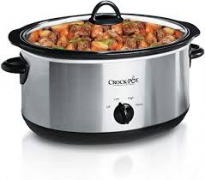
Crock Pot
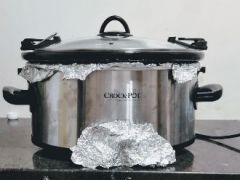
Crock Pot with Lining
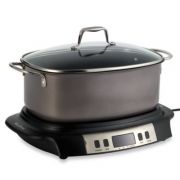
Slow Cooker on Base


- Leaving food in a crock pot, to alleviate both issues of shehiya and hatmana,
- according to some poskim all you need to do is cover the knob as long as it is cooking for Shabbat day.
- However, some forbid it unless there is an aluminum foil lining between the insert and the heating element and the knob is covered.[8]
- Furthermore, some take this a bit further and insist that there be a significant space between the heating element and the crock pot insert. This can be accomplished by placing a few balls of tin foil under the crock pot insert.[9]
- A crock pot or slow cooker that doesn’t fit into a heating element and just sit upon a heating element don’t have the question of hatmana and only need cover the heating element with aluminum foil and preferably the knob as well.[10]
Oven
- An oven is considered an uncovered fire unless one places a metal 4 sided box into the oven to interpose between the walls and the pot of food to serve as a reminder and some disagree holding that it’s an uncovered fire under all circumstances. [11] Some Ashkenazic poskim allow leaving uncooked food in an oven before Shabbat if the buttons or knobs used to raise the temperature are covered with a piece of tape.[12]
- Many Sephardic poskim are lenient to do Shehiya in an oven from before Shabbat. Some poskim add that one should cover the buttons and other poskim add that one should place a tray or aluminum foil on the bottom of the oven to cover the heating element.[13] In order to permit opening the oven door on Shabbat one must make sure that the oven is on "Shabbos mode" or has a light to indicate when the fire is running and open it only then.[14] Once one opens the door on Shabbat if the food is uncooked it is forbidden to close the oven door since that enables the food to cook quicker; rather one should make sure not to open the door until the food is completely cooked or one has to remove it from the oven.[15]
Warming Drawers
- One may leave fully cooked food in a warming drawer before Shabbat. According to Ashkenazim it is permitted even if the food is just half cooked.[16]
- If the food is no fully cooked according to Sephardim or according to Ashkenazim it is not half cooked, it is still possible to leave food in a warming drawer from before Shabbat if one lines the inside of the warming drawer with aluminum foil. Some say that the aluminum foil lining should be visible from the outside. Also, ideally, the knobs should also be covered with multiple pieces of tape.[17]
Hot Water Urn
- The only way to leave water in a hot water urn from before Shabbat is by turning it on several minutes before Shabbat so that the water reaches at least Yad Soledet Bo before Shabbat. Otherwise the leniencies of covering the fire or using raw meat are inapplicable.[18]
Sous Vide

- Using a sous vide to cook food from before Shabbat is not an issue of hatmana, however, shehiya has to be solved either by placing raw meat in immediately before candle lighting or by cooking the food halfway before Shabbat.[19]
Cooked Food
- One may leave cooked food on an uncovered fire before Shabbat. Sephardim hold that the food must be fully cooked and worsens the more it cooks. However, according to Ashkenazic minhag, it’s permissible if it was cooked Machal Ben Dursai (half way). Nonetheless, Sephardim may be lenient to consider it as cooked from once it’s Machal Ben Dursai if the food is going to be eaten for Shabbat day and not Friday night.[20]
- Cooked food (according to Ashkenazim, half cooked and Sephardim, fully cooked, as above) may be left in an oven before Shabbat if it is on a Shabbos setting, meaning that opening the door will not activate the oven to become heated. [21]
- Some consider Machal Ben Dursai to be half cooked and some a third cooked. Therefore one shouldn’t leave food on the fire from before Shabbat unless it’s half cooked, however if it’s a third cooked there’s room to be lenient in a case of difficulty.[22]
- According to Sephardim, even completely cooked foods can’t be left on the fire unless it also worsens the more it cooks. The general rule is that any food that has flour in it is in the category of foods that worsen the more they cook, however, cabbage, beans, small pieces of meat, and egg are in the category of food for which it’s beneficial to continue cooking. If there’s a doubt considered whether something worsens or benefits from continued cooked one should be careful. [23]
Leaving raw food on the fire
- If the food cooking is raw meat or there’s a piece of raw meat in a the food it’s permitted to leave it on the fire before Shabbat as long as it is put on right before Shabbat. The explanation is that there’s no concern that you’ll come to stoke the coals since you know it isn’t going to be ready by Friday night.[24]
- Some poskim hold that this leniency does not apply nowadays to a stove or oven since it is possible to increase the fire so that it’ll be ready quickly.[25] However, it it is permissible to rely on this for putting food in a crockpot since it is made to cook slowly and there’s no concern you’re going to adjust the temperature since it won’t be ready by Friday night anyway.[26]
With what stoves and how are they heated?
- A Kirah fueled with olive peals, wood chips, dung of large animals, or charcoal need to be Garuf and Katum in order to leave something not cooked upon it, however, if the Kirah is fueled with straw or stubble, one may leave not cooked food on it. [27]
- There’s a dispute whether our stoves nowadays fueled by oil also have the issue of Shehiya or not. Because of the old Minhag to be lenient one has what to rely on to leave food on a gas fire if the food is half cooked[28] and the food is meant to be eaten the Shabbat day and not that night. [29]
Sources
- ↑ The Mishna Shabbat 36b records the prohibition of chazal not to leave uncooked food on the fire before Shabbat. Shulchan Aruch O.C. 253:1 codifies this. Rashi explains that the prohibition is based on a concern that one will come to stoke the coals. Rashi also mentions that there is an additional issue of 'Mosif Hevel' (keeping food in a state of raised temperature). Tosfot questions this addition of Rashi because Mosif Hevel is normally associated with the rabbinic prohibition of Hatmanah and not Shehiyah. Even though technically the gemara is discussing a two pot coal-heated stove (Kirah) see the next halachot for its applicability to modern day stoves.
- ↑ See copy of paper by Rabbi Brand for a detailed description of the different types of "stoves" used in the ancient world: http://www.the-daf.com/wp-content/uploads/2011/05/Earthenware-Vessels-Kupach-Kira-and-Tanur-Brand.pdf
- ↑ S”A 253:1 writes that a Kirah has the resemblance of a large pot and has room for two pots. The five leniencies listed are all sourced in S”A 253:1 but will be discussed below at length. See Laws of Shabbat (Rabbi Shimon Eider; vol 4 pg 326) for a description and pictures.
- ↑ Orchot Shabbat (vol 1 pg 62), Shabbos Kitchen (pg 52), and Laws of Shabbat (Rabbi Shimon Eider; vol 4 pg 327) quoting Rav Moshe and Rav Henkin hold that a modern stove is considered a Kirah.
- Rav Ovadia Yosef (Chazon Ovadia Shabbat v. 1 pp. 48-9) writes that seemingly there shouldn't be any prohibition of shehiya with a gas stove or burner because they didn't exist in the days of Chazal. Since it didn't exist in the days of chazal, perhaps we can't invent a gezerah today to forbid Shehiyah on modern stoves. However, he cites numerous poskim who write that there is a prohibition of Shehiyah with a gas stove. These poskim include: Panim Meirot 1:84, Maharsham 3:165, Maharam Brisk 2:76, and Shoel VeNishal 1:36. In conclusion, Chazon Ovadia pp.49-50 agrees with those who are strict on the matter as he says in order to satisfy the opinion of Maran one should cover the fire. Additionally on p. 44 he writes that nowadays one can be lenient if it is for the day time meal, implying that otherwise not.
- ↑ Sh”t Igrot Moshe (1:93 and 4:74:26) considers a modern day oven to be considered like a Kirah. This is also the opinion of Orchot Shabbat (2:15, vol 1 pg 67), Laws of Shabbat (Rabbi Shimon Eider; vol 4 pg 327), and Shabbos Kitchen (Rabbi Simcha Bunim Cohen, pg 53). However, Sh”t Az Nidbaru 4:18 considers it be a Tanur based on the heat of a modern oven.
- ↑
- Magen Avraham 253:31 permits Shehiya in an oven because the fire is covered by a cement or clay wall built into the oven based on the S”A 253:3 who permits leaving on the fire if there’s an empty vessel separating between the fire and the food. However, the Magen Avraham adds that based on the Maharil (Minhagei Maharil pg 36; see 318:15), Agudah, and Tashbetz 27 the flame must have some interposition such a wooden plank that serves as a reminder besides being covered by metal. The Achronim unanimously agree including Eliyah Rabba 253:31, Tosefet Shabbat 253:40, Shulchan Aruch HaRav 253:26, Aruch HaShulchan 253:25, Mishna Brurah 253:81, and Chazon Ovadyah (Shabbat 1 pg 50).
- According to this, a metal covering of the fire which also serves as a reminder would permit the fire to be used. Therefore, Sh”t Igrot Moshe 1:93 writes that a gas stove when covered with a metal sheet, commonly referred to as a Blech, is like a covered Kirah and is permissible. Shemirat Shabbat KeHilchata 1:63 and specifies that the cover should be something that’s not usually used to cover a fire. Sh”t Zera Emet O”C 253:26, Sh”t Maharam Brisk 2:76, Sh”t Tefilah LeMoshe 1:37 (also recorded in Menuchat Ahava Ahava 3:1 in Rabbi Moshe HaLevi), Shem Chadash (on Yereyim 1 pg 58), Kaf Hachaim 253:11, Sh”t Maharshag 2:50, Sh”t Divrei Chizkiyah 1:2 in name of Mahari Shari, Sh”t Yaskil Avdi O”C 3:10(2), Sh”t Ohel Yosef (Rabbi Yosef Parid; Siman 10), Rav Vosner in Sh”t Shevet HaLevi 1:91, and Chazon Ovadyah (Shabbat 1 pg 50) concur.
- [Chazon Ish 37:9 argues on the Mishna Brurah from Rashi (Shabbat 37a D”H Gaba; quoted by the Tur) who forbids a covering over an empty space and concludes that a covering that’s not normally used and lowers the heat of the fire is considered a covering. Thus, a covering on our modern stove wouldn’t be sufficient. Chazon Ovadyah (vol 1 pg 51), Sh”t Shevet Levi O”C 1:91, Toldot Zev (Shabbat 2 pg 192) argue on the Chazon Ish that Rashi is referring to a cooking on Shabbat in a way that’s usual and so a covering it’s sufficient, however but by Shehiya one only needs a reminder not to stoke the coals and once it’s an unusual interposition it doesn’t need to lower the heat of the fire. See Bach 253:14 s.v. VeDavka and Sh”t Maharam Shik O”C 117 who also make this distinction. Rabbi Hershel Schachter (in The Laws of Cooking and Warming Food on Shabbat p. 181) writes that the minhag is to allow leaving food on a blech before Shabbat unlike the Chazon Ish.] Rav Hershel Schachter (The Laws of Cooking and Warming Food on Shabbat p. 181) writes that the minhag is not like the Chazon Ish and to accept a blech as an acceptable covering.
- Knobs: Sh”t Igrot Moshe O”C 1:93, Sh”t Tzitz Eliezer 7:17(3), Sh”t Bear Moshe vol 7, and Yalkut Yosef (Shabbat vol 1 pg 96) add that besides covering the flame it’s preferable to cover the knobs also. Yet, covering the fire is essential. Additionally, Orchot Shabbat (vol 1 2:9, pg 65) quotes Rav Shlomo Zalman Auerbach and Rav Elyashiv (who is also quoted by Hilchot Shabbat BeShabbato pg 197) who hold that a covering of the knobs isn’t necessary if the fire is covered.
- On the other hand, Rav Aharon Kotler (quoted by The Laws of Shabbat p. 338 fnt. 800) and Rav Soloveitchik (quoted by Rav Schachter in The Laws of Cooking and Warming Food on Shabbat p. 181) held that covering the knobs is the primary way to avoid the issue of not coming to adjust the temperature and covering the fire is an added stringency.
- ↑
- Reasons to forbid a Plaata: 1) Sh”t Yaskil LeAvdi O”C 5:34, 6:15 is lenient by a covered stove since the cover is a separate piece but a Plaata is entirely like a coal and there’s nothing covering it (S”A 253:1 rules that one can’t do Shehiya with something directly touching the coals).
- 2) Sh”t Yaskil Avdi O”C 5:34, 6:15 adds that there’s an issue that one may come to plug it in because it’s so easy unlike lighting a flame anew which the Rabbi’s didn’t make a Gezerah because it requires preparation and by that time one will remember it’s Shabbat. [Later on, he retracted because the Minhag was to use it, see Sh”t Yaskil LeAvdi O”C 7:28(8).]
- Arguments to permit a Plaata: 1) Chazon Ovadyah (Shabbat 1 pg 52) argues on the first reason because by a Plaata the heat comes from electric current under the metal sheet and so it’s like a covered flame.
- 2) Chazon Ovadyah and Netivei Am (pg 120-1) argue on the second reason, based on Sh”t Maharam Provinsal 46, and Birkei Yosef 339:7 who write that there’s no Gezerah of coming to write by composing a song as there’s a Gezerah by doing a business transaction because it may come to writing because we don’t extend the Gezerah of the Rabbis on what they didn’t just because it’s easy to come to do a Melacha. [Similarly, Rosh (Shabbat 24a), Maggid Mishna (Chol HaMoad 5:20), Sh”t Rivash 390 in name of Ran, Radvaz (Trumot 1:22; Sh”t Radvaz 1:149), and Bet Yosef (O”C 462) say that nowadays the Rabbis can’t enact new Gezerah’s not enacted by Chazal.]
- 3) Chazon Ovadyah explains that it should be permissible since a flame is consistent (unlike coals that flicker) and the heat can’t be changed. This reason is also found is Gedolei Tzion 9:11, Mishna Brurah (Beiur Halacha 253:1 D”H Afilu), Sh”t Tzitz Eliezer 7:16(3), Shemirat Shabbat KeHilchata 1:25, and Rav Yosef Kapach (commentary on Rambam Shabbat 3 pg 74).
- Halacha: Shemirat Shabbat KeHilchata 1:25 for a plaata which one can’t change it’s temperature and it’s not usually used for cooking is considered a covered fire and doesn’t require another covering. So holds Rav Moshe in Sh”t Igrot Moshe 4:74:35 (who emphasizes that it must be impossible to cook on it), Rav Vosner (MeBeyt Levi vol 6, laws of Shehiya #2) Chazon Ovadyah (vol 1 pg 52), Or Letzion (vol 2, 17:1) and Shabbos Kitchen (pg 52).
- However, Orchot Shabbat (2:13, v. 1 p. 66) and Otzrot HaShabbat (pg 100) quotes Rav Elyashiv who requires a covering of thick aluminum even on a Plaata which one can’t change its temperature.
- ↑ 39 Melachos v. 2 p. 633 writes that Rav Moshe held the crock pot wasn't an issue and to avoid those who are strict it is sufficient to place aluminum foil between the insert and the heating element and also cover the knob.
- ↑ Reasons to permit:
- Hatmana: Hatmana for Tomorrow: There are some Rishonim that permit Hatmana if the food is meant to be eaten the next day. [Shibolei HaLeket 57 in name of Rabbenu Simcha says that Shehiya is permitted if a person has two pots and the one that’s cooking for Shabbat day is separate from the pot cooking for Friday night. Rabbenu Binyamin (quoted by Shibolei HaLeket), Mordechai (Shabbat 3:300), Rabbenu Yishaya HaRishon (Shabbat Bameh Tomnin), and Ravan (Shabbat 338) concerning Hatmana allow something that is set aside for the next day.] Rama 257:1 rules like these opinions. However Bet Yosef 253:1(4) concludes that this seemingly goes against many of the Mefarshim that are brought in the following Siman.
- Hatmana: Partial Insulation: There is a dispute in the Rishonim whether there is Hatmana when the food is touching the coals even though the food itself isn’t covered. S”A 253:1 end of saif rules (based on Rosh (Shabbat 3:1), Tur 253:1, Ran 15b s.v. Kirah, and Magid Mishna 3:4 in name of Rambam) that if the pot is touching the coals directly it’s forbidden to do hatmana in any case. However Rama 253:1 says that there are those who permit (namely, Mordechai (Shabbat 299, Hagahot Maimon 7:20, and Or Zaruh 2:8 pg 3c) and so is the Minhag. Chazon Ish 37:19 argues on this Rama and follows S”A. See The Great Crock Pot Controversy by Rabbi Yirmiyahu Kaganoff.
- Hatmana: The Tiny Space Between the Pot and Heating Element: Some distinguish between the pot directly on the coals and where there’s a small airspace in between including Mishna Brurah (Shaar Hatziyun 257:43) and Shulchan Aruch HaRav 257:10 (based on Ritva Shabbat 47b). Thus, Chazon Ovadyah (1 pg 64) argues that the small airspace is reason to permit even according to S”A, while Shulchan Shlomo 257:13 doesn’t consider the airspace as an interference between the coals and the pot because that’s the way it cooks.
- Shehiya: Covering the Knobs: Chazon Ovadia permits the shehiya because of covering the knobs. Orchot Shabbat 2:18 holds that covering the knob with tape permits shehiya.
- Shehiya: Other Solutions: Halacha Brurah 253:9 writes that if one covers the heating element with tin foil that solves the shehiya problem. Halacha Brurah 257:32 notes that if one puts in a raw piece of meat before Shabbat that also solves the issue of shehiya.
- Those who permit: Rav Vosner (Kovetz MeBet Levi 9, Shabbat LeYisrael pg 373), Sh”t Shevet HaLevi 9:52, and Rav Moshe Feinstein (Sefer Otzrot HaShabbat and Sefer Matmin UMevashel Beshabbat quote it in his name, see also Igros Moshe OC 4:74:Hatmana 4, Teshuvot Vihanhagot 3:106) permit (according to the Rama). Chazon Ovadyah (Shabbat 1 pg. 64) permits according to S”A based on a Safeka Safeka, and the small airspace, as long as one covers the knob to serve as a reminder. Rabbi Eli Mansour on DailyHalacha.com quotes this opinion of Rav Ovadia. Halacha Brurah 257:32 permits the crock pot for hatmana purposes if the food is intended for tomorrow.
- Those who forbid: Rav Shlomo Aurbach in Shulchan Shlomo 257:13 forbids. Rabbi Daniel Mann writes that although one is not required to do so, one who wishes to satisfy the opinion of Rav Shlomo Zalman may place little balls of tin foil underneath the removable part of the crock pot to create a separation between the pot of food and the heating element and raise the pot of food about the walls (see Rav Shlomo Zalman's letter in the back of Orchot Shabbat and Orchot Shabbat pg. 113). Rav Elyashiv (commonly quoted “in his name” (as in Sefer Otzrot HaShabbat and Sefer Matmin UMevashel Beshabbat) as forbidding the crock pot, however Shabbat Hayom recounts that he and his friend Rabbi Ofir Malka showed Rav Elyashiv the pot and Rav Elyashiv permitted it according to the Rama.
- Aluminum Balls Solution: Orchot Shabbat 2:88 writes that in terms of shehiya it is considered an uncovered fire which can be solved by creating a space between the pot and the insert. In terms of hatmana even though the top is uncovered it is still considered insulated since it is mostly surrounded by the heating element. Rav Shlomo Zalman Auerbach and Rav Elyashiv both held that it is only permitted to using a crock pot is the insert is raised in a noticeable way from the heating element otherwise it would be hatmana. Additionally, Rav Shlomo Zalman Auerbach added that the food had to be completely cooked before Shabbat to avoid hatmana. Lastly, Rav Wosner held that one should be strict but one doesn't have to protest Ashkenazim who are lenient since it is only partial insulation. Rav Hershel Schachter (The Laws of Cooking and Warming Food on Shabbat p. 184) writes that one should place something in between the pot and the heating element to avoid hatmana.
- ↑ 39 Melachos v. 2 p. 633
- ↑
- Magen Avraham 253:31 permits Shehiya in an oven because the fire is covered by a cement or clay wall built into the oven based on the Shulchan Aruch Orach Chaim 253:3 who permits leaving on the fire if there’s an empty vessel separating between the fire and the food. However, the Magen Avraham adds that based on the Maharil (Minhagei Maharil pg 36; see 318:15), Agudah, and Tashbetz 27 the flame must have some interposition such a wooden plank that serves as a reminder besides being covered by metal. The Achronim unanimously agree including Eliyah Rabba 253:31, Tosefet Shabbat 253:40, Shulchan Aruch HaRav 253:26, Aruch HaShulchan 253:25, Mishna Brurah 253:81, and Chazon Ovadyah (Shabbat vol 1 pg 50).
- Sh”t Igrot Moshe 4:74:26 considers a modern day oven to be considered like a Kirah.
- Seemingly there’s no simple way to make an interposition for the oven in order to leave food in it before Shabbat. However, Sh”t Igrot Moshe 4:74:27 considers a metal 4 sided box to be an adequate cover and recognition. This is also the opinion of the Shabbos Kitchen.
- However, the Sh”t Minchat Yitzchak 3:28(1) writes that an oven has the status of an uncovered fire even if there metal interposition based on Chazon Ish 37:11 who holds that an empty pot isn’t considered a covering (see above where many disagree with the Chazon Ish).
- ↑ Orchot Shabbat 2:15
- ↑ Yalkut Yosef 253:6 writes that it is permitted to do Shehiya into an oven before Shabbat. It is a stringency to cover the buttons. Tefillah LMoshe 1:2 writes that an oven is a covered fire and it is sufficient to cover the knobs to remind oneself not to change the temperature and then it is permitted to do Shehiya into an oven. Or Letzion 2:17:4 writes that one may do Shehiya in an oven if one can cover the heating element with a tray or aluminum foil. Halacha Brurah 253:10 is lenient with the condition of the Or Letzion to cover the bottom of the oven with an empty metal tray.
- ↑ Yalkut Yosef 253:7, Tefillah LMoshe 1:2, Or Letzion 2:17:4, Halacha Brurah 253:10
- ↑ Yalkut Yosef 253:6, Tefillah LMoshe 1:2, Or Letzion 2:17:4, Halacha Brurah 253:10
- ↑ Shulchan Aruch and Rama 253:1
- ↑ Rabbi Ari Zahtz (Bishul BShabbat #7 min 51-54) explained that according to Rav Moshe it is necessary to line it with foil. Additionally, Rav Mordechai Willig thought that he should line the inside of the warming drawer with aluminum foil so that it could be seen from the outside and also cover the knobs with multiple pieces of tape.
- ↑ Igrot Moshe 4:74:23 requires that it have time to boil. 39 Melachos fnt. 183 writes that it seems Rav Moshe was concerned that if it was only left on so that the water would become Yad Soledet Bo, although shehiya was avoided, nonetheless if htey took out some water before it boiled that would be forbidden since it would cause the rest of the water to boil quicker. However, he quotes Chazon Ish and Rav Shlomo Zalman Auerbach who disagreed as long as the water is Yad Soledet Bo, which is the temperature necessary not to violate shehiya (Igrot Moshe 4:74:24).
- ↑ OK Article by Rabbi Levi Schapiro
- ↑ The Mishna in the third perek of Shabbat (36b) says that if a Kirah (stove that’s made to hold two pots (38b)) is heated with straw or stubble, one can put food on it to cook. But if it’s heated with wood or olive peals one can’t put food on the Kirah unless one made a recognizable sign to prevent one from stoking the coals on Shabbat by having the coals Garuf (shoveled out) or Katum (covered with dust). * The Gemara (36b) asks when the mishna says not to put a food on a fire if it is heated by wood or olive peals (Lo Iten) whether it forbids returning food to a stove on Shabbat (Lo Yachzir) but it would be totally permitted to do Shehiyah (leaving food on the fire from before Shabbat) or rather it’s forbidden to leave food on from before Shabbat unless it’s Garuf or Katum (Lo Yish’heh) and certainly it’s forbidden to return food on Shabbat. There are no clear proofs in the Gemara concerning the Mishna but gives a few rulings on the issue. The Gemara has two rulings like the latter explanation, and then an opposing ruling supported by a Mishna which accords with the former explanation.
- The Rif (16a) rules like the latter interpretation and so unless the stove was Garuf or Katum one can’t leave a food that wasn’t totally cooked on the stove before Shabbat. The Rambam (Shabbat 3:4), Rabbenu Yonah, Shiltot (Shlach 128), Rabbi Yehuda Barsiloni (Itim 19), and Ramban (Milchamot 15b, Chiddushim 37a D”H Mahu) concur with Rif (16a). However, Rashi (37b D”H VeRav Sheshet) rules like the former interpretation because it’s supported by a Mishna. The Rosh (Shabbat 3:1), Baal HaMoer (15b D”H Ule’inyan), Tosfot (18b D”H Bashil), Rabbenu Chananel (quoted by Tosfot 37b D”H Amar), Ran (16b D”H Tu) in name of Rav Hai Goan, Rashba (38a D”H VeHatemiha), Smag (Lav 65:13), Smak (282 pg 285), Sefer HaTrumah (231), Hagahot Maimon (Shabbat 3:2), and Mordechai (Shabbat 3:299) in name of Or Zaruha (Erev Shabbat 8), and Tosfot Rabbenu Peretz Pesachim 37a s.v. vchen concur with Rashi.
- Shulchan Aruch O.C. 253:1 quotes the opinion of Rambam and Rif that if the stove isn’t Garuf or Katum one may not leave food on it from before Shabbat unless it’s fully cooked and worsens as it cooks and then the opinion of Rosh and Rashi that if it’s cooked Machal Ben Dursai one can leave it on from before Shabbat. Seemingly the S”A holds like Rif and Rambam since he wrote that opinion as the anonymous first ruling and only quotes the Rosh as a “Yesh Omirim” (minority opinion). Interestingly, Minchat Cohen (Mishmeret Shabbat 5) says that S”A really holds like Rosh because he didn’t make his opinion clear in 253:1 but in 254:4 he rules on another issue in favor of the Rosh. However, Erech HaShulchan 253:3, Sh”t Shoel VeNishal (1:36, 5:32), and Mishna Brurah (Shaar Tzion 254:22 in name of Pri Megadim) argue that 254:4 is a ruling that everyone would agree to and so the Minchat Cohen has no proof. There are a few approaches in the Achronim to be lenient on this issue.
- Firstly, Rama 253:1 says that the Minhag is to be lenient like the Rosh. Mishna Brurah (Beiur Halacha D”H VeNehagu writes that preferably one should be strict like S”A.) Therefore according to Ashkenazim, Shemirat Shabbat KeHilchata 1:63 rules that one may be lenient to leave food on an uncovered fire if the food is Machal Ben Dursai before Shabbat as long as one doesn’t intend of returning the food to the fire on Shabbat (if removed). For Sephardim, Sh”t Zechur LeYitzchak (O”C 74 pg 113a) writes in name of Maharam Ben Chaviv that Sephardim may be lenient against S”A, since it’s a Minhag from before S”A and there’s an mitzvah of Oneg Shabbat to have hot food on Shabbat. Eretz Chaim (Klal 7) supports the Zechur LeYitzchak with the Shach Y”D 242 who says a Minhag can rely a Yesh Omrim against the anonymous ruling. Sh”t Ginat Veradim 3:4, Sh”t Pirchei Cohen O”C 34, Sh”t Divrei Chizkiya O”C 1:2, Yashkil Avdi O”D 3:10, and Sh”t Vayomer Moshe O”C 3 concur based on minhag. However, Sh”t Shoel VeNishal 1:36, 5:36 argues that the Minhag is based on lack of knowledge and incorrect practices and so shouldn’t be kept.
- Secondly, Sh”t Rashbatz 8 defends the Minhag to leave food that was cooked Machal Ben Dursai on a stove not Garuf or Katum because of a Safek Safeka whether halacha is like Rosh and even if not there are opinions that one can be lenient if the food is only going to be eaten Shabbat day because then there isn’t a concern of coming to stoke the coals. [Shibolei HaLeket 57 in name of Rabbenu Simcha says that Shehiya is permitted if a person has two pots and the one that’s cooking for Shabbat day is separate from the pot cooking for Friday night. Rabbenu Binyamin (quoted by Shibolei HaLeket), Mordechai (Shabbat 3:300), Rabbenu Yishaya HaRishon (Shabbat Bameh Tomnin), and Raavan (Shabbat 338) concerning Hatmana allow something that is set aside for the next day. However Bet Yosef 253:1(4) concludes that this seemingly goes against many of the Mefarshim that are brought in the following Siman.] Even though seemingly Bet Yosef should disagree with this idea of the Rashbetz, nonetheless, Bet Yosef 253:1(3) himself writes such a defense of the Minhag because of the opinion of Rashi and the possibility that one is allowed to do Shehiya for Shabbat day. Birkei Yosef 253:1 writes the same in the name of his grandfather and adds that’s it’s better to satisfy all opinions by adding a piece of raw meat (S”A 254:1) to the pot so it’s clear that the pot is cooking for the next day. Nonetheless, Chazon Ovadyah (Shabbat 1 pg 48) concludes based on the minhag and Safek Safeka of the Rashbetz a Kirah that one can leave a food cooked Machal Ben Dursai on a stove that’s not Garuf or Katum if the food is meant for the Shabbat day.
- ↑ Shemirat Shabbat KeHilchata 1:17 in the note, Orchot Shabbat (2:15 pg 67). It seems that Sh”t Igrot Moshe 4:74:26 agrees.
- ↑ Mishna Brurah 253:38
- ↑ Beiur Halacha 253:1 D”H VeHu, Laws of Shabbat (Rabbi Shimon Eider vol 4 pg 344)
- ↑ Shulchan Aruch 253:1 writes that if the food is raw or there’s a piece of raw food in a pot it’s permissible to leave the food on the fire from before Shabbat. Mishna Brurah 253:9 specifies that this only work for a piece of meat and not raw vegetables. This is also the opinion of The Laws of Shabbat p. 345 who specifies that it should be meat that is potted and not roasted.
- ↑ The Shabbos Kitchen p. 54 quotes Rav Henkin as holding that nowadays the leniency of adding raw meat to a pot doesn't permit leaving it on the fire from before Shabbat. Similarly, Rav Schachter in Nefesh Harav (pg. 156-157) writes that this leniency of adding raw food doesn't apply nowadays because the food can always become cooked by Friday night. This is also found in The Laws of Cooking and Warming Food on Shabbat by Rabbi Willig p. 184. The Laws of Shabbos (Rabbi Eider, p. 346) concludes that it is preferable to follow this opinion. On p. 336 fnt. 783 he quotes Rav Moshe Feinstein as holding that this leniency does apply nowadays.
- ↑ The Shabbos Kitchen p. 56. Rabbi Mordechai Willig ("The Laws of Cooking and Warming Food on Shabbat" p. 126) concurs.
- ↑ The Mishna (Shabbat 36b) differentiates between a Kirah heated by stubble and straw which don’t make coals (that can later be stoked) and a Kirah heated by olive peals, wood chips that make coals. The Tur and S”A 253:1 rule that one may leave not cooked food on a Kirah fueled by straw or stubble but if was fueled with olive peals or wood chips it’s forbidden unless the food is cooked. Mishna Brurah 253:4 in name of the Kol Bo includes charcoal in the second category of fuels. [Rambam (Shabbat 3:4) includes dung of small animals in the same category as straw and stubble, implying that dung of large animals is the category of olive peals and wood chips. However, Bet Yosef 253:1 (s.v. Umasha Katuv VeIm Husaka BeKash) writes that our version of the Yerushalmi is that dung of small animals is included in the category of olive peals and woods. The Kolbo (Siman 31, pg 31c) and Rambam had different versions of the Yerushalmi. Mishna Brurah 253:4 rules like Rambam that dung of large animals is included in the category of olive peals and wood chips.]
- ↑ There is dispute between Rashi and the Rambam how to define Machal Ben Dursai. The Rambam Shabbat 9:5 writes that the definition is half cooked and (Shabbos 20a s.v. ben drusai) holds it is a third cooked. Mishna Brurah 253:38 writes that one should be strict not to leave food on the fire unless it is half cooked. He adds that in an extenuating circumstance one can be lenient to rely on the opinion that Machal Ben Dursai means one-third cooked.
- ↑
- Our stove nowadays fueled with gas or oil which don’t leave over coals seemingly shouldn’t be included in the laws of Shehiya. However, some argue that since the flame that can be raised it’s forbidden because of the Gezerah just like a fire fueled with wood chips. Sh”t Panim Meirot 1:84 says a portable stovetop with a flame fueled by alcohol which can be raised by manipulation is forbidden because of the Gezerah. Sh”t Maharsham 3:165, Sh”t Amrei Yosher 2:171, Sh”t Maharam Brisk 2:76, Sh”t Esei HaLevanon O”C 11, Sh”t Shoel VeNishal 1:36, Sh”t Vayomer Boaz 18, Sh”t Divrei Chizkiya 1:2 pg 12 quoting Mahari Sharim, and Shaarei Teshuva 254:7 (s.v. Mipneh) concur. [See Beiur Halacha 253:1 s.v. Afilu Eina Garufa who is in doubt whether it’s permissible to leave food on a Kirah that’s heated by straw and stubble only if the straw and stubble have been consumed prior to Shabbat or it’s permissible even if there’s a lot of fuel to last a long time. If so, it seems clear that the same doubt would apply to the case of a flame continuously fueled by oil.]
- Second source to forbid: Bear Yitzchak (Introduction to Kodshim) writes that he asked the Goan MeBrisk about leaving a container of water by an oil stove and he was answered that it’s totally forbidden as by the hot water container mentioned in Yerushalmi (Shabbat 3:3e), that forbids it since the walls of the container remain hot. Bear Yitzchak continues that Rav Zonenfeld asked Rav Yacov Elishor why he didn’t protest the Minhag some Sephardim had to leave a container of water by an oil stove and was answered that he didn’t have the power to protest this bad Minhag. Those who don’t apply the Gezerah to a modern stove:
- 1) Sh”t Maharshag 2:50 argues that since Chazal didn’t make a Gezerah about the case of a flame fueled by oil we shouldn’t make a Gezerah. Chazon Ovadyah (Shabbat 1 pg 48) quotes Yadei Chaim pg 200 who explains that even if something is very similar to a modern example we can’t extend the Gezerot of Chazal like the Rishonim were able to, thus modern day stoves such be permissible. Sh”t Tzitz Eliezer 2:7 (quoting Rav Tzvi Peasch Frank) based on a Yerushalmi (Shevit 2:4) concurs.
- 2) Sh”t Igrot Moshe O”C 1:93 distinguishes between stoking the coals for which the Rabbis made a Gezerah and adding more fuel which the rabbis didn’t make a Gezerah, and so a oil stove isn’t an issue of stoking coals and the issue of increasing the fire is permitted. This idea is applied elsewhere in Sh”t Yacheve Daat 6:20.
- 3) Additionally, Gedolei Tzion 9:11 (quoted by Sh”t Tzitz Eliezer 7:16(3) and Sh”t Yachave Daat 6:20) and Sh”t Kochavei Yitzchak 3:37(4) say that the Gezerah only applies to coals which constantly flicker and get close to going out, but an oil stove where the fire is constant there shouldn’t be a Gezerah.
- Sh”t Tzitz Eliezer 7:15(3) writes that even the Chazon Ish (Sefer Moed Siman 37) who forbids a modern stove by Chazarah didn’t even entertain the idea of forbidding it for Shehiyah. Rejection of the second source: On the other hand, Chazon Ovadyah (Shabbat 1 pg 49) rejects the proof from the Yerushlami based on Ritva (Shabbbat 41a; see also Chiddushei Ran), who explains that water that’s totally cooked is even allowed to be left on a Kirah or a Tanur but the problem of a water container is that it was made of metal pieces and if the water evaporates one may come to add more water in fear that the fire will make the container fall apart. This is also the opinion of Maginei Shlomo (Shabbat 41a) in name of Rashi. Chazon Ovadyah concludes that had Rav Yacov Elishor seen the Ritva and Poskim who permit he would have rejoiced to defend the Minhag! Sh”t Tzitz Eliezer 7:15(1) (quoting Sh”t Maharsham 3:165) also rejects the proof from the Yerushalmi because we don’t pasken like the Yerushalmi since it’s not mentioned in the Bavli.