Shnayim Mikra V'Echad Targum and Koshair: Difference between pages
m (Text replacement - "S"A" to "Shulchan Aruch") |
|||
| Line 1: | Line 1: | ||
{{Good}} | |||
[[Image:Knots.jpg|200px|right]] | |||
On [[Shabbat]], there are certain types of knots that one may tie or untie and some that one may not tie or untie. See below for details and practical applications. | |||
== The Basics of Koshair == | |||
'''Where was it in the Mishkan?''' The gemara<ref>Shabbat 74b</ref> explains that Koshair was performed in the construction of the Mishkan by the trappers of ''chilazon'' who would tie knots in their nets in order to adjust their nets. | |||
'''Definition''': There is an important machlokes Rishonim as to the definition of a knot that would warrant a chiyuv min hatorah. According to Rashi<ref> Shabbos 112a s.v. b’dirabanan</ref> and Rosh<ref> Shabbos 15:1</ref>, as long as the knot is intended to stay tied forever or for a long time, one is chayav min hatorah for tying it. According to Rambam<ref> Shabbos 10:1</ref> and Rif<ref name="ftn152"> Shabbos 41b</ref>, not only must one intend to keep it tied for a long time to be chayav min hatorah, it must also be defined as a ''kesher uman'' - professional knot, such as a sailor’s or camel-driver’s knot. | |||
'''Permanence''':There are different opinions as to what constitutes a ‘long time.’ The Kol Bo<ref> Cited in Rama 317:1</ref> says that a knot that is tied for more than one day is called somewhat permanent, and it is rabbinically forbidden to tie. The Tur and Mordechai<ref> As cited in Rema 317:1. Tur in 317 says that a knot is only permanent enough to be chayav chatas if it is able to be kept forever, but a knot meant to last seven days is patur aval assur.</ref> say that a knot that is tied for more than seven days is permanent. Rabbeinu Yerucham<ref> Cited in Beit Yosef 317:1</ref> says that only a knot that is tied for half a year or a year is considered permanent. | |||
== | ===Bibical prohibition=== | ||
# | # The Melacha of Koshair is the binding two pliable items by intertwining them such as through a firm knot or twining threads into rope. <Ref> Mishna Brurah 317:34 quoting the Rambam, Shemirat [[Shabbat]] KeHilchata 51:52 </ref> | ||
# A knot that’s forbidden on a Torah level is one that is both (1) professional and (2) is meant to be permanent. <Ref> Shulchan Aruch (317:1) in the opinion of the Rambam and Rif </ref> | |||
===Rabbinic prohibition=== | |||
# Many Rishonim hold that it is rabbinically forbidden to tie a knot which is either professional or meant to last for more than 24 hours. Some Sephardim hold that a non-professional knot is only rabbinically forbidden if it meant to last a week. Some Rishonim hold that a knot which is permanent even if it's not professional is Biblical prohibited.<Ref> | |||
* According to Rashi, (Gemara [[Shabbat]] 112a), [[tying]] a knot that lasts forever is forbidden Deoritta, [[tying]] a knot that is untied after some time is forbidden Derabbanan, and [[tying]] a knot that is untied all the time is permitted. (For a precise explanation of Rashi see Bet Yosef 317:1 and Taz 317:1.) The Rosh 15:1 agrees. The Rif 41b, however, explains that a professional knot which is meant to last forever is forbidden Deoritta, a non-professional knot which is meant to last is forbidden Derabbanan, and a non-professional knot which is not meant to last is permitted. The Rambam 10:2 adds that a professional knot which is not meant to last is forbidden Derabbanan. S”A 317:1 and Yalkut Yosef 317:1-4 rule like the Rif, while the Rama and Mishna Brurah 317:5 and 14 are concerned both for Rashi and the Rif. Pri Megadim M”Z 317:3 and Mishna Brurah 317:5 writes that according to the Rambam even if it lasts a long time it’s permitted as long as it is not meant to last forever. | |||
* The Bet Yosef 317:1 explains based on the Tur that a knot that lasts for less than a week is considered to be untied every day. Yalkut Yosef (vol 2 p. 555) agrees. Rama 317:1, however, quotes the Maharam MiRotenburg’s who says that a knot that lasts for more than a day is forbidden. Pri Megadim (E”A 317:2) and Mishna Brurah 317:6 clarify that one day means 24 hours. Sh”t Yabia Omer 8:39:8 agrees that one day means 24 hours for this halacha, unlike the Tal Orot who says that it goes by the halachic day. Taz 317:1, Eliyah Rabba 317:2 Aruch HaShulchan 317:8, and Kaf HaChaim 317:14 rule like the Maharam. </ref> | |||
===Permissible knots=== | |||
# A knot which is both non-professional and meant to be undone within 24 hours may be tied. <Ref> The Rama 317:1 quoting Tur and Mordechai; Mishna Brurah (317:6) explains it as anything less than 24 hours. </ref> Some Sephardic authorities permit a non-professional knot which is meant to last less than 7 days. <Ref> Rama also quotes Kol Bo and Hagahot Maymoniyot. Chazon Ovadia [[Shabbat]] Part 5 page 47 and Yalkut Yosef (317:6) writes that Sephardim hold like this opinion. </ref> | |||
# | # Even if you personally intend to leave it less than 24 hours, if it’s a knot sometimes left permanently by people it’s forbidden Rabbinically to prevent confusion between temporary and permanent knots. <Ref> Magen Avraham (317:20), Kol Sinai (Koshair #3) </ref> | ||
# | |||
===Tightening=== | |||
# Any knot which is forbidden to tie is also forbidden to tighten. <Ref> Shemirat [[Shabbat]] KeHilchata 15:50 (in new editions 15:53), Kesot HaShulchan (Siman 123, at the end of note 4), Sh"t Az Nidabru 3:22, Sh"t Bear Moshe 6:3. [http://www.hebrewbooks.org/pdfpager.aspx?req=7724&st=&pgnum=56 Kesot HaShulchan (v. 5 p. 56)] explains that in his opinion a loose knot isn't a knot on a Torah level and tightening it is creating a knot. Additionallyת according to some opinions bringing the two knots that were very much separated together even though they remain loose is also considered creating a knot. See there for his discussion. </ref> | |||
# For example, one may not tighten the double knot of the [[tzitzit]] or [[Tallit]] if it became loose. <ref>39 Melachos (Rabbi Ribiat, vol 3, pg 799) </ref> | |||
==Untying== | |||
# The rules of untying are parallel to the rules for tying. Thus, any not that is permitted to tie is also permitted to untie.<ref> Mishna 111b, Rambam Shabbos 10:7, Rama 317:1, Mishna Brura 317:7, Chazon Ovadia (Shabbat vol. 5, p. 47).</ref> | |||
# According to some opinions, matir only applies if you are untying with intention to re-tie a better knot.<ref> Tosfos Shabbos 73a “Hakoshair”, Biur Halacha 317:1 “‘Dino’”. See 39 Melochos v. 3, p. 786, fn. 2. </ref> Others disagree.<ref> Rashi (74b “Shari”), see 39 Melochos, pg. 805.</ref> | |||
# If someone attempted to tie a slipknot but then they made it into a real knot by accident, they may untie the knot because the intent from the beginning was to untie it. <ref> Sh"t Rivivot Ephraim 1:222:17 </ref> | |||
== A bow== | |||
# A bow-knot, slipknot, or a single-knot isn’t a true Kesher-bind and is permissible even if it does remain in place for a while. <Ref> Shulchan Aruch (317:5) and implied by Rama (317:1). Kitzur Shulchan Aruch 80:45 and Yalkut Yosef (317:11) agree. </ref> For example: a ribbon on a gift, a single bind on a shopping bag or garbage liner. | |||
# It is permitted to tie a slip knot or bow without a underlying knot even if it is tight and meant never to be undone. <Ref>Shulchan Aruch (317:5), Beiur Halacha 317:5, Yalkut Yosef (317:11, [[Shabbat]], vol 2, pg 562), The [[Shabbos]] Home (Rabbi Simcha Cohen, vol 1, chap 13, pg 207) </ref> | |||
# After [[tying]] a bow knot (a bow on top of a single knot), as is common when [[tying]] one's shoes, some poskim hold that one may not tie a second bow on top of the bow knot. <ref>39 Melachos (Rabbi Ribiat, vol 3, pg 798) writes that it is forbidden as his definitive ruling, but in the footnote 49a he admits that since it is easy to undo he doesn't know why one should be strict.</ref> Others permit [[tying]] this knot since it can still be untied with a single hand by pulling on the end of the string. <Ref>Orchot [[Shabbat]] (10:15) and footnote 28 </ref> | |||
== A bow on top of a single knot== | |||
# According to Ashkenazim, it is permissible to tie one's shoelaces with a bow on top of a single knot (initial winding) only if it is meant to be untied within 24 hours. According to Sephardim, it is permissible as long as it is meant to be untied within 7 days. <Ref> | |||
* Rambam 10:5, Tur, and S”A 317:5 rule like Chachamim on [[Shabbat]] 113a who hold that [[tying]] a bow is permitted. Bet Yosef 317:5 quotes the Mordechai, who forbids [[tying]] a bow on top of a single knot. However, Darkei Moshe 317:3 quotes the Agur who says that the minhag is lenient to tie a bow on top of a single knot. | |||
* Magen Avraham 317:15, Taz 317:7, Eliyah Rabba 317:13, Mishna Brurah 317:29, and Kaf HaChaim 317:59 rule like the Agur but explain that it must be untied within 24 hours so that it is not considered a permanent knot. The Aruch HaShulchan 317:25, however, rules like the Mordechai. Kitzur Shulchan Aruch 80:45, Shemirat [[Shabbat]] KeHilchata 15:53 (in new edition 15:56), and the [[Shabbos]] Home (Rabbi Simcha Cohen, vol 1, chap 13, pg 207) concur with the Mishna Brurah. | |||
* Birkei Yosef 317:2 argues that the Agur was lenient even if the bow-knot is permanent. Yalkut Yosef ([[Shabbat]], vol 2, p. 562) agrees. </ref> However, if one doesn't usually untie it within 24 hours (and manages to slip one's foot in and out) it would be forbidden to tie one's shoes on [[Shabbat]]. <ref> 39 Melachos (Rabbi Ribiat, vol 3, pg 798) </ref>According to Sephardim it is permissible even if it isn't meant to be untied within 24 hours, yet it's preferable to make sure to untie it within 7 days. <ref> Yalkut Yosef (317:11), Rav Ovadyah in Kol Sinai (Koshair #5). See previous two footnotes.</ref> | |||
# Someone doing the wrapping of an Ashkenaz Sefer Torah (Gelilah) and has to tie a sash around the Torah, it's preferable to just wrap the sash around the Torah and tuck in the end, however, if that's not possible then some are lenient to tie a bow on top of a single knot <Ref> Sh"t Tzitz Eliezer 7:29, Shalmat Chaim 185, Beir Moshe 6:55. </ref> while others are strict unless one is planning on [[untying]] it within 24 hours. <ref>Shemirat [[Shabbat]] KeHilchata 15:53 (in new editions 15:56) is strict unless one is planning to untie it within 24 hours, however, in the footnote (15:188) he quotes Rav Shlomo Zalman who said that the minhag is to be lenient.</ref> | |||
# Many authorities hold that it is permissible to tie a necktie on [[Shabbat]] if one usually unties it within 24 hours. However, if one doesn't usually untie it within 24 hours, some say that if one intends to untie it within 24 hours it is permitted, while others write that one should tie it from before [[Shabbat]] and put it on and take it off by just tightening and loosening the side which goes around the neck, however, one shouldn't untie it on [[Shabbat]]. <ref> | |||
* [[Image:Ties.gif|200px|right]] For diagrams of the different ways to make a tie, click on the image to the right. Shemirat [[Shabbat]] KeHilchata 15:58 quotes Rav Shlomo Zalman as permitting [[tying]] a necktie on [[Shabbat]] if it is “not tied as a knot” (to be explained) and meant to be undone in 24 hours because it is like a bow on top of a single knot. He adds that if one doesn't usually untie it within 24 hours, one should tie it before [[Shabbat]] and put it on and take it off by tightening and loosening it. The English translation of Shemirat [[Shabbat]] KeHilchata explains “not tied as a knot” as a tie which would become undone if the narrow end is pulled out. The new edition of Shemirat [[Shabbat]] KeHilchata 15:62, however, writes that it is permitted to tie a necktie on [[Shabbat]] if one usually unties it within 24 hours and does not have any other stipulations. | |||
* Yalkut Yosef (vol 2, p. 562), however, writes that for Sephardim, it’s permitted to tie a necktie if it is going to be untied within a week. | |||
* Rav Moshe Feinstein (cited by 39 Melachos, footnote #42), Rabbi Eliezer Waldenburg (cited by [[Shabbat]] VeHilchoteha p. 221), Menuchat Ahava (vol 3, 14:13), and Or Letzion 2:47:21 permit [[tying]] a necktie and don’t specify which type. | |||
* Rabbi Mordechai Willig ([http://www.yutorah.org/lectures/lecture.cfm/726909/Rabbi_Mordechai_I_Willig/Hilchos_Shabbos_5761_-_KosherMatir_#1 “Hilchos Shabbat 5761 Kosher#1”] min 90-4) says that even according to those who consider a tie to be a knot, it is permitted to make a tie if one has intent to undo it within 24 hours. This is even true for a person who usually leaves their tie tied. Although the Beiur Halacha s.v. HaKosher writes that one’s personal intent to undo it within 24 hours is ineffective when the way of the world is to leave a knot tied, Rabbi Willig explained that this case is not similar because some do untie their ties everyday. The 39 Melachos (footnote #41) has the same idea. | |||
* [[Shabbos]] Home (p. 221) writes that if the tie is totally undone by pulling out the narrow end (“Four in Hand”) it may be tied forever, and if it isn’t totally undone when narrow end is pulled out (“Windsor”), some permit [[tying]] it forever, and some say it’s only permitted if one intends to undo it within 24 hours. | |||
* Orchot [[Shabbat]] (vol 1, p. 338) argues that the first type (“Four in Hand”) is only permitted if one intends to untie in within 24 hours, but the second type (“Windsor”) is questionable. | |||
* See Torat HaMelachot (p. 79-80) quotes Rav Nissim Karelitz as permitting a “full-Windsor” knot but forbidding a “four in hand”. See Chut Shani (vol 2, p. 227).</ref> | |||
==Single knot== | |||
# It is forbidden to tie a single knot with one string onto itself. <Ref> Rama (317:1) quoting the Hagahot Alfasi, Kitzur Shulchan Aruch 80:45, Shemirat [[Shabbat]] KeHilchata (in the new edition 15:52) </ref> | |||
## In situations where it's common to tie a double knot such as the last knot of a [[tzitzit]] fringe one may tie a single knot. <ref>Shemirat [[Shabbat]] KeHilchata (in the new edition 15:53) </ref> | |||
# It is permitted to tie a single knot in two strands of string even if it is tight and meant never to be undone. <Ref>S”A HaRav 317:1, Yalkut Yosef (317:11, [[Shabbat]], vol 2, pg 562), The [[Shabbos]] Home (Rabbi Simcha Cohen, vol 1, chap 13, pg 207) </ref> | |||
# It is permitted to tie a single knot and then tuck in the ends of the string so that it doesn’t come out only if it is meant to be undone within 24 hours. <Ref> The [[Shabbos]] Home (Rabbi Simcha Cohen, vol 1, chap 13, pg 207-8) </ref> | |||
# One may not add a second knot on top of a preexisting single knot,<ref>Shemirat [[Shabbat]] KeHilchata (in the new edition 15:53), Chazon Ovadia [[Shabbat]] Part 5 page 68 also says it's worthwhile to be stringent. </ref> nor may one add a third knot onto a double knot in order to tighten it. <ref>Shemirat [[Shabbat]] KeHilchata (in the new edition 15:53), 39 Melachos (Rabbi Ribiat, vol 3, pg 799). </ref> | |||
== Double knots== | |||
# According to Ashkenazim, a tight double knot is considered like a professional knot and may not be tied. The Sephardic custom, however, is to be lenient if one intends to untie it within 7 days, yet, one who is strict will be blessed. <Ref> | |||
* Shiltei Giborim 41b writes that a double knot might be a professional knot because it is a strong knot. Thus, Rama 317:1 forbids [[tying]] a double knot even if it is not meant to last. Many Ashkenazic authorities, including Kitzur S”A 80:45, Mishna Brurah 317:14, Shemirat [[Shabbat]] KeHilchata 15:52 and The 39 Melachos (vol 3, p. 792) agree, while the Aruch HaShulchan 317:10 disagrees. | |||
* However, the Chida in Birkei Yosef 317:1 writes that in his locale, almost no one was strict for this Rama. Ben Ish Chai in Rav Pe’alim 2:44 explains that the Chida meant that the minhag is incorrect but that one need not protest. Thus, Ben Ish Chai (Ki Teitzei #2) forbids [[tying]] a double knot. Yalkut Yosef 317:8 argues that the Chida meant that Sephardim consider a double knot to be a non-professional knot and it may be tied if it is not meant to last. This is also the conclusion in Chazon Ovadia Part 5 page 57 that in time of need one may be lenient. | |||
* The Magen Avraham 317:4 (according to the Pri Megadim and Levushei Sarad, unlike the Machasit HaShekel) writes that the only issue with the double knot is that it might be a professional knot because it is tight. If, however, one were to tie a loose double knot, it would be permitted. Similarly, Kaf HaChaim 317:23 explains that the Chida was only lenient if it is a loose double knot. Menuchat Ahava (vol 3, 14:5) agrees for a different reason. Shemirat [[Shabbat]] KeHilchata 15:55 rules that it is permitted to tie a loose double knot if it is meant to come undone within one day. He clarifies that loose means that it is able to become undone by itself. The [[Shabbos]] Home (vol 1, p. 207) agrees. </ref> | |||
# It is permitted to tie a loose double knot if it’s usually not meant to last 24 hours and this time specifically it's also not meant to last 24 hours. <Ref> Shemirat [[Shabbat]] KeHilchata 15:52 (in new edition 15:55), The [[Shabbos]] Home (Rabbi Simcha Cohen, vol 1, chap 13, pg 208) </ref> For example, it’s permissible to tie a double knot for a belt (gartel) or sash (tichel) if it’s going to be untied in 24 hours since it’s not meant to be tight. <Ref> Shaarei Teshuva (317:1), Tzitz Eliezer 16:10, Menuchat Ahava 14:5, 39 Melachos (Rabbi Ribiat, vol 3, pg 793) </ref> | |||
# If unintentionally one pulled the bow-knot of the shoelaces and it became a double knot, one may untie it. <Ref> Mishnat Halachot 3:38, Rav Ovadyah in Kol Sinai (Koshair 3:5), Shemirat [[Shabbat]] KeHilchata 15:56 (in new editions 15:60) </ref> | |||
# One can untie a double knot that is made on a candy bag given out at shul for a simcha. <Ref> Toldot Yitzchak O”C 2:11 </ref> | |||
# One may tie a bandage on a wound with a loose double knot if it is meant to be untied within 24 hours. If it is meant to last for more than 24 hours but less than 7 days, one should use a adhesive bandage or a bow knot, however, if that isn't possible then it's permissible. <ref>Shemirat [[Shabbat]] KeHilchata (in new editions 15:55) </ref> | |||
# One may tie a head covering with a loose double knot as long as one usually unties it everyday. However, if one usually removes it within [[untying]] the knot then it's forbidden to tie it even if this time one's intent is to untie within 24 hours. <ref>Shemirat [[Shabbat]] KeHilchata (in new editions 15:55) </ref> | |||
==Wrapping a string== | |||
# It is permitted to wrap a string around an object and then tuck the ends of the string in even if it is meant to be left permanently. <Ref> Rama 651:1, The [[Shabbos]] Home (Rabbi Simcha Cohen, vol 1, chap 13, pg 208) </ref> | |||
==Twist ties and Cable ties== | |||
# Some authorities forbid using wire twist ties to close bags unless one plans to undo it within 24 hours. <ref>Shemirat [[Shabbat]] KeHilchata 14:9 and (15 note 166, in the new edition note 174) quoting Rav Shlomo Zalman </ref> However, others permit. <ref> 39 Melachos (Rabbi Ribiat, Melechat Koshair note 54) quoting Rav Moshe Feinstein </ref> It is praiseworthy to avoid using them if they will remain undone for more than 24 hours. <ref>39 Melachos (Rabbi Ribiat, vol 3, pg 800) </ref> | |||
# Some poskim permit using plastic cables ties since it is not a knot, but simply tightening. <ref> Chazon Ovadia [[Shabbat]] Part 5 page 75 </ref> | |||
== Fixing clothing == | |||
# Socks or gloves that are tied together should be detached before [[Shabbat]], but if one forgot one may untie it because they are only tied in the first place until they are going to be used. If one cannot untie them, he may rip the string, but should make sure to destroy the string <Ref> Shemirat [[Shabbat]] Kahilchata 15:67 in name of Rav Shlomo Zalman Aurbach, Az Nidberu 1:58. </ref> | |||
# One can take out the pins put into shirts in packaging to keep it from wrinkling. <Ref> Shemirat [[Shabbat]] Kahilchata 15:64 in name of Rav Shlomo Zalman Aurbach, Bier Moshe 1:22. </ref> | |||
# It’s totally permitted to thread new laces into shoes to replace old laces but it’s not permitted if the shoe was never laced. <ref> Rav Ovadya Yosef in the Haskama of Netiv Mitzvot, Mayim Chaim Meshash O”C 1:147, Bier Moshe 2:20(2),6:59, Tefilah LeMoshe 1:58. </ref> | |||
==Sources== | ==Sources== | ||
< | <references/> | ||
[[Category:Orach Chaim]] | |||
[[Category:Shabbat]] | [[Category:Shabbat]] | ||
Revision as of 03:20, 17 May 2018
 | This article is good. |

On Shabbat, there are certain types of knots that one may tie or untie and some that one may not tie or untie. See below for details and practical applications.
The Basics of Koshair
Where was it in the Mishkan? The gemara[1] explains that Koshair was performed in the construction of the Mishkan by the trappers of chilazon who would tie knots in their nets in order to adjust their nets.
Definition: There is an important machlokes Rishonim as to the definition of a knot that would warrant a chiyuv min hatorah. According to Rashi[2] and Rosh[3], as long as the knot is intended to stay tied forever or for a long time, one is chayav min hatorah for tying it. According to Rambam[4] and Rif[5], not only must one intend to keep it tied for a long time to be chayav min hatorah, it must also be defined as a kesher uman - professional knot, such as a sailor’s or camel-driver’s knot.
Permanence:There are different opinions as to what constitutes a ‘long time.’ The Kol Bo[6] says that a knot that is tied for more than one day is called somewhat permanent, and it is rabbinically forbidden to tie. The Tur and Mordechai[7] say that a knot that is tied for more than seven days is permanent. Rabbeinu Yerucham[8] says that only a knot that is tied for half a year or a year is considered permanent.
Bibical prohibition
- The Melacha of Koshair is the binding two pliable items by intertwining them such as through a firm knot or twining threads into rope. [9]
- A knot that’s forbidden on a Torah level is one that is both (1) professional and (2) is meant to be permanent. [10]
Rabbinic prohibition
- Many Rishonim hold that it is rabbinically forbidden to tie a knot which is either professional or meant to last for more than 24 hours. Some Sephardim hold that a non-professional knot is only rabbinically forbidden if it meant to last a week. Some Rishonim hold that a knot which is permanent even if it's not professional is Biblical prohibited.[11]
Permissible knots
- A knot which is both non-professional and meant to be undone within 24 hours may be tied. [12] Some Sephardic authorities permit a non-professional knot which is meant to last less than 7 days. [13]
- Even if you personally intend to leave it less than 24 hours, if it’s a knot sometimes left permanently by people it’s forbidden Rabbinically to prevent confusion between temporary and permanent knots. [14]
Tightening
- Any knot which is forbidden to tie is also forbidden to tighten. [15]
- For example, one may not tighten the double knot of the tzitzit or Tallit if it became loose. [16]
Untying
- The rules of untying are parallel to the rules for tying. Thus, any not that is permitted to tie is also permitted to untie.[17]
- According to some opinions, matir only applies if you are untying with intention to re-tie a better knot.[18] Others disagree.[19]
- If someone attempted to tie a slipknot but then they made it into a real knot by accident, they may untie the knot because the intent from the beginning was to untie it. [20]
A bow
- A bow-knot, slipknot, or a single-knot isn’t a true Kesher-bind and is permissible even if it does remain in place for a while. [21] For example: a ribbon on a gift, a single bind on a shopping bag or garbage liner.
- It is permitted to tie a slip knot or bow without a underlying knot even if it is tight and meant never to be undone. [22]
- After tying a bow knot (a bow on top of a single knot), as is common when tying one's shoes, some poskim hold that one may not tie a second bow on top of the bow knot. [23] Others permit tying this knot since it can still be untied with a single hand by pulling on the end of the string. [24]
A bow on top of a single knot
- According to Ashkenazim, it is permissible to tie one's shoelaces with a bow on top of a single knot (initial winding) only if it is meant to be untied within 24 hours. According to Sephardim, it is permissible as long as it is meant to be untied within 7 days. [25] However, if one doesn't usually untie it within 24 hours (and manages to slip one's foot in and out) it would be forbidden to tie one's shoes on Shabbat. [26]According to Sephardim it is permissible even if it isn't meant to be untied within 24 hours, yet it's preferable to make sure to untie it within 7 days. [27]
- Someone doing the wrapping of an Ashkenaz Sefer Torah (Gelilah) and has to tie a sash around the Torah, it's preferable to just wrap the sash around the Torah and tuck in the end, however, if that's not possible then some are lenient to tie a bow on top of a single knot [28] while others are strict unless one is planning on untying it within 24 hours. [29]
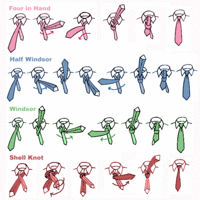
- Many authorities hold that it is permissible to tie a necktie on Shabbat if one usually unties it within 24 hours. However, if one doesn't usually untie it within 24 hours, some say that if one intends to untie it within 24 hours it is permitted, while others write that one should tie it from before Shabbat and put it on and take it off by just tightening and loosening the side which goes around the neck, however, one shouldn't untie it on Shabbat. [30]
Single knot
- It is forbidden to tie a single knot with one string onto itself. [31]
- It is permitted to tie a single knot in two strands of string even if it is tight and meant never to be undone. [33]
- It is permitted to tie a single knot and then tuck in the ends of the string so that it doesn’t come out only if it is meant to be undone within 24 hours. [34]
- One may not add a second knot on top of a preexisting single knot,[35] nor may one add a third knot onto a double knot in order to tighten it. [36]
Double knots
- According to Ashkenazim, a tight double knot is considered like a professional knot and may not be tied. The Sephardic custom, however, is to be lenient if one intends to untie it within 7 days, yet, one who is strict will be blessed. [37]
- It is permitted to tie a loose double knot if it’s usually not meant to last 24 hours and this time specifically it's also not meant to last 24 hours. [38] For example, it’s permissible to tie a double knot for a belt (gartel) or sash (tichel) if it’s going to be untied in 24 hours since it’s not meant to be tight. [39]
- If unintentionally one pulled the bow-knot of the shoelaces and it became a double knot, one may untie it. [40]
- One can untie a double knot that is made on a candy bag given out at shul for a simcha. [41]
- One may tie a bandage on a wound with a loose double knot if it is meant to be untied within 24 hours. If it is meant to last for more than 24 hours but less than 7 days, one should use a adhesive bandage or a bow knot, however, if that isn't possible then it's permissible. [42]
- One may tie a head covering with a loose double knot as long as one usually unties it everyday. However, if one usually removes it within untying the knot then it's forbidden to tie it even if this time one's intent is to untie within 24 hours. [43]
Wrapping a string
- It is permitted to wrap a string around an object and then tuck the ends of the string in even if it is meant to be left permanently. [44]
Twist ties and Cable ties
- Some authorities forbid using wire twist ties to close bags unless one plans to undo it within 24 hours. [45] However, others permit. [46] It is praiseworthy to avoid using them if they will remain undone for more than 24 hours. [47]
- Some poskim permit using plastic cables ties since it is not a knot, but simply tightening. [48]
Fixing clothing
- Socks or gloves that are tied together should be detached before Shabbat, but if one forgot one may untie it because they are only tied in the first place until they are going to be used. If one cannot untie them, he may rip the string, but should make sure to destroy the string [49]
- One can take out the pins put into shirts in packaging to keep it from wrinkling. [50]
- It’s totally permitted to thread new laces into shoes to replace old laces but it’s not permitted if the shoe was never laced. [51]
Sources
- ↑ Shabbat 74b
- ↑ Shabbos 112a s.v. b’dirabanan
- ↑ Shabbos 15:1
- ↑ Shabbos 10:1
- ↑ Shabbos 41b
- ↑ Cited in Rama 317:1
- ↑ As cited in Rema 317:1. Tur in 317 says that a knot is only permanent enough to be chayav chatas if it is able to be kept forever, but a knot meant to last seven days is patur aval assur.
- ↑ Cited in Beit Yosef 317:1
- ↑ Mishna Brurah 317:34 quoting the Rambam, Shemirat Shabbat KeHilchata 51:52
- ↑ Shulchan Aruch (317:1) in the opinion of the Rambam and Rif
- ↑
- According to Rashi, (Gemara Shabbat 112a), tying a knot that lasts forever is forbidden Deoritta, tying a knot that is untied after some time is forbidden Derabbanan, and tying a knot that is untied all the time is permitted. (For a precise explanation of Rashi see Bet Yosef 317:1 and Taz 317:1.) The Rosh 15:1 agrees. The Rif 41b, however, explains that a professional knot which is meant to last forever is forbidden Deoritta, a non-professional knot which is meant to last is forbidden Derabbanan, and a non-professional knot which is not meant to last is permitted. The Rambam 10:2 adds that a professional knot which is not meant to last is forbidden Derabbanan. S”A 317:1 and Yalkut Yosef 317:1-4 rule like the Rif, while the Rama and Mishna Brurah 317:5 and 14 are concerned both for Rashi and the Rif. Pri Megadim M”Z 317:3 and Mishna Brurah 317:5 writes that according to the Rambam even if it lasts a long time it’s permitted as long as it is not meant to last forever.
- The Bet Yosef 317:1 explains based on the Tur that a knot that lasts for less than a week is considered to be untied every day. Yalkut Yosef (vol 2 p. 555) agrees. Rama 317:1, however, quotes the Maharam MiRotenburg’s who says that a knot that lasts for more than a day is forbidden. Pri Megadim (E”A 317:2) and Mishna Brurah 317:6 clarify that one day means 24 hours. Sh”t Yabia Omer 8:39:8 agrees that one day means 24 hours for this halacha, unlike the Tal Orot who says that it goes by the halachic day. Taz 317:1, Eliyah Rabba 317:2 Aruch HaShulchan 317:8, and Kaf HaChaim 317:14 rule like the Maharam.
- ↑ The Rama 317:1 quoting Tur and Mordechai; Mishna Brurah (317:6) explains it as anything less than 24 hours.
- ↑ Rama also quotes Kol Bo and Hagahot Maymoniyot. Chazon Ovadia Shabbat Part 5 page 47 and Yalkut Yosef (317:6) writes that Sephardim hold like this opinion.
- ↑ Magen Avraham (317:20), Kol Sinai (Koshair #3)
- ↑ Shemirat Shabbat KeHilchata 15:50 (in new editions 15:53), Kesot HaShulchan (Siman 123, at the end of note 4), Sh"t Az Nidabru 3:22, Sh"t Bear Moshe 6:3. Kesot HaShulchan (v. 5 p. 56) explains that in his opinion a loose knot isn't a knot on a Torah level and tightening it is creating a knot. Additionallyת according to some opinions bringing the two knots that were very much separated together even though they remain loose is also considered creating a knot. See there for his discussion.
- ↑ 39 Melachos (Rabbi Ribiat, vol 3, pg 799)
- ↑ Mishna 111b, Rambam Shabbos 10:7, Rama 317:1, Mishna Brura 317:7, Chazon Ovadia (Shabbat vol. 5, p. 47).
- ↑ Tosfos Shabbos 73a “Hakoshair”, Biur Halacha 317:1 “‘Dino’”. See 39 Melochos v. 3, p. 786, fn. 2.
- ↑ Rashi (74b “Shari”), see 39 Melochos, pg. 805.
- ↑ Sh"t Rivivot Ephraim 1:222:17
- ↑ Shulchan Aruch (317:5) and implied by Rama (317:1). Kitzur Shulchan Aruch 80:45 and Yalkut Yosef (317:11) agree.
- ↑ Shulchan Aruch (317:5), Beiur Halacha 317:5, Yalkut Yosef (317:11, Shabbat, vol 2, pg 562), The Shabbos Home (Rabbi Simcha Cohen, vol 1, chap 13, pg 207)
- ↑ 39 Melachos (Rabbi Ribiat, vol 3, pg 798) writes that it is forbidden as his definitive ruling, but in the footnote 49a he admits that since it is easy to undo he doesn't know why one should be strict.
- ↑ Orchot Shabbat (10:15) and footnote 28
- ↑
- Rambam 10:5, Tur, and S”A 317:5 rule like Chachamim on Shabbat 113a who hold that tying a bow is permitted. Bet Yosef 317:5 quotes the Mordechai, who forbids tying a bow on top of a single knot. However, Darkei Moshe 317:3 quotes the Agur who says that the minhag is lenient to tie a bow on top of a single knot.
- Magen Avraham 317:15, Taz 317:7, Eliyah Rabba 317:13, Mishna Brurah 317:29, and Kaf HaChaim 317:59 rule like the Agur but explain that it must be untied within 24 hours so that it is not considered a permanent knot. The Aruch HaShulchan 317:25, however, rules like the Mordechai. Kitzur Shulchan Aruch 80:45, Shemirat Shabbat KeHilchata 15:53 (in new edition 15:56), and the Shabbos Home (Rabbi Simcha Cohen, vol 1, chap 13, pg 207) concur with the Mishna Brurah.
- Birkei Yosef 317:2 argues that the Agur was lenient even if the bow-knot is permanent. Yalkut Yosef (Shabbat, vol 2, p. 562) agrees.
- ↑ 39 Melachos (Rabbi Ribiat, vol 3, pg 798)
- ↑ Yalkut Yosef (317:11), Rav Ovadyah in Kol Sinai (Koshair #5). See previous two footnotes.
- ↑ Sh"t Tzitz Eliezer 7:29, Shalmat Chaim 185, Beir Moshe 6:55.
- ↑ Shemirat Shabbat KeHilchata 15:53 (in new editions 15:56) is strict unless one is planning to untie it within 24 hours, however, in the footnote (15:188) he quotes Rav Shlomo Zalman who said that the minhag is to be lenient.
- ↑
- For diagrams of the different ways to make a tie, click on the image to the right. Shemirat Shabbat KeHilchata 15:58 quotes Rav Shlomo Zalman as permitting tying a necktie on Shabbat if it is “not tied as a knot” (to be explained) and meant to be undone in 24 hours because it is like a bow on top of a single knot. He adds that if one doesn't usually untie it within 24 hours, one should tie it before Shabbat and put it on and take it off by tightening and loosening it. The English translation of Shemirat Shabbat KeHilchata explains “not tied as a knot” as a tie which would become undone if the narrow end is pulled out. The new edition of Shemirat Shabbat KeHilchata 15:62, however, writes that it is permitted to tie a necktie on Shabbat if one usually unties it within 24 hours and does not have any other stipulations.
- Yalkut Yosef (vol 2, p. 562), however, writes that for Sephardim, it’s permitted to tie a necktie if it is going to be untied within a week.
- Rav Moshe Feinstein (cited by 39 Melachos, footnote #42), Rabbi Eliezer Waldenburg (cited by Shabbat VeHilchoteha p. 221), Menuchat Ahava (vol 3, 14:13), and Or Letzion 2:47:21 permit tying a necktie and don’t specify which type.
- Rabbi Mordechai Willig (“Hilchos Shabbat 5761 Kosher#1” min 90-4) says that even according to those who consider a tie to be a knot, it is permitted to make a tie if one has intent to undo it within 24 hours. This is even true for a person who usually leaves their tie tied. Although the Beiur Halacha s.v. HaKosher writes that one’s personal intent to undo it within 24 hours is ineffective when the way of the world is to leave a knot tied, Rabbi Willig explained that this case is not similar because some do untie their ties everyday. The 39 Melachos (footnote #41) has the same idea.
- Shabbos Home (p. 221) writes that if the tie is totally undone by pulling out the narrow end (“Four in Hand”) it may be tied forever, and if it isn’t totally undone when narrow end is pulled out (“Windsor”), some permit tying it forever, and some say it’s only permitted if one intends to undo it within 24 hours.
- Orchot Shabbat (vol 1, p. 338) argues that the first type (“Four in Hand”) is only permitted if one intends to untie in within 24 hours, but the second type (“Windsor”) is questionable.
- See Torat HaMelachot (p. 79-80) quotes Rav Nissim Karelitz as permitting a “full-Windsor” knot but forbidding a “four in hand”. See Chut Shani (vol 2, p. 227).
- ↑ Rama (317:1) quoting the Hagahot Alfasi, Kitzur Shulchan Aruch 80:45, Shemirat Shabbat KeHilchata (in the new edition 15:52)
- ↑ Shemirat Shabbat KeHilchata (in the new edition 15:53)
- ↑ S”A HaRav 317:1, Yalkut Yosef (317:11, Shabbat, vol 2, pg 562), The Shabbos Home (Rabbi Simcha Cohen, vol 1, chap 13, pg 207)
- ↑ The Shabbos Home (Rabbi Simcha Cohen, vol 1, chap 13, pg 207-8)
- ↑ Shemirat Shabbat KeHilchata (in the new edition 15:53), Chazon Ovadia Shabbat Part 5 page 68 also says it's worthwhile to be stringent.
- ↑ Shemirat Shabbat KeHilchata (in the new edition 15:53), 39 Melachos (Rabbi Ribiat, vol 3, pg 799).
- ↑
- Shiltei Giborim 41b writes that a double knot might be a professional knot because it is a strong knot. Thus, Rama 317:1 forbids tying a double knot even if it is not meant to last. Many Ashkenazic authorities, including Kitzur S”A 80:45, Mishna Brurah 317:14, Shemirat Shabbat KeHilchata 15:52 and The 39 Melachos (vol 3, p. 792) agree, while the Aruch HaShulchan 317:10 disagrees.
- However, the Chida in Birkei Yosef 317:1 writes that in his locale, almost no one was strict for this Rama. Ben Ish Chai in Rav Pe’alim 2:44 explains that the Chida meant that the minhag is incorrect but that one need not protest. Thus, Ben Ish Chai (Ki Teitzei #2) forbids tying a double knot. Yalkut Yosef 317:8 argues that the Chida meant that Sephardim consider a double knot to be a non-professional knot and it may be tied if it is not meant to last. This is also the conclusion in Chazon Ovadia Part 5 page 57 that in time of need one may be lenient.
- The Magen Avraham 317:4 (according to the Pri Megadim and Levushei Sarad, unlike the Machasit HaShekel) writes that the only issue with the double knot is that it might be a professional knot because it is tight. If, however, one were to tie a loose double knot, it would be permitted. Similarly, Kaf HaChaim 317:23 explains that the Chida was only lenient if it is a loose double knot. Menuchat Ahava (vol 3, 14:5) agrees for a different reason. Shemirat Shabbat KeHilchata 15:55 rules that it is permitted to tie a loose double knot if it is meant to come undone within one day. He clarifies that loose means that it is able to become undone by itself. The Shabbos Home (vol 1, p. 207) agrees.
- ↑ Shemirat Shabbat KeHilchata 15:52 (in new edition 15:55), The Shabbos Home (Rabbi Simcha Cohen, vol 1, chap 13, pg 208)
- ↑ Shaarei Teshuva (317:1), Tzitz Eliezer 16:10, Menuchat Ahava 14:5, 39 Melachos (Rabbi Ribiat, vol 3, pg 793)
- ↑ Mishnat Halachot 3:38, Rav Ovadyah in Kol Sinai (Koshair 3:5), Shemirat Shabbat KeHilchata 15:56 (in new editions 15:60)
- ↑ Toldot Yitzchak O”C 2:11
- ↑ Shemirat Shabbat KeHilchata (in new editions 15:55)
- ↑ Shemirat Shabbat KeHilchata (in new editions 15:55)
- ↑ Rama 651:1, The Shabbos Home (Rabbi Simcha Cohen, vol 1, chap 13, pg 208)
- ↑ Shemirat Shabbat KeHilchata 14:9 and (15 note 166, in the new edition note 174) quoting Rav Shlomo Zalman
- ↑ 39 Melachos (Rabbi Ribiat, Melechat Koshair note 54) quoting Rav Moshe Feinstein
- ↑ 39 Melachos (Rabbi Ribiat, vol 3, pg 800)
- ↑ Chazon Ovadia Shabbat Part 5 page 75
- ↑ Shemirat Shabbat Kahilchata 15:67 in name of Rav Shlomo Zalman Aurbach, Az Nidberu 1:58.
- ↑ Shemirat Shabbat Kahilchata 15:64 in name of Rav Shlomo Zalman Aurbach, Bier Moshe 1:22.
- ↑ Rav Ovadya Yosef in the Haskama of Netiv Mitzvot, Mayim Chaim Meshash O”C 1:147, Bier Moshe 2:20(2),6:59, Tefilah LeMoshe 1:58.